Three Regular Trains Halted on First Day of Rail Union's Work-to-Rule Action... Delayed Train Dispatch Disrupts Services
- Input
- 2026-11-26 16:26:17
- Updated
- 2026-11-26 16:26:17
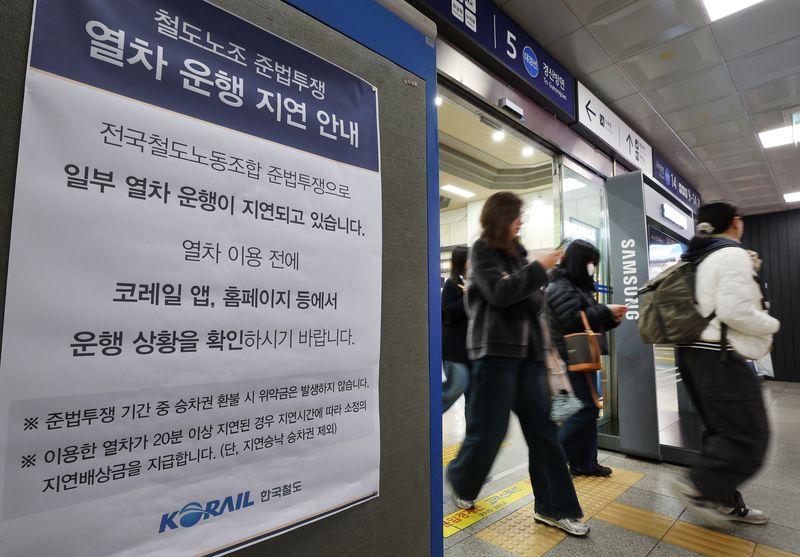
According to Korea Railroad Corporation (Korail), as of 3 p.m. that day, three trains had been suspended: Mugunghwa train No. 1573 on the Jeolla Line and ITX-Saemaeul trains Nos. 1203 and 1210 on the Janghang Line.
The Mugunghwa train No. 1573 to Yeosu, scheduled to depart Yongsan Station at 3:10 p.m., was canceled after dispatch preparations—including assembling the train by connecting the locomotive and passenger cars—were delayed by at least an hour. A total of 431 passengers had purchased tickets for the train.
Earlier, the ITX-Saemaeul train No. 1203 from Yongsan to Iksan, scheduled to depart at 12:33 p.m., was also unable to run. The suspension of ITX-Saemaeul train No. 1210 from Iksan to Yongsan, scheduled to depart at 7:05 p.m., was also decided.
Korail plans to provide service updates through its website, app and text messages, and to pay compensation for delayed trains in accordance with its passenger transport terms and conditions.
At 9 a.m. that day, the KRWU began its “safe-operation campaign,” a form of action in which workers strictly follow safety regulations and work procedures. The action is scheduled to continue through the 4th of next month, raising concerns about further delays to regular and high-speed trains as well as metropolitan-area electric train services.
Labor and management have held working-level talks, two rounds of formal negotiations and follow-up intensive talks since July, but have been unable to reach agreement on staffing increases, improvements to the promotion system, additional allowances, and having Korail directly carry out maintenance on GTX-B trains.
The biggest point of contention is frontline staffing. The union says a shortfall of about 400 employees per month, on average, compared with authorized staffing levels has persisted, affecting safety and increasing workloads. It maintains that the shortfall should be reflected in hiring plans and that staff needed for new lines and integrated operations should be recruited. It has also called for the government to scrap its plan to cut public institutions' authorized headcount by 1%. Korail said it would review staffing needs by job category and that, after consultations between labor and management, the company should seek additional staff from the government.
Differences also remain over promotions and compensation. The union is calling for changes to a promotion system it says favors the head office and headquarters, and for the abolition of special promotions to expand promotion opportunities for frontline employees. It is also seeking additional allowances to compensate for promotion bottlenecks among long-serving employees. Management has proposed compromises, including giving priority to long-serving employees and allocating promotion slots to frontline staff, but is reluctant to abolish special promotions. It also says the additional allowances would be difficult to accept because they could reduce the funds available for overall wage increases.
On maintenance of GTX-B trains, the union is concerned that outsourcing could undermine technical expertise and safety, and is calling for Korail to handle the work directly. Management, however, said that carrying out the work in-house would be expected to result in annual losses of about 9 billion won, making it difficult under current conditions, and that further discussions are needed.
The union plans to launch an indefinite general strike from 9 a.m. on the 10th of next month if no agreement is reached.
[email protected] Choi Ga-young Reporter