Foreigners' Political Activity Ban Ruled Incompatible with the Constitution... Court Says It Violates Freedom of Expression
- Input
- 2026-11-26 16:30:23
- Updated
- 2026-11-26 16:30:23
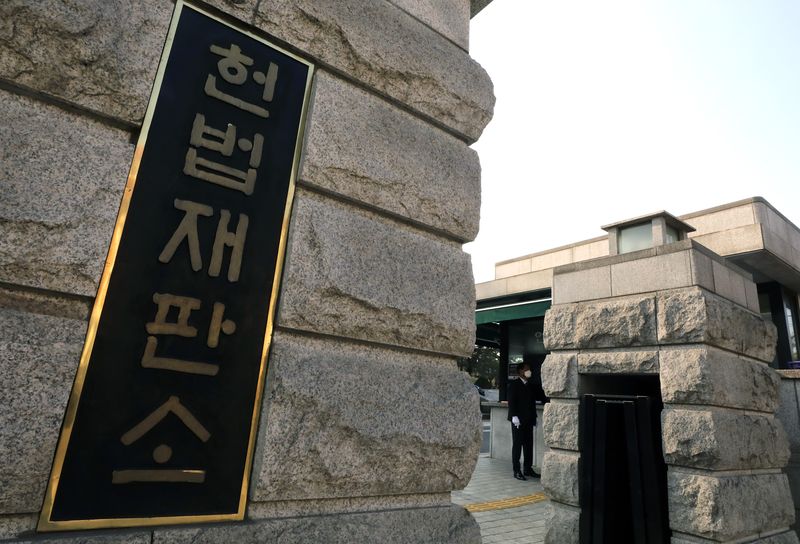
[Financial News] The Constitutional Court of Korea has ruled that a provision of the Immigration Control Act that in principle prohibits foreigners residing in South Korea from engaging in political activities violates freedom of expression. The provision was introduced about 50 years ago.
On the 26th, the court ruled, by a 6-3 vote, that Article 17(2) of the Immigration Control Act was incompatible with the Constitution in a constitutional complaint brought by two Mongolian nationals residing in South Korea as international students. The provision will, however, remain in effect until corrective legislation is enacted, with December 31, 2028, set as the deadline.
The provision stipulates that foreigners residing in the Republic of Korea must not engage in political activities, except in cases provided for by the Immigration Control Act or other laws.
The petitioners learned of the provision while seeking policies to address discrimination against foreigners from preliminary candidates in the 20th presidential election. They filed a constitutional complaint in July 2021, arguing that the ban on political activities—a vague and broadly defined concept—chilled the full range of foreigners’ activities. The Constitutional Court found the petition filed by one of the two petitioners admissible and proceeded to review the merits.
The court found that the provision had a legitimate legislative purpose and that the means were suitable, as it aimed to promote the security, order, and interests of the Republic of Korea. However, it ruled that the provision failed to meet the requirements of least-restrictive means and proportionality in balancing legal interests, and therefore violated the principle against excessive restriction.
The court noted in particular that the scope of “political activities” prohibited by the provision was excessively broad.
The court said, “Not all activities that could potentially fall within the scope of political activities can be considered related to the independent exercise of sovereignty by the people of the Republic of Korea or as posing a risk to the country’s security, order, or interests, yet the provision under review generally prohibits all such activities.”
It went on to note that “activities to improve treatment related to a foreigner’s own purpose for staying in the country, or even an individual’s simple expression of views in speech or writing, could constitute political activities.”
The court also took into account that it would be possible to adopt a legislative approach that generally permits foreigners’ political activities while specifically enumerating the acts that need to be prohibited.
In a dissent, Justices Jeong Hyeong-sik, Kim Bok-hyeong, and Jo Han-chang said the provision did not violate the principle of clarity or the principle against excessive restriction, and therefore did not infringe the petitioners’ freedom of expression.
The justices found that the provision did not violate the principle of clarity, as the political activities it defines could be interpreted as “activities that may affect the independent exercise of sovereignty by the people of the Republic of Korea.”
They also ruled that the provision did not violate the principle against excessive restriction, noting that it would be difficult in practice to adopt legislation specifically enumerating the political activities to be prohibited. They also considered that even under the current provision, political activities may be permitted in cases provided for by the Immigration Control Act or other laws.
The provision prohibiting foreigners’ political activities has remained in place for about 50 years since its introduction in 1977.
A Constitutional Court official explained, “This does not mean that all political activities by foreigners should be allowed. Rather, it means that legislation should take the form of specifically enumerating activities that need to be prohibited, as in Article 47 of Germany’s Residence Act, for example.”
[email protected] Choi Eun-sol Reporter