'Historic Low' for KOSDAQ... 'It Could Benefit More Than KOSPI if the Stabilization Fund Is Deployed'
- Input
- 2026-11-26 17:30:45
- Updated
- 2026-11-26 17:30:45
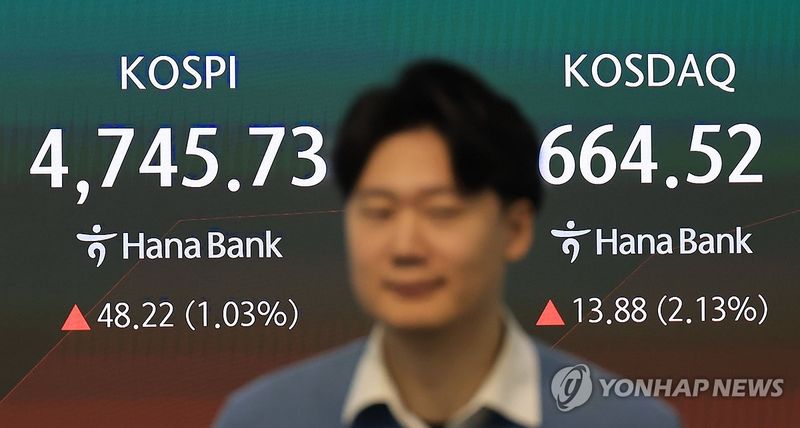
[Financial News] With the KOSDAQ Index sliding to its lowest level in more than two years, analysts say the government’s planned Securities Market Stabilization Fund could help the KOSDAQ rebound. They point to the fact that, unlike on the KOSPI, the balance of “debt-financed investments” on the KOSDAQ has fallen by more than 40% so far this year, reducing the overhang of shares for sale in a rebound. However, stabilization of the recent interest-rate-hike cycle is seen as a prerequisite.
According to the Korea Exchange (KRX) on the 26th, the KOSDAQ Index fell as low as 618.74 intraday on the 23rd before closing at 635.45. The intraday low of 618.74 on the 23rd was the lowest in six years and seven months, since April 22, 2020. On a closing basis, it was the lowest since December 9, 2024 (627.01), shortly after the emergency martial law crisis. At the close on the 26th, when it stood at 655.71, the index was down 29.22% from the start of the year.
Trading also declined. From the 1st to the 24th of this month, the KOSDAQ’s average daily trading value was 5.2814 trillion won, down 22.0% from 6.7726 trillion won the previous month. It was the lowest monthly daily average so far this year. That was about one-third of the 15.5661 trillion won recorded in May, when trading was most active.
Weak supply and demand is being cited as the cause of the KOSDAQ’s underperformance. “The KOSDAQ has fallen more than 48% from its peak this year, but this is a supply-and-demand issue, not a fundamental one,” said Kang Young-hoon, a researcher at Samsung Securities. “There has been little change in consensus estimates for annual operating profit at KOSDAQ-listed companies. In fact, the projected net income of KOSDAQ stocks for the next 12 months has risen from 11.1 trillion won at the start of the year to 14.1 trillion won,” he said in his analysis.
However, some expect the KOSDAQ’s “supply-and-demand drought” to make the stabilization fund’s deployment even more effective. As the KOSDAQ fell, debt-financed investment also dropped sharply, leading to analysis that there will be less selling pressure during a rebound after the fund’s money is deployed. The government is reportedly considering directing funds into exchange-traded funds (ETFs) that track major market indices, such as the KOSPI 200 and KOSDAQ 150, as it did in 2008, the last time the stabilization fund was deployed.
Indeed, debt-financed investment trends diverged between the KOSPI and KOSDAQ. From the 1st to the 24th of this month, the KOSDAQ’s average daily balance of credit trading loans was 6.0676 trillion won, down 41.7% from 10.4089 trillion won in January. By contrast, the KOSPI balance rose 13.9% over the same period, from 18.3711 trillion won to 20.9329 trillion won. The KOSDAQ’s share of total credit loan balances also fell by 13.70 percentage points, from 36.17% in January to 22.47% this month, while the KOSPI’s share rose to 77.53%.
“If the stabilization fund is deployed, it may buy KOSPI 200 or KOSDAQ 150 ETFs,” said Lee Sang-heon, a researcher at iM Securities. “On the KOSPI, shares may come up for sale whenever Samsung Electronics and SK hynix rise, but the KOSDAQ faces less selling pressure because credit trading loans have declined. If money flows into KOSDAQ 150 ETFs, the largest stocks by market capitalization could benefit,” he said.
However, a full-fledged rebound is considered possible only after the current period of consecutive interest-rate hikes and reduced liquidity comes to an end. The U.S. Personal Consumption Expenditures Price Index (PCE) for October, released on the 25th (local time), rose 3.8% year on year, increasing the likelihood of a Federal Reserve rate hike in December. As a result, conditions are expected to stabilize around the first quarter of next year.
“The U.S. Federal Reserve is expected to raise its policy rate again next month and make its final increase in the first quarter of next year, bringing it to a final range of 4.25%–4.50%,” said Cho Yong Gu, a researcher at Shinyoung Securities. “As falling international oil prices bring down inflation expectations, the likelihood of aggressive tightening by the Fed will gradually diminish,” he forecast.
[email protected] Im Sang-hyeok Reporter