‘Sunlight Income Village’ Built on Idle Expressway Land ... First Project Completed in Gimhae’s Chojeon Village
- Input
- 2026-11-26 15:51:37
- Updated
- 2026-11-26 15:51:37
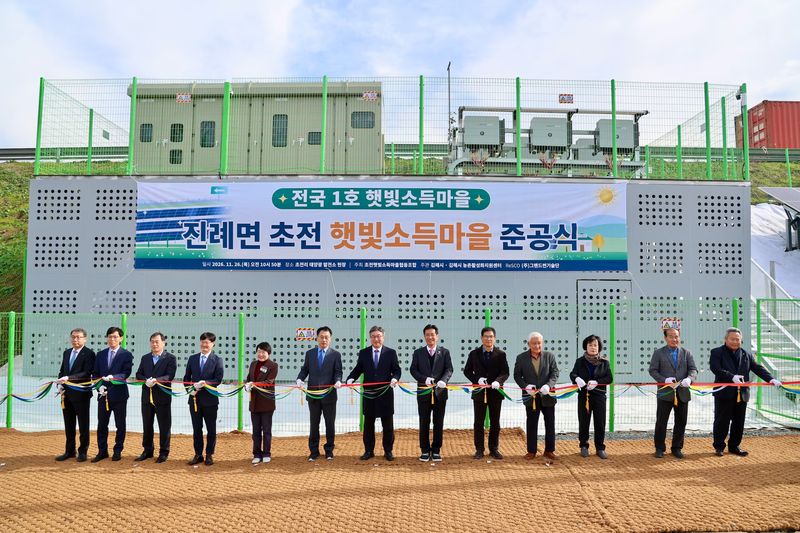
[Financial News] Land lying idle beside an expressway has been transformed into a source of income for village residents.
According to Korea Expressway Corporation on the 26th, the Chojeon Village power plant has a capacity of 997.1 kW and occupies 6,024 m2 across eight parcels along the Namhae Expressway (km 141.8–142.7, toward Busan), around Chojeon-ri, Jillye-myeon, Gimhae. Based on Korea Electric Power Corporation (KEPCO)’s annual per-capita electricity use, it can generate enough electricity for about 800 people for one year. A review of whether the site could be used began in May, the project was selected in the first round in July, and construction began after a road-occupancy permit was issued in September. It started operating about six months after the review began. The completion ceremony held that day in Chojeon Village was attended by Minister of the Interior and Safety Yun Ho-jung and Han Eun-ho, head of Korea Expressway Corporation’s New Business Division, among others.
Sunlight Income Village is a program in which residents form a cooperative themselves and install and operate solar power plants using local resources, such as unused village land. Unlike the existing supplier-led model, residents, as consumers, become the driving force behind the project. Revenue from power generation is expected to support village community welfare and residents’ incomes, helping restore communities and revitalize local economies.
The government is expanding the program as a means of achieving energy self-sufficiency and responding to population decline in rural areas. In March, the Ministry of the Interior and Safety, the Ministry of Agriculture, Food and Rural Affairs, and the Ministry of Climate, Energy and Environment reported the “Sunlight Income Village Expansion Plan” to a Cabinet meeting. Under the arrangement, the government lends 85% of solar installation costs from policy funds at an annual interest rate of 1.75%, while residents cover the remaining 15%. In the first round of applications in August, 86 villages across the country were selected. The government is expanding the program with a target of establishing at least 700 villages this year and 3,000 by 2030.
Korea Expressway Corporation is helping supply sites for the program. In April, it opened up 233 locations, including 89 disused expressway sections and 144 embankment areas, and is currently reviewing whether sites requested by 177 villages in 40 local governments can be used. So far, eight villages, including those in Gimhae City, have been selected, with a total capacity of 7.1 MW. Projects with a capacity of 2.8 MW were selected in the first round and 4.3 MW in the second. Budong Village in Damyang County (0.8 MW) is set to be completed by the end of December, while five villages in Eumseong County, Gimcheon-si and Miryang-si are expected to go through road-occupancy procedures in December.
“We will continue to actively identify and provide unused expressway sites and carefully address difficulties encountered during project implementation, so that Sunlight Income Villages can take root securely and spread nationwide,” said Han Eun-ho, head of Korea Expressway Corporation’s New Business Division.
[email protected] Jeong Gyeong-su Reporter