Education Superintendents Nationwide Seek 88.4 Trillion Won in Grants for Next Year... Jeju Superintendent Ko Ui-suk Also Urges Legislation at the National Assembly
- Input
- 2026-11-26 15:55:06
- Updated
- 2026-11-26 15:55:06
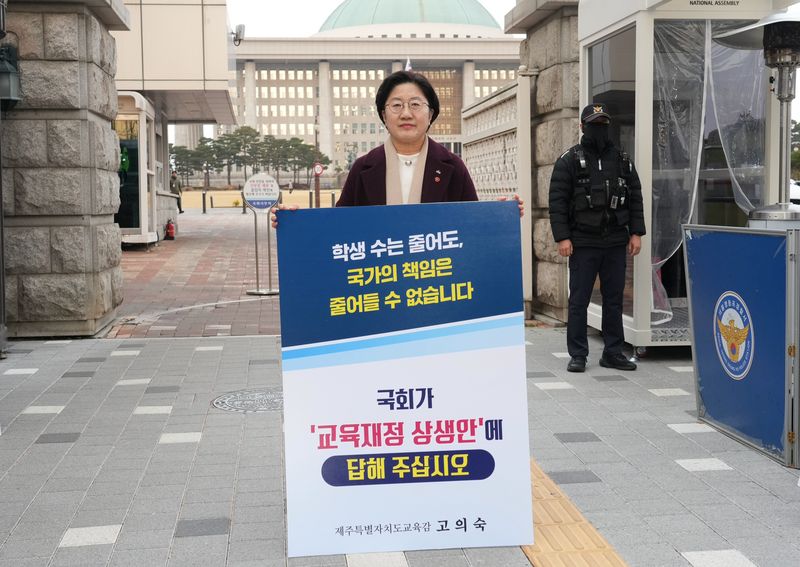
【Financial News, Jeju—Reporter Jeong Yong-bok】Superintendents of education from across the country asked the National Assembly to secure at least 88.4 trillion won in local education finance grants for next year. That is 9.5 trillion won more than the 78.9 trillion won in grants for next year under the government’s proposed reform.
According to the Jeju Special Self-Governing Provincial Office of Education and the Korean Council of Superintendents of Education on the 26th, Ko Ui-suk, superintendent of education for Jeju, joined a solo picket protest outside the National Assembly in Yeouido, Seoul, that morning, urging the enactment of a local education finance partnership plan. Ko visited the National Assembly before attending the council’s general meeting in Incheon that afternoon.
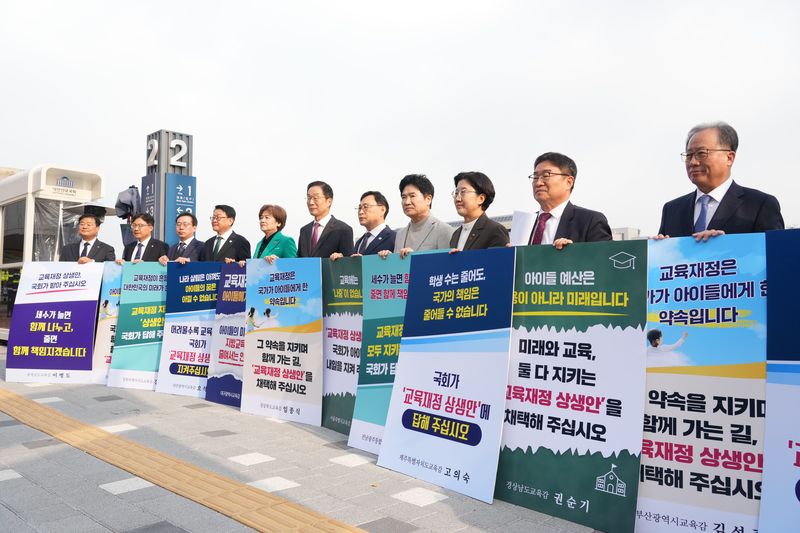
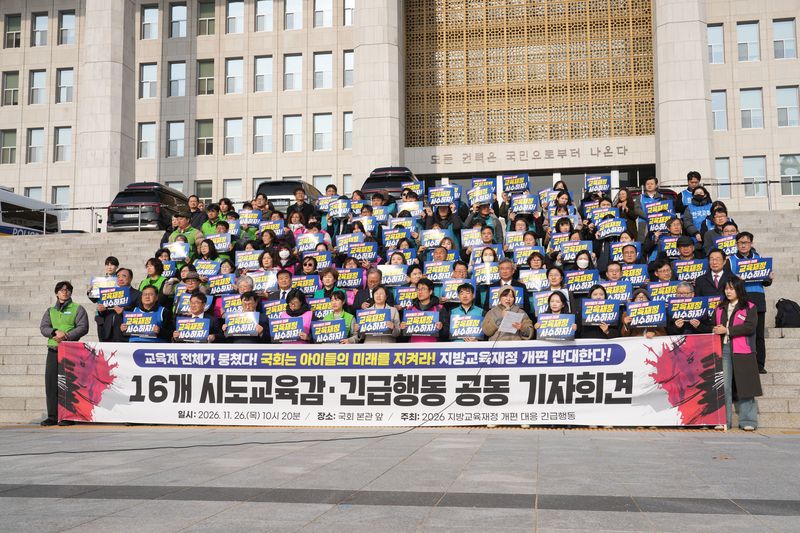
Superintendents of education from across the country also held a press conference in front of the National Assembly that day and announced four demands concerning an amendment to the Local Education Finance Grants Act. They also held a joint press conference with the Emergency Action to Respond to the Reform of Local Education Finance Grants, a coalition of education, labor, parent and civil society groups.
The central issue is how the state calculates the education funding it allocates to metropolitan and provincial education offices across the country. Local education finance grants are a major source of funding for the operating costs of kindergartens and elementary, middle and high schools; staff salaries; improvements to educational facilities; and education welfare programs. Under the current system, 20.79% of domestic tax revenue and a portion of the education tax are used to fund the grants.
To address the declining school-age population and fluctuations in tax revenue, the government is pursuing a new calculation method that would abolish the link to domestic tax revenue and factor in economic growth and changes in the school-age population.
Under the method, the average nominal growth rate over the past three years and the rate of change in the school-age population are applied to the previous year’s grants, with only 35% of the population-change rate factored in. If the total grants fall from the previous year, the state would make up the difference. The plan is to use some of the funding secured through the reform via the Future Fund for early childhood education, university and lifelong education, and talent development.
The superintendents’ council, however, points out that essential expenses—including staff salaries, school operating costs and facility maintenance—do not fall in the same proportion as student numbers, even when enrollment declines. It says new educational needs, including AI-based learning, special education and care, must also be considered.
The local education finance partnership plan that the superintendents’ council proposed to the government and the National Assembly on the 4th would maintain the current 20.79% link to domestic tax revenue while sharing the fiscal burden of tax revenue fluctuations between the state and education offices.
If domestic tax revenue rises by more than 5% from the previous year, two-thirds of the excess increase in grants would be used as national funding for future response. Conversely, if domestic tax revenue falls by more than 5%, the state would make up one-third of the excess decrease in grants.
The superintendents’ council estimated that implementing the partnership plan could secure about 89.6 trillion won in grants for next year and generate about 44.5 trillion won in national funding for future response over 2027–2030.
With the National Assembly’s deadline for reviewing the bill approaching, the superintendents’ council presented specific additional measures to be incorporated into the government’s reform plan alongside its existing partnership proposal. It called for raising the base amount used to calculate grants from the 75.7 trillion won proposed by the government to 84.1 trillion won, and lowering the weight given to changes in the school-age population from 35% to 10%.
The council also called for payment of the 11.7 trillion won estimated to be due in this year’s grant settlement because of excess tax revenue, and for a mechanism requiring the state to make up the difference if grant increases fall short of increases in personnel costs. Its proposals also included explicitly establishing a basis for supporting elementary and secondary education through the Future Fund.
Changes to the grant calculation method have direct implications for Jeju’s education finances as well. Under a special provision in Article 83 of the Special Act on the Establishment of Jeju Special Self-Governing Province and the Creation of an International Free City, Jeju receives 1.57% of the total ordinary grants nationwide. Even if the allocation rate remains unchanged, a change in the nationwide total of ordinary grants would affect the funding Jeju receives.
The Jejudo Office of Education’s draft initial budget for its special account for education next year is 1.617 trillion won. Transfers from the central government account for 1.2949 trillion won of that, or about 80% of the total budget.
The fiscal outlook is also tight. The draft initial budget for next year is up 38.2 billion won from this year’s initial budget, but personnel-related expenses are budgeted at 933.4 billion won, an increase of 55.8 billion won. By contrast, spending on school facilities projects is 105 billion won, down 21.2 billion won. The budget excluding personnel costs and basic school operating expenses is also down 19.9 billion won from this year.
Superintendent Ko Ui-suk said, “To implement a new college admissions system that responds to AI technology, improvements to the educational environment, the development of educational platforms, diversification of curricula and the recruitment of staff must all proceed smoothly,” adding, “To prepare for future education, we should instead increase investment in education finance beyond current levels and build a stronger institutional foundation to support it reliably.”
Ko continued, “Education is the most important investment in preparing for the nation’s future, so funding should not be cut solely on the basis of a declining school-age population,” and urged, “As the government prepares a new college admissions system, it should swiftly enact a local education finance partnership plan linked to it to stabilize investment in education.”
The government’s amendment to the Local Education Finance Grants Act was discussed by the Bill Review Subcommittee of the National Assembly Education Committee on the 17th, but the members failed to reach an agreement. If the standing committee does not complete its review by the 30th, the bill may be referred to the plenary session on December 1.
[email protected] Jeong Yong-bok Reporter