Three Mobile Carriers Usher in the 'Complete' 5G Era... Tailored Communications for Firefighting, Robots and Drones
- Input
- 2026-11-26 15:35:06
- Updated
- 2026-11-26 15:35:06
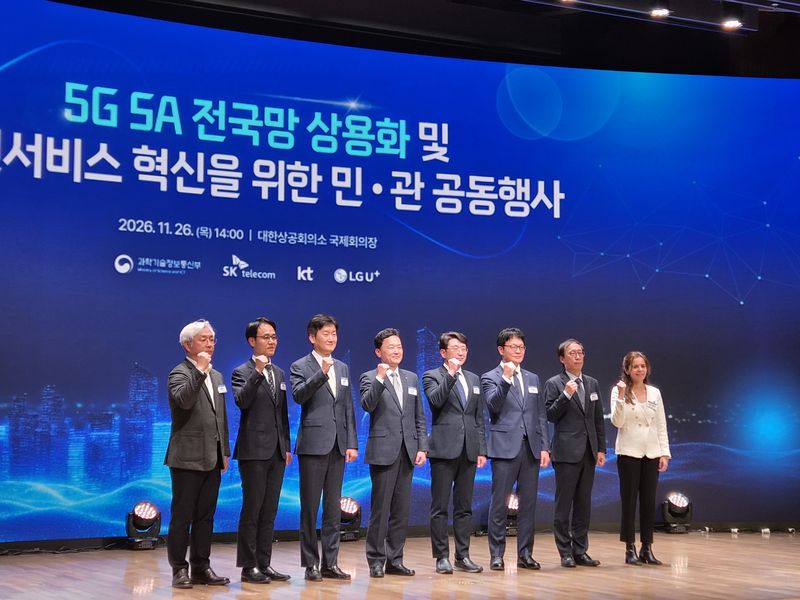
Nationwide 5G SA Service Era Begins
The Ministry of Science and ICT (MSIT) held a public-private event with the three mobile carriers on the 26th at the Korea Chamber of Commerce and Industry in Jung-gu, Seoul, to mark the commercialization of a nationwide 5G SA network and promote innovation in communications services.5G SA is a communications network built entirely with 5G technology, from the base stations that transmit and receive radio signals to the core network that processes them. Unlike 5G non-standalone (NSA), which uses the existing Long-Term Evolution (LTE) core network, it can deliver distinctive 5G capabilities such as ultra-low-latency, high-reliability communications and network slicing.
Network slicing is a technology that divides a single physical communications network into multiple virtual networks to provide the quality of service required for each service. It can be used to maintain reliable emergency communications at disaster sites or precisely control robots in industrial settings.
KT commercialized 5G SA back in July 2021. LG Uplus Corp. will launch the service on the 30th, and SKT on the first of next month. As a result, all three of South Korea's mobile carriers will provide nationwide 5G SA network services.
Drawing on its experience operating a nationwide network, including an on-site trial at the Busan Fireworks Festival, KT plans to launch an enterprise security service using network slicing. LG Uplus Corp. will run an SA experience group at a baseball stadium on the 5th of next month and expand its services into industrial, firefighting and emergency medical fields. SKT plans to pursue pilot services that provide stable communications quality even in crowded settings such as festivals and performances, as well as industrial robot control.
"Revising Net Neutrality Standards and Communications Quality Assessments"
The government will establish an institutional framework to encourage the launch of new services based on 5G SA. It will maintain the fundamental principles of net neutrality—protecting the quality of the general internet and not giving preferential treatment to specific applications (apps) or content—while allowing reasonable differences in communications quality based on the characteristics of each service. It will also clarify the criteria for recognizing specialized services that require separate quality guarantees.The communications quality assessment framework will also be revamped to focus on users' experience. This year, the government will conduct pilot measurements of 5G SA connection retention rates and latency, among other factors, and will develop additional SA-specific assessment indicators starting next year. It also plans to encourage network capacity expansions as the number of users and services grows, and quality improvements in areas with limited communications service.
The government will also support the discovery and demonstration of services closely tied to everyday life, as well as the adoption of SA security services in the public and corporate sectors. It will also pursue technology development and standardization in preparation for the era of artificial intelligence (AI) and sixth-generation mobile communications (6G).
Choi Woo-hyuk, director general of the Information Security and Network Policy Bureau at MSIT, emphasized, "The commercialization of a nationwide 5G SA network is not the finish line, but the beginning. The task before us is to expand services that people can experience firsthand and create practical services in industrial settings," adding, "We will establish a reasonable institutional framework so that private-sector technological innovation can proceed smoothly."
[email protected] Yoon Hong-jip Reporter