“AI to Address Customer Needs Directly” ... Banks Prepare for the “Prompt Banking” Era [On-Site]
- Input
- 2026-11-26 16:31:27
- Updated
- 2026-11-26 16:31:27
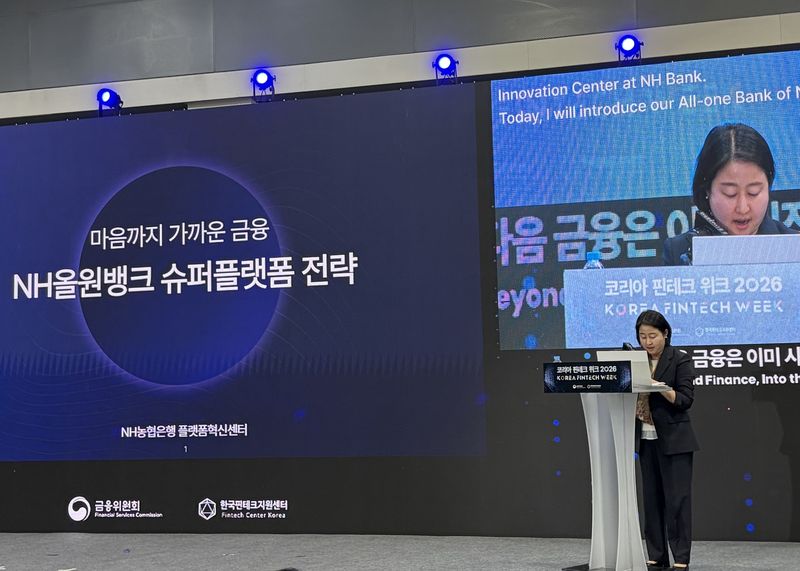
[Financial News] Commercial banks’ competition to build super apps is shifting beyond the integration of financial and nonfinancial services toward innovation in AI-based financial transactions. Instead of customers having to seek out financial products and services themselves, banks are pursuing an approach in which AI understands customers’ intentions, recommends the services they need and helps them complete transactions. There is growing consensus that this shift must reflect the financial industry’s particular need for accuracy and stability, and even change banks’ organizational culture and ways of working.
Suggesting services and connecting transactions
At Korea Fintech Week 2026, hosted by the Financial Services Commission on the 26th at the aT Center in Yangjae-dong, Seoul, KB Kookmin Bank and Nonghyup Bank shared the trial and error they encountered as they pursued digital innovation, along with their medium- to long-term platform strategies.
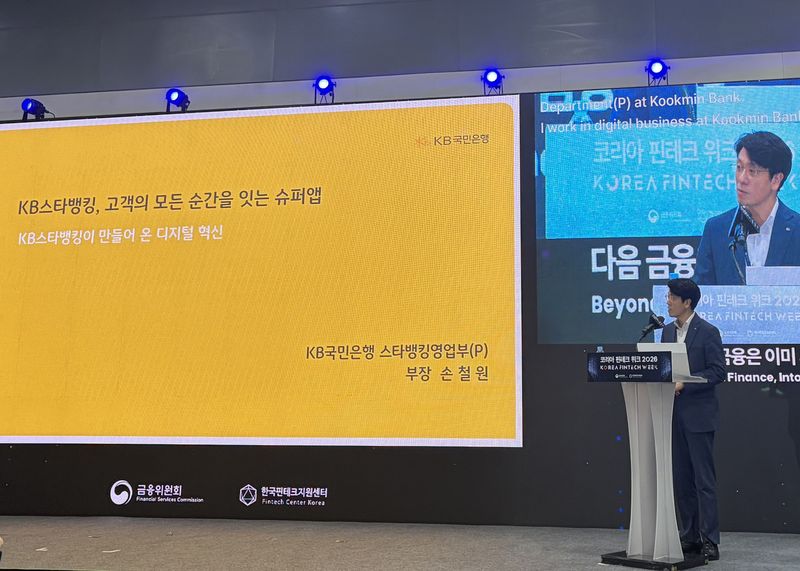
KB Kookmin Bank is currently piloting AI search and consultation services on KB Star Banking. It plans to digitize tasks that require branch visits, such as inheritance-related services, submitting loan documents and retirement pensions, ultimately expanding the range of tasks that can be handled remotely to 100%.
Son Cheol-won, head of the Star Banking Sales Department at KB Kookmin Bank, predicted, “Right now, customers have to navigate through several screens in Star Banking themselves to carry out the tasks they want. In the future, this could change: customers could tell AI what they want, and AI would understand their needs and find the services they need.” He added, “As AI technology advances further, it could even be connected to actual financial transactions.”
Nonghyup Bank plans to transform its flagship platform, NH Allone Bank, into an AI agent-based platform by 2028. By the first half of next year, it will integrate the bank’s internal knowledge and consultation information, build a natural-language response system based on a large language model (LLM), and pilot four AI agents. Its goal is to enable customers to complete banking tasks through conversation alone about two years from now.
Lee Su-jeong, head of Nonghyup Bank’s Platform Innovation Center, said, “Allone Bank, which began as an easy-banking service 10 years ago, has evolved into a superplatform and is now preparing to become an agentic AI bank that proactively identifies customers’ needs and actively recommends and provides the financial services they need. We expect that one day, banking apps, too, will become ‘prompt banking,’ with just a single prompt remaining.”
Organizational change, harder than technology
A common challenge facing banks is securing the participation of front-line departments and strengthening their ability to plan AI services. That is because implementing AI services that reflect the particularities of financial work requires active cooperation not only from technology staff but also from business units such as product and sales departments.
Lee acknowledged, “It was difficult to build consensus because people thought AI was the responsibility of only the department in charge. This was especially challenging with AI services built in on-premises (self-hosted) environments, where participation from front-line departments is crucial.”
He went on to emphasize, “Financial institutions have to provide accurate answers. To reduce the scope for AI to make its own inferences, we need to classify query types precisely and carefully design multiple branches, including rule-based responses. Front-line departments need to pay closer attention to these aspects.”
Nonghyup Bank has responded by holding a contest in which business units and technology staff jointly develop AI agents, and by offering incentives such as overseas training, prize money and promotions.
KB Kookmin Bank is also reducing trial and error by operating a dedicated AI task force (TF). Son said, “Building the infrastructure is important, but planning is also necessary to deliver a good customer experience, and it’s true that this is still unfamiliar in the banking industry. We are drawing on what we learned from the search and consultation services we pioneered through our dedicated TF.”
Banks are also grappling with how to achieve both platform growth and profitability. Son explained, “We don’t look only at monthly active users (MAU); lately, we’ve also been paying close attention to daily active users (DAU). In addition to customer engagement, we track improvements in profitability through internal management accounting metrics.”
[email protected] Seo Ji-yun Reporter