President Lee: “Seven SEED Projects Must Pick Up Speed...The World Is in a Race for Future Tech Dominance”
- Input
- 2026-11-26 14:58:47
- Updated
- 2026-11-26 14:58:47
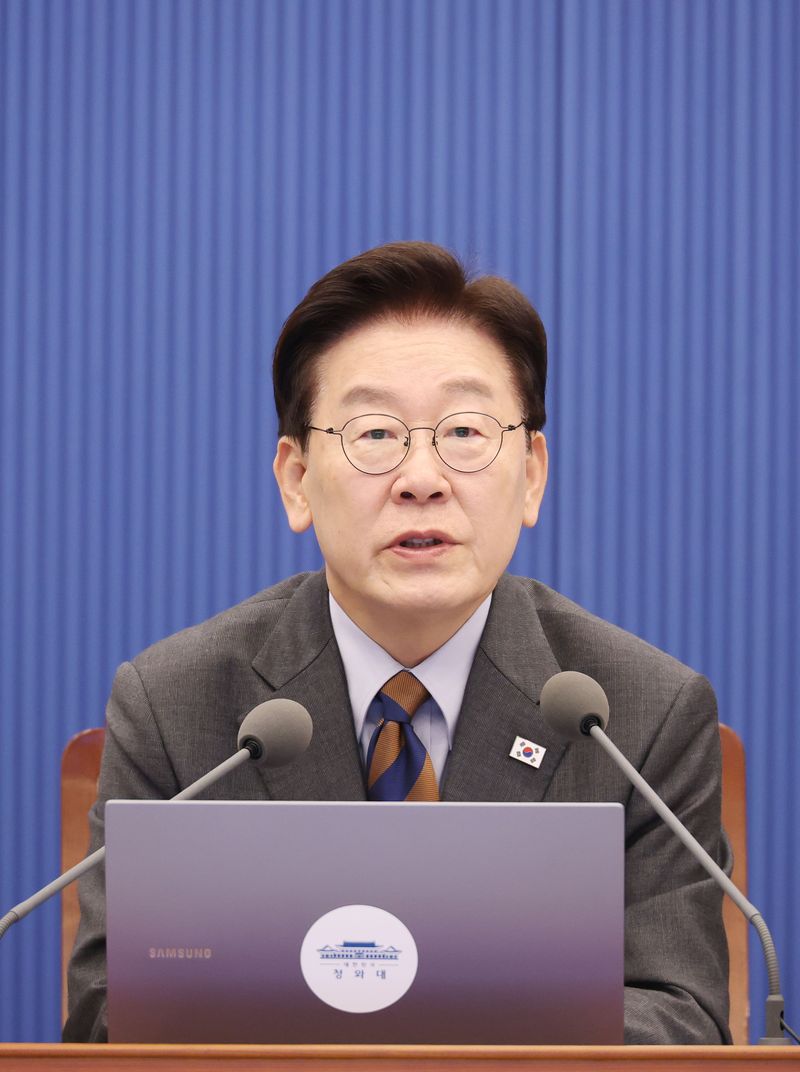
[Financial News] President Lee Jae Myung said on the 26th that “we are setting historic milestones in key economic indicators such as economic growth, exports and national income,” while calling for a careful review of progress on government tasks and policies. Regarding the seven SEED projects aimed at fostering future growth engines, he said, “I think we need to pick up the pace a little,” and called for tailored strategies for each project and stronger private-sector cooperation.
At the Senior Presidential Aides Meeting he chaired at Cheong Wa Dae that day, President Lee said, “The world is now engaged in fierce technological competition over dominance in future industries.” He added that “the arena of competition is also rapidly expanding beyond the two fields of artificial intelligence and semiconductors to include renewable energy, nuclear fusion, quantum technology, aerospace and advanced biotechnology.”
He emphasized that “in this competition, which will determine the nation’s future, a one-step difference today could widen into a gap of 100 steps, or even 1,000 steps, down the road.” He added, “Just as we continually upgraded our growth engines in the past, moving from light industry centered on shoes and clothing to heavy and chemical industries, and then again to advanced industries centered on IT, this is a time when we need the strategic wisdom to look 10 or 20 years ahead.”
President Lee said, “The two key pillars for this are the Three Mega-Projects and the seven SEED projects.” He noted, “The Three Mega-Projects seem to be progressing in a fairly systematic manner, with groundbreaking ceremonies being held in various regions. But the seven SEED projects need to pick up the pace a little.”
President Lee said that despite domestic and international uncertainties and crises, including the war in the Middle East, “2026 will be remembered as a year in which South Korea firmly established its standing as a globally leading nation in many fields, including the economy, industry, diplomacy and culture.” He added, “As the end of the year approaches, it is also very important to look at what has been lacking in the government’s work so far,” and said, “Cheong Wa Dae and the government should carefully review progress on the government tasks and policies we promised the public at the beginning of the year.”
Regarding winter safety measures, he urged public officials across the country to do their utmost with the attitude that “I am the president, and I am ultimately responsible.” President Lee said, “Before winter sets in in earnest, we need to review the public safety measures carefully once again,” and emphasized that “as abnormal weather becomes commonplace, disaster responses that rely on past experience or conventional forecasts are no longer effective.” He acknowledged that some might ask, “Why is the president going into such detail about things like that?” but emphasized that “protecting the lives and safety of the public is the state’s most important duty,” and that “it is also very important and only natural for the person ultimately responsible for running the country to look into this.”
Meanwhile, in a post on X (formerly Twitter) that day, President Lee said, “Starting next month, the health insurance copayment rate for people with rare and severe diseases will be lowered from 10% to 7%.” He added, “As I promised the public during the presidential election, I will continue to reduce the burden of treatment costs.” He went on, “On Christmas Eve last year, I met with people with rare diseases and their families and heard about the difficulties they face during treatment and diagnosis, as well as the daunting burden of medical costs.” He explained, “Based on what you told me then, we have been developing measures one by one to ease the burden of treatment costs.” He added, “That change is now translating into tangible benefits,” with “about 1.36 million people set to benefit, and medical expenses expected to fall by around 220,000 won per person annually on average.”
[email protected] Choi Jong-geun, Seong Seok-woo Reporter