Lee: “Every Public Official Is the President and Ultimately Responsible for Public Safety ... Seven Seed Projects Need to Pick Up the Pace”
- Input
- 2026-11-26 14:33:58
- Updated
- 2026-11-26 14:35:13
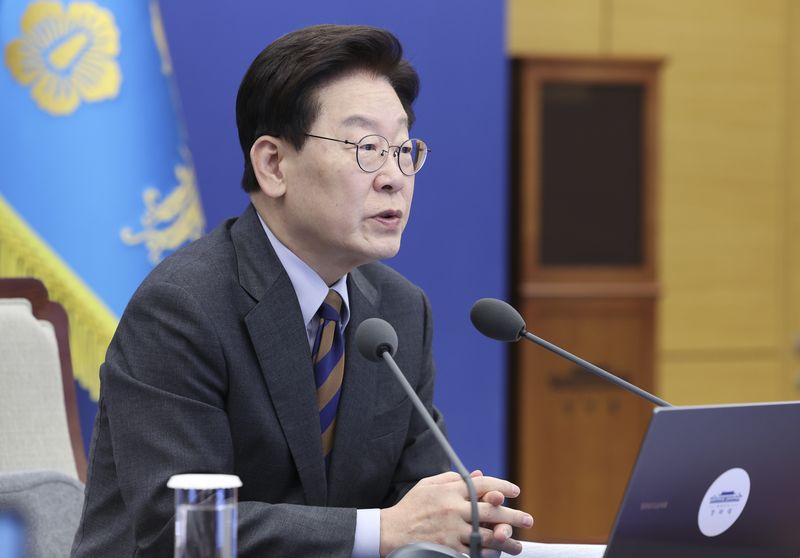
[Financial News] President Lee on the 26th urged public officials across the country to do their utmost on winter safety measures with the attitude that “I am the president, and I am ultimately responsible.” He emphasized that the Seven SEED Projects to foster future growth engines “need to pick up the pace.”
At the Senior Presidential Aides Meeting he chaired at Cheong Wa Dae that day, President Lee said, “Ahead of the full onset of winter, we need to carefully review our measures for public safety once again,” adding, “As abnormal weather becomes commonplace, disaster response based on past experience or conventional forecasts is no longer effective.”
He continued, “According to the Korea Meteorological Administration’s forecast, this winter is likely to bring more snow and rain than average because of the effects of a strong El Niño,” and called on the government to “make every effort to establish an effective heavy-snow response system in close coordination with local governments.”
In particular, he urged officials to “actively consider ways to flexibly deploy relevant equipment and personnel to minimize gaps in snow removal that could arise at administrative boundaries,” and to “proactively implement safety measures to prevent the collapse of agricultural and livestock facilities due to heavy snowfall.” He also called for preparations for black ice on roads, water pipes freezing due to sudden cold snaps, and fires in gosiwon (small-room lodgings), jjokbang neighborhoods, residential vinyl greenhouses, and traditional markets.
President Lee acknowledged that some might ask, “Why is the president going into such detail about things like that?” but emphasized that “protecting the lives and safety of the people is the state’s most important duty” and that “it is also very important and only natural for the person ultimately responsible for state affairs to look into this.”
On fostering future industries, he said, “The world is now engaged in fierce technological competition for dominance in future industries,” adding, “The arena of competition is also rapidly expanding beyond the two fields of artificial intelligence and semiconductors to include renewable energy, nuclear fusion, quantum technology, aerospace, and advanced biotechnology.”
In particular, he stressed, “In this competition that will determine the nation’s future, a one-step difference today could widen into a gap of 100 steps, or even 1,000 steps, in the future.” He added, “Just as we continuously upgraded our growth engines in the past—from light industry centered on shoes and clothing to heavy and chemical industries, and then to high-tech industries centered on IT—we now need the strategic foresight to look 10 or 20 years ahead.”
President Lee said, “The two core pillars for this are the Three Mega-Projects and the Seven Seed Projects,” adding, “The Three Mega-Projects seem to be progressing in a fairly systematic way, with groundbreaking ceremonies being held in various regions. But the Seven Seed Projects seem to need to pick up the pace.”
He called for “developing tailored implementation strategies for each project, strengthening private-sector cooperation in planning, investment, research and development, and demonstration, and making every effort in public outreach and communication.” He also called for regulatory reform, financial and tax support, and the development of key talent.
President Lee said, “I ask you all to join forces, with a profound sense of mission, to draw a new growth map for South Korea.”
Regarding the year-end review of government initiatives, he said, “Cheong Wa Dae and the government need to carefully review the progress of the government initiatives and policies promised to the public at the beginning of the year,” adding, “We must thoroughly examine whether the results of governance are reaching people’s everyday lives and whether implementation is being delayed by administrative convenience or silos between ministries.”
He continued, “For initiatives that are not being implemented adequately, we need to accurately diagnose the causes and actively mobilize the necessary means to double the pace of the projects.” He also called for a thorough review of this year’s achievements and limitations and for next year’s work plans to be drawn up in keeping with the principle of putting what the public experiences first.
President Lee emphasized, “I ask you to think deeply from the public’s perspective about what is lacking and what needs to change,” adding, “The time of public officials is a valuable public resource that should be devoted to the 52 million people.” He continued, “Never forget for a moment that all the time and authority entrusted to us belong to the people and are for the people. To build a government that changes people’s lives, I ask you to devote yourselves to delivering governance whose results the public can feel.”
[email protected] Choi Jong-geun, Seong Seok-woo Reporter