Retirement Age Extension Talks to Resume in 1 Day... Plan to Reach 65 in 2037 Seen as Likely
- Input
- 2026-11-26 14:26:30
- Updated
- 2026-11-26 14:26:30
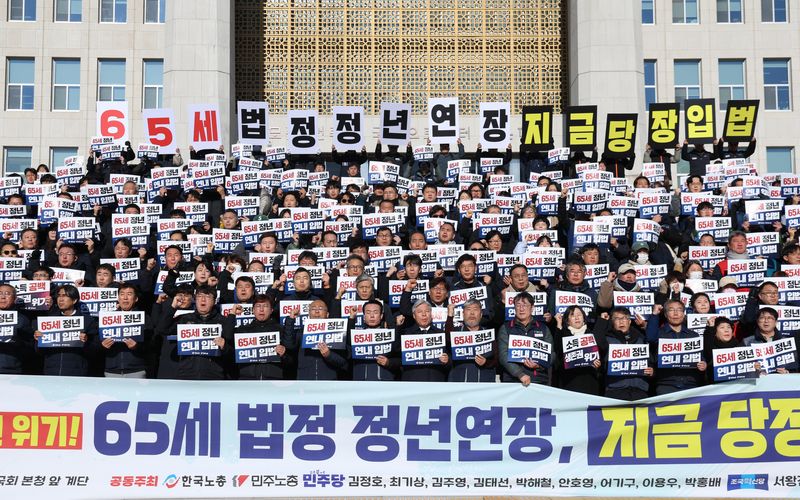
[Financial News] Labor-management negotiations over extending the retirement age to 65 will resume after about 10 months. Labor groups have effectively issued an ultimatum demanding legislation within the year, while the government has also urged the ruling party to speed up its discussions. There is consensus on gradually raising the statutory retirement age from the current 60 to 65, but differences remain over the pace of implementation, post-retirement reemployment and changes to the wage system. Attention is focused on whether the Democratic Party of Korea can revise its existing compromise proposal and pave the way for legislation within the year.
According to political circles and labor groups on the 26th, the Democratic Party’s Special Committee on Extending the Retirement Age will hold a closed-door subcommittee meeting on the 27th to discuss legislative plans with labor and management. The committee was launched last year with the goal of passing legislation within the year, but failed to bridge the differences between labor and management. In January this year, it decided to postpone discussions until after the June 3 local elections, and in April it only met separately with labor and business groups. Negotiations between labor and management, which had effectively been suspended after the FKTU walked out of a meeting in protest over the delay in legislation, are now set to resume.
The starting point for the discussions is a draft compromise proposal prepared by the Democratic Party committee last June. Under the plan, 2027 would be a preparation period, the statutory retirement age would rise to 61 in 2029, and then increase by one year every two years, reaching 65 in 2037. The proposal also calls for gradually raising the age at which employers are required to reemploy workers after retirement, alongside the increase in the statutory retirement age. The mandatory reemployment age would rise from 61 in 2028 to 62 in 2029, 63 in 2031, 64 in 2033 and 65 in 2035.
Pairing an extension of the retirement age with reemployment is a compromise intended to reduce the burden on businesses while filling the income gap before people begin receiving National Pension benefits. The statutory retirement age is currently 60, but the age at which people can start receiving National Pension benefits is gradually increasing and will reach 65 in 2033. Since an income gap of up to five years can arise between retirement and the start of pension payments, the plan is to raise the statutory retirement age while making use of reemployment during the transition.
However, labor and management also differ sharply over the details of the compromise proposal. The ruling party’s draft would, in principle, require employers to accept all workers who want to be reemployed, while allowing exceptions based on legal criteria such as health. On wages, it also considered a temporary exception to employment rules that would allow adjustments to working hours and changes to the wage system for workers affected by the retirement-age extension. The measure takes into account both the wage cuts and job insecurity that labor groups fear and the reduction in labor costs sought by business groups, but it is difficult for either side to accept readily.
Labor groups say extending the statutory retirement age must take priority and that reemployment after retirement should not be treated as an alternative. The FKTU and the KCTU held a joint press conference at the National Assembly on the 25th, calling for legislation within the year to extend the statutory retirement age to 65. FKTU chairman Kim Dong-myeong warned, “If legislation is not passed within the year, there will be no further dialogue.” Labor groups argue that reemployment could widen disparities in wages and job security among workers by allowing companies to hire selectively.
By contrast, business groups argue that a continued-employment system should be designed around reemployment after retirement rather than a uniform extension of the statutory retirement age. They say extending the retirement age across the board would increase companies’ labor costs and could also reduce their capacity to hire young workers. The burden is said to be particularly great for large companies and the manufacturing sector, where seniority-based pay systems that raise wages with years of service are prevalent. Business groups want companies to be able to set reemployment eligibility and duration flexibly, alongside changes to wage systems based on job duties and performance.
Measures to support youth employment are also an issue the ruling party must resolve. The Democratic Party initially delayed the legislative schedule, saying it would also draw up measures for youth employment, but internal coordination is reportedly still incomplete. The government’s role is another variable. Kim Young-hoon, the Minister of Employment and Labor, said in a broadcast on the 22nd, “If labor and management fail to reach an agreement, the government can step in responsibly.” It remains unclear whether a final agreement will be reached at this subcommittee meeting. To pass legislation within the year, the proposal must secure the special committee’s agreement, be introduced as a bill and undergo review by the National Assembly’s standing committees.
[email protected] Kim Kyung-min Reporter