[Exclusive] Out-of-Town Buyers Head to Seoul, Seoul Residents to Gyeonggi... Why ‘Cross-Regional Auction Buying’ Is Diverging
- Input
- 2026-11-29 14:20:58
- Updated
- 2026-11-29 14:20:58
[Financial News] Different demand patterns are evident in the ‘cross-regional auction buying’ between Seoul and Gyeonggi. For buyers from outside Seoul, auctions in Seoul offer an investment route to owning a home without the burden of living in it. For Seoul residents, auctions in Gyeonggi offer a way to buy a home while easing the burden of high home prices and remaining within their existing sphere of daily life.
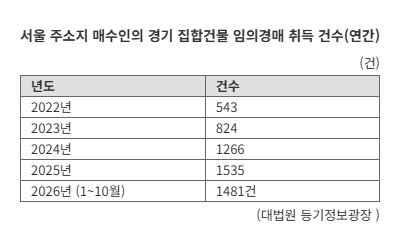
On the 29th, Financial News analyzed buyer data from applications for ownership-transfer registration following sales at voluntary auctions, published by the Supreme Court’s Registry Information Plaza. Of the 7,510 purchases of multi-unit buildings in Gyeonggi recorded from January to October this year, 1,481 were by buyers with Seoul addresses, accounting for 19.7%. That was up 16.9% from 1,267 during the same period last year.
The number of cross-regional auction purchases in Gyeonggi by buyers with Seoul addresses rose each year, from 543 in 2022 to 824 in 2023, 1,266 in 2024 and 1,535 last year.
■ “Seoul Home Prices Are Too High”... End-User Buyers Turn Their Attention to Gyeonggi
Both price and location shaped demand shifting from Seoul to Gyeonggi. Buyers who struggle to find a home of their desired size in Seoul within their budget are widening their search to areas in Gyeonggi from which they can commute to Seoul. By area, Goyang had the most acquisitions of multi-unit buildings in Gyeonggi by buyers with Seoul addresses, at 168. Suwon (142), Pyeongtaek (123), Namyangju-si (107) and Gimpo (96) followed.
Pyeongtaek and Suwon saw particularly sharp increases. In Pyeongtaek, the number rose by 80, from 43 in January–October last year to 123 in the same period this year. In Suwon, it more than doubled, from 70 to 142. Gwonseon District alone recorded 84 this year, exceeding its total for all of last year (58).
Ko Jun-seok, a professor at Yonsei University’s Sangnam Institute of Management, said, “In places such as Goyang and Gimpo, properties may have gone to end users looking to buy their first home, as repeated failed auctions drove prices down,” adding, “They can buy below market price and avoid brokerage fees, which helps reduce acquisition costs.”
■ Acquisitions in 15 Gyeonggi land transaction permit zones up 44%... Paldal and Dongtan account for 64% of the increase
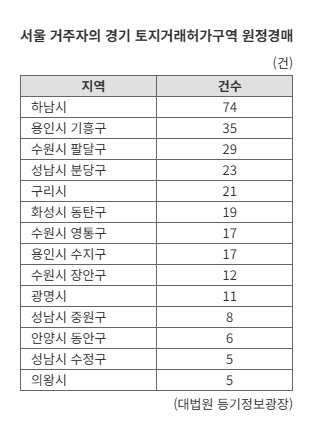
Acquisitions of multi-unit buildings at auction in these areas increased 44.0%, from 1,158 in January–October last year to 1,667 in the same period this year. Within that total, purchases by buyers with Seoul addresses rose 29.4%, from 218 to 282.
Hanam City had the most auction acquisitions by buyers with Seoul addresses. It recorded 74 from January to October this year, accounting for 26.2% of all purchases by buyers with Seoul addresses across the 15 areas (282). Yongin’s Giheung-gu (35), Suwon’s Paldal District (29) and Seongnam’s Bundang District (23) followed.
Professor Ko said, “Buyers who are short of funds to invest in Seoul are turning to areas such as Bundang, Dongtan and Gwangmyeong through auctions.”
[email protected] Choi Ga-young Reporter