NIPA Lays the Groundwork for AI G3...All-Out Push for Industrial Innovation and Global Expansion Next Year
- Input
- 2026-11-26 14:30:15
- Updated
- 2026-11-26 14:30:15
[Financial News] The National IT Industry Promotion Agency (NIPA) will shift the focus of its support for the AI industry next year from expanding infrastructure to achieving tangible gains in industrial productivity. Having focused this year on securing graphics processing units (GPUs) and building a domestic AI semiconductor ecosystem, NIPA plans to generate concrete industrial results next year by upgrading its public-facing AI service, “MOAI,” and applying physical AI at manufacturing sites.
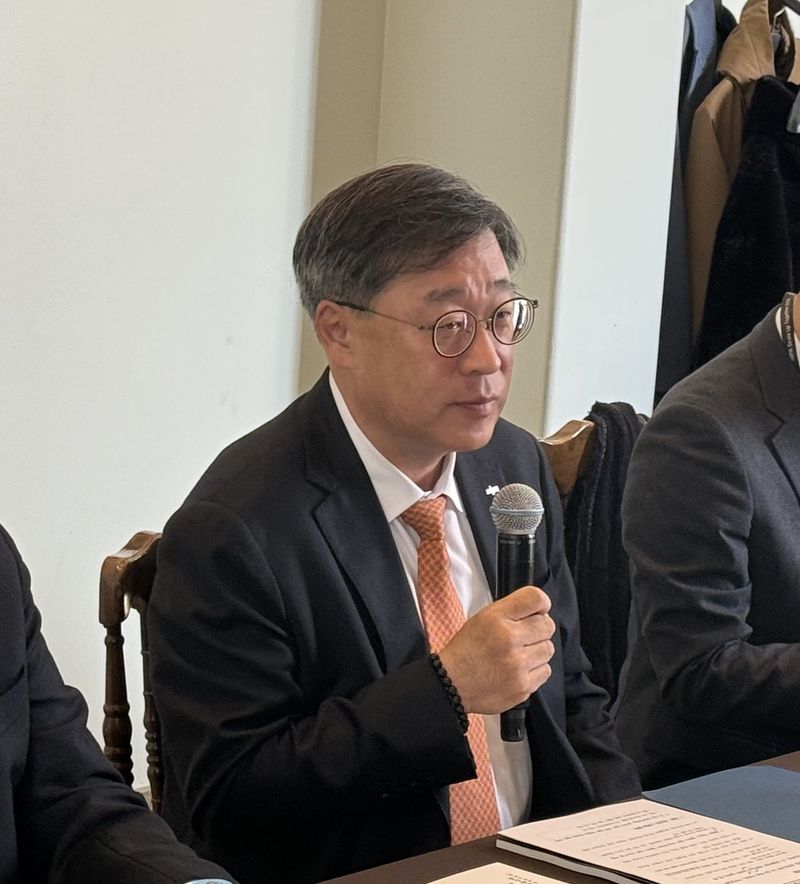
NIPA President Park Yoon-kyu outlined this year’s achievements in supporting industry and the agency’s business plans for next year at a press briefing for “NIPA Shared Growth 2026” at Raum Art Center in Gangnam-gu, Seoul, on the 26th.
Park said that although technological advances had accelerated—with five frontier-level AI models released in just nine days—and AI use had become widespread, achieving tangible productivity gains remained a challenge. “There is still criticism that AI is used more to assist with work than to generate added value,” he said. “The task ahead is to go beyond using AI and change structures to boost productivity.”
This year, NIPA focused on expanding AI infrastructure and building a domestic AI semiconductor ecosystem. A total of 19,000 GPUs based on NVIDIA B200 units purchased by the government this year are being introduced in phases. NIPA is also pursuing a plan to supply GPUs starting next year through a special-purpose corporation (SPC) involving Samsung SDS, ahead of the completion of the National AI Computing Center. “As the government has purchased GPUs and begun putting them to use, the shortage has eased to some extent,” Park said. “Conditions for using GPUs will be much better next year.”
Although management uncertainty has increased recently following Jensen Huang’s resignation and return as NVIDIA’s CEO, NIPA expects there to be no disruption to domestic GPU procurement. After questions arose about Huang’s future, NIPA reviewed its NVIDIA-related projects and confirmed that those included in this year’s and next year’s budgets would proceed as planned.
Tangible results have also emerged in the domestic AI semiconductor industry. The combined valuations of five leading domestic neural processing unit (NPU) companies—Furiosa AI, Rebellions, HyperExcel, DEEPX and Mobilint—more than doubled in a year, surpassing 10 trillion won. Exports related to domestic AI semiconductors also exceeded $30 million in the first half of this year.
NIPA named “AI-native” as a key business priority for next year. It plans to go beyond simply incorporating AI into existing work and focus on redesigning how services and industrial operations are run around AI. The public-facing AI service “MOAI,” set to launch this December, will also be upgraded in stages. The plan is to start with chatbot-centered services this year and expand the service’s functions next year to include AI agents that perform specific tasks, such as booking KTX tickets and accessing public benefits.
Physical AI projects are moving beyond technology development into demonstrations at manufacturing sites. In Jeonbuk State, NIPA will develop a platform and operating system (OS) to centrally control manufacturing equipment; in South Gyeongsang Province, it will develop behavior models for precision tasks such as injection molding and welding. Next year, AI models will be applied to some manufacturing processes, with plans to expand their use to entire factories based on the demonstration results.
“Support for the AI ecosystem should go beyond individual layers and cover the full stack,” Park said. “Next year, an important challenge will be to achieve meaningful results in global markets and secure a certain level of market share.”
[email protected] Choi Hye-rim Reporter