“A 9.5 Trillion Won Hole in Next Year’s School Budget”; Superintendents and Teachers’ Groups Mount All-Out Push to Block Grant Overhaul
- Input
- 2026-11-26 13:18:49
- Updated
- 2026-11-26 13:18:49
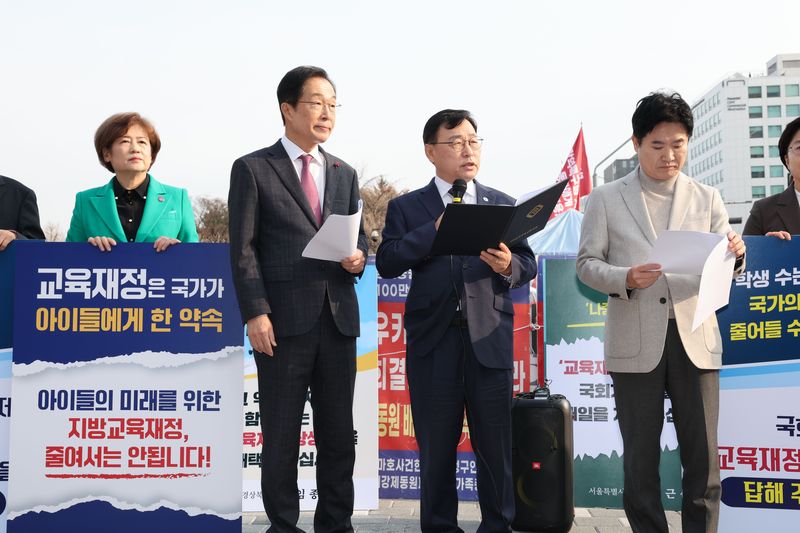
[Financial News] Superintendents of education from cities and provinces nationwide, along with teachers’ and parents’ groups, urged the National Assembly to strengthen its review of the bill, saying that passage of the government’s proposed overhaul of Local Education Subsidy Grants would leave education offices 9.5 trillion won short next year. The bill would abolish the 55-year-old system linking grants to domestic tax revenue; if it fails to clear a standing committee by the 30th, it will automatically be referred to the National Assembly plenary session on Dec. 1.
The Korean Council of Superintendents of Education and the “2026 Emergency Action Against the Local Education Subsidy Grant Reform,” a coalition of around 420 education and civic groups, made the announcement at a series of press conferences at the National Assembly in Yeouido, Seoul, on the 26th.
“A decline in the number of students does not mean that the costs needed to run schools fall by the same proportion,” said Geun-sik Chung, chair of the Korean Council of Superintendents of Education. He stressed, “Securing stable education funding and preparing for the country’s future are by no means separate goals, so the National Assembly must engage in responsible discussion over the remaining four days.”
According to the Korean Council of Superintendents of Education, the minimum grants needed to operate the 17 metropolitan and provincial education offices next year total 88.4 trillion won. By contrast, under the government’s proposal submitted to the National Assembly, next year’s grants would amount to just 78.9 trillion won, leaving a 9.5 trillion won funding gap.
The council noted in particular that grants would increase by 2.4 trillion won next year, while the increase in personnel costs alone, due to higher civil servant salaries, would reach 2.5 trillion won. It said the system would leave education offices unable even to cover personnel costs with the increased funding. The National Assembly Budget Office also projected that applying the proposed reform would reduce grants by 113.4 trillion won over 2026–2030 compared with the current system.
With the deadline for the National Assembly’s bill review just four days away, the superintendents called for at least four measures to be incorporated into the bill. These include raising the baseline used to calculate grants to 84.1 trillion won and lowering the weighting for the school-age population from 35% to 10%; specifying in a supplementary provision the payment of 11.7 trillion won in 2026 grant settlements resulting from this year’s increase in national tax revenue; requiring the national government to make up any shortfall if grant increases fall below the rise in personnel costs; and establishing a basis for using 2.5 trillion won in available funds from the Education and Talent Account within the Future Fund to support elementary and secondary education.
The education community says it has reached the limit of relying on reserves accumulated over the years. Funds held by metropolitan and provincial education offices plunged from 20.2 trillion won at the end of 2022 to 4.4 trillion won this September. Amid mounting financial pressure, 16 education offices nationwide were unable to allocate 1.2209 trillion won in next year’s initial budgets for projects to improve aging school facilities and environments. Currently, 39.1% of school buildings nationwide are aging facilities more than 30 years old.
The proposed amendment to the grant law failed to win agreement on the 17th at the Board of Education’s Bill Review Subcommittee in the National Assembly, amid differences between the ruling and opposition parties. If the Board of Education’s bill subcommittee does not conduct a thorough review at its scheduled meeting on the 30th, the education community plans to continue persuading the floor leaders of both parties and the Special Committee on Budget and Accounts, seeking to have revisions incorporated into the plenary-session version of the bill.
[email protected] Man-gi Kim Reporter