Kyung Hee University Sets Out to Develop an Ultra-Small Satellite That Analyzes Data in Space With AI
- Input
- 2026-11-26 13:40:52
- Updated
- 2026-11-26 13:40:52
[Financial News] Kyung Hee University students are setting out to develop an ultra-small satellite that will use artificial intelligence (AI) to analyze data collected in space. Before sending data to the ground, they will validate technology that allows the satellite itself to detect hazardous particle environments and equipment malfunctions and compress observation data.
According to Kyung Hee University on the 26th, the PADO-SAT team, formed mainly by students in the Department of Space Exploration, was selected for the beginner satellite category of the 7th Small Satellite (CubeSat) Competition, hosted by the Korea AeroSpace Administration and organized by the Korea Aerospace Research Institute. Twenty-two teams applied to this category, and five were selected.
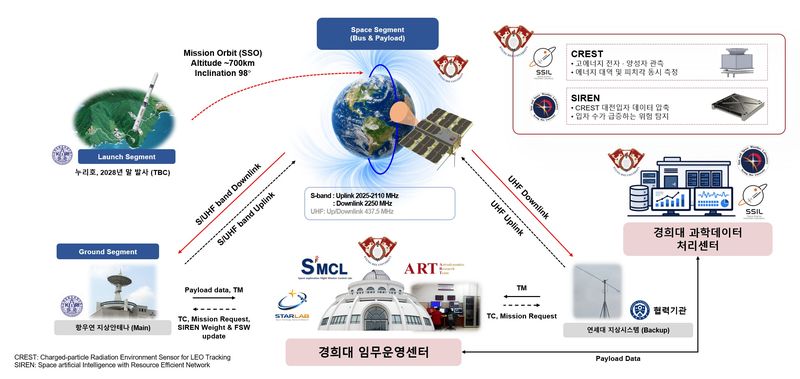
The satellite being developed by the students is PADO-SAT, measuring 10 cm by 10 cm and 30 cm high. It will carry CREST, a high-energy particle detector, and SIREN, which will demonstrate AI technology inside the satellite.
CREST is an instrument that simultaneously measures the energy and incoming direction of high-energy particles in space. It is designed to measure the particles’ direction while keeping the satellite’s attitude stable. The detector measures 10 cm in each dimension.
SIREN analyzes particle observation data and information on the satellite’s status to detect hazardous particle environments and equipment malfunctions. It will also validate technology for compressing observation data to reduce the amount of data sent to the ground. The technology is expected to be useful for lunar and deep-space exploration, where communications with Earth are limited.
Twenty undergraduate students and 14 master’s students took part in developing the satellite. The students, who study subjects including space science, mechanical engineering, electrical engineering and computer engineering, divided into four areas—payload, satellite bus, ground station and systems engineering—and completed the preliminary design and selected key components in just two and a half months.
When they found that there were not enough communication interfaces to connect equipment inside the satellite, the students considered several alternatives and decided to design and build a separate circuit board themselves.
Ju Yang-ha and Lee Ji-won, who served as systems engineering lead and deputy lead, respectively, said, “It was a very valuable opportunity to coordinate and review the design process for the entire satellite system as systems engineers,” and, “We hope this PADO-SAT project will not remain a one-off achievement, but will lead to further satellite development at Kyung Hee University.”
Faculty adviser Professor Song Yeong-ju, along with Professors Seon Jong-ho, Mun Yong-jae, Im Jae-hyeok, Lee Seon-ho and Lee Jin-seong, will also provide technical support in their respective fields, including space mission design, observation instruments, AI and satellite structural design.
The PADO-SAT team will develop the satellite over about two years, starting this month. It plans to complete the detailed design by the first half of next year and build a test satellite as well as the satellite intended for spaceflight. After functional, performance and environmental testing, the team plans to prepare for a launch aboard Nuri (KSLV-II).
Kyung Hee University plans to operate the satellite it developed in-house directly from its campus ground station and use the observation data collected in space for scientific research.
[email protected] Lee Bomi Reporter