Vietnam's 100-Trillion-Won North–South High-Speed Rail Project With Korean Participation Gets Underway
- Input
- 2026-11-26 18:14:11
- Updated
- 2026-11-26 18:14:11
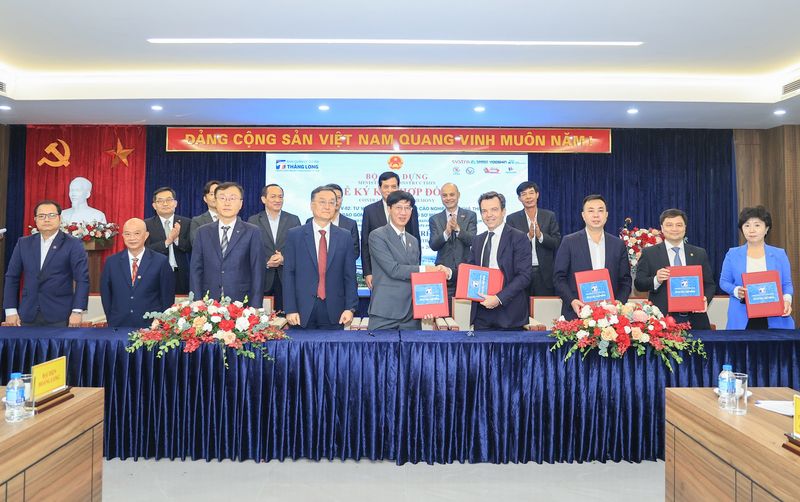
According to local media on the 26th, a signing ceremony for the 'TV-02' package contract for the North–South Express Railway project was held in Hanoi the previous day. The package is an advisory service covering field surveys, preparation of a feasibility study report, FEED, and preparation of bidding documents.
The event was attended by senior officials from Vietnam's Ministry of Construction, the project owner, the Thang Long Project Management Board, and a delegation from the advisory consortium comprising companies from South Korea, France, and Vietnam.
Earlier, on the 20th, the Thang Long Project Management Board officially approved the award result for the work. The winning contractor is a multinational consortium involving eight companies from South Korea, France, and Vietnam. The contract is worth at least 10.2 trillion dong (about 530 billion won), and the work is scheduled to take 30 months. The consortium includes South Korea's Korea National Railway (KR), Sambo Engineering, and Yooshin; France's SYSTRA; and four Vietnamese firms: TEDI, TEDI SOUTH, TRICC, and Hoang Long Construction Consultancy.
In his congratulatory remarks, Bui Xuan Dung, Vietnam's Deputy Minister of Construction, stressed that “for a megaproject as vast as the North–South Express Railway, which requires advanced technical capabilities and complex processes, the investment preparation phase—including field surveys, feasibility studies, and FEED—is a key factor determining the quality and feasibility of the entire project, as well as investment efficiency.”
Deputy Minister Dung then urged the consortium to “quickly put in place dedicated personnel and an operating organization for the TV-02 package and draw up a thorough schedule management plan,” adding that it “must secure accurate data through detailed field surveys to underpin route alternatives, detailed designs, and calculations of total investment costs.” He also called for the feasibility study and FEED to be carried out in close coordination and for advanced technologies and technical standards to be selected that suit local conditions in Vietnam while ensuring long-term safety and operational efficiency.
The Thang Long Project Management Board said that “the deliverables of the TV-02 work will serve as key supporting materials for the relevant authorities' review of the final investment decision.” On that basis, specific technical solutions and standards, the project implementation approach, and the total project cost are expected to be finalized, while conditions for tenders for the subsequent main construction work and systems procurement are also expected to be established.
Vietnam's North–South Express Railway will run for 1,541 km from Ngoc Hoi Station in Hanoi to Thu Thiem Station in Ho Chi Minh City, passing through 15 provinces and cities. It will be a double-track railway using standard gauge (1,435 mm), with a design speed of 350 km/h and an axle load of 22.5 tonnes. The total project cost is provisionally estimated at about $67.3 billion (about 95 trillion won).
[email protected] Kim Jun-seok Reporter