79.4% of University Students Frequently Use AI... Only 8.1% Use It for ‘Learning Expansion and Exploration’
- Input
- 2026-11-26 11:47:57
- Updated
- 2026-11-26 11:47:57
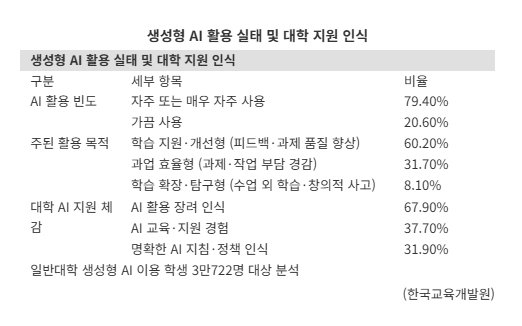
[Financial News] Students at four-year universities who use generative artificial intelligence (AI) differ in their level of engagement in learning not only according to how often they use it but also according to their “primary purpose for using it.” While most students perceive their universities as encouraging AI use, fewer than four in 10 have experienced education or support, and only about three in 10 consider the guidelines clear.
On the 26th, Kim Ji-ha, a senior research fellow at the Korea Educational Development Institute, released the findings in KEDI Brief No. 22, titled “What Conditions Are Needed for University Students’ Use of Generative AI to Lead to Challenging Learning Experiences?” Kim analyzed 30,722 students at four-year universities who used generative AI and took part in the 2025 student survey.
The analysis found that 79.4% of students who used generative AI used it frequently or very frequently. The most common primary purpose was learning support and improvement—getting feedback or improving the quality of assignments—at 60.2%, followed by task efficiency, or reducing the burden of assignments, at 31.7%, and learning expansion and exploration, or using AI for learning outside class and creative thinking, at 8.1%.
After controlling for factors including gender, major and university size, he measured “challenging learning experiences”—the overall level of students’ engagement in learning, not limited to AI use—on a four-point scale. The measure covered three areas: higher-order learning, which involves analyzing and reviewing course material; reflective and integrative learning, which involves connecting knowledge and perspectives and reflecting on them; and quantitative reasoning, or making judgments based on numerical evidence. Even at the same frequency of AI use, students in the learning expansion and exploration group scored higher in all three areas than those in the task efficiency group, with the largest difference—up to 0.23 points—in higher-order learning. The learning support and improvement group also scored higher than the task efficiency group in all three areas. By frequency of use, the very frequent-use group scored higher than the occasional-use group in all three areas, but in higher-order learning, the frequent-use group did not differ significantly from the occasional-use group.
A perceived gap in university AI support also emerged. While 67.9% of students perceived that their university encouraged AI use, 37.7% had experienced education or support, and 31.9% considered the guidelines or policies clear. Students who perceived or had experienced support scored higher in challenging learning experiences than those who had not; among very frequent users, the difference associated with whether students perceived the guidelines as clear was the largest of the three support measures.
“It was not only how much students used AI, but also what they used it for and how universities supported that use that was associated with challenging learning experiences,” said senior research fellow Kim Ji-ha.
He also recommended that universities guide students to use AI actively in their learning rather than restricting its use. To that end, students’ own review processes—including prompts, revision histories and evidence of fact-checking—should be reflected in assessments. Asked how assignments and assessments should be changed, he replied, “I think assignments or assessments themselves need to be changed into a format that allows the learning process to be examined, including how AI is used.”
There was also a recommendation to develop guidelines. The idea was to expand opportunities to participate in education and support while guiding students on how to apply the guidelines to actual classes and assignments. He said, “It is necessary to specify the scope of AI use, or what is permitted, for each class or assignment in the syllabus or assignment instructions.”
[email protected] Kim Man-gi Reporter