Choi Woong-jo: “Don Carlos” in French Is a Little Softer
- Input
- 2026-11-26 14:52:14
- Updated
- 2026-11-26 14:52:14
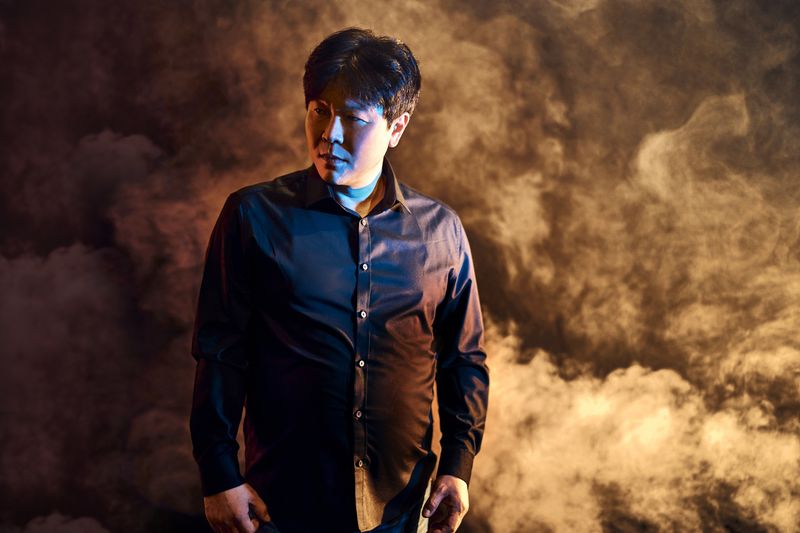
[Financial News] “It sounds a little softer than in Italian.”
Bass Choi Woong-jo described what it was like to sing Giuseppe Verdi’s opera Don Carlos in French for the first time. Philip II, King of Spain, was a role he had performed many times in the four-act Italian version at theaters in Germany. But this is his first time singing it in French and appearing in a five-act production.
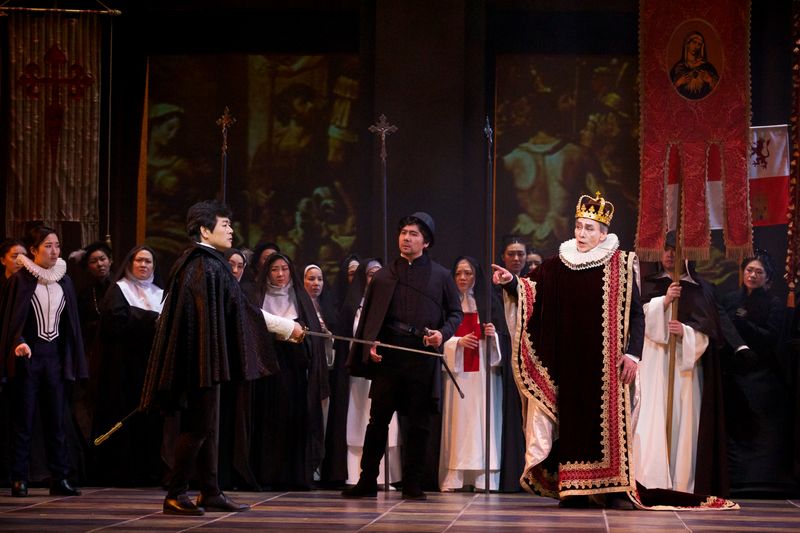
Korea National Opera (KNO) will stage Don Carlos at the Opera Theater of the Seoul Arts Center from December 3 to 6. It is the company’s first new production in 13 years, following its 2013 staging of the four-act Italian version. Premiered in Paris in 1867 in French as a five-act opera, the work is a landmark of 19th-century grand opera, depicting the clash of love, power and religion. This time, Yannis Kokkos is responsible for the direction, sets and costumes, and Valerio Galli will conduct the Korea Coop Orchestra. Choi Woong-jo will appear as Philip II in all four performances.
When Choi Woong-jo met with the press at the Seoul Arts Center on the 22nd, he cited the opening line of Philip’s signature aria, “She Has Never Loved Me,” and said, “At first, it felt strange to hear familiar lyrics changed into French, but the distinctive sound of French appealed to me not only in the aria but in other scenes as well.”
A king who longs for the queen’s love and cherishes a subject who speaks frankly
Don Carlos is based on the play of the same name, completed in 1787 by German playwright Friedrich Schiller. Drawing on real historical figures, including Philip II and Prince Don Carlos, Schiller wrote a tragedy about the clash between the king’s absolute power and the yearning for freedom.
The five-act version opens with the Forest of Fontainebleau scene, added when the play was adapted as an opera. Don Carlos, a Spanish prince, and Elisabeth, a French princess, fall in love at their first meeting. But when marriage negotiations between the two countries change, Elisabeth becomes queen to Carlos’s father, Philip II. Later, Philip finds his son’s portrait in the queen’s jewel box and is enraged. Choi Woong-jo saw in that anger a husband’s longing for his wife’s love.
The other figure he focused on almost as much as the queen was Rodrigo, Carlos’s friend. Rodrigo describes the suffering of the people of Flanders under Spanish rule and bluntly says that peace cannot be achieved through bloodshed. Choi explained, “Philip wanted Rodrigo, who risked his life to speak frankly, by his side, and after Rodrigo’s death, he sings of his grief, if only briefly.”
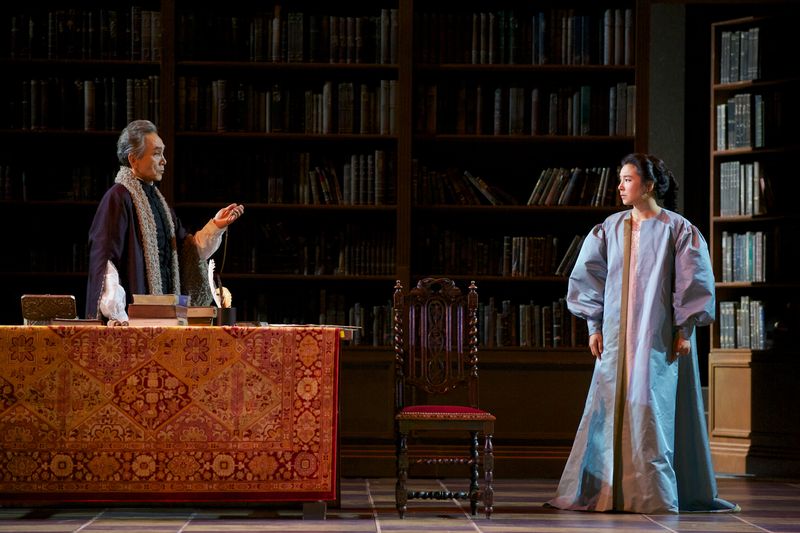
Choi Woong-jo said, “When I play Philip, I pay attention to whom I’m facing.” The king’s demeanor differs depending on whether he is dealing with his wife, his son or his subjects. Even the king bows his head before the Grand Inquisitor, a symbol of religious authority. “Bass duets are quite rare in opera,” he said, explaining that “the two low voices add solemnity to the scene.”
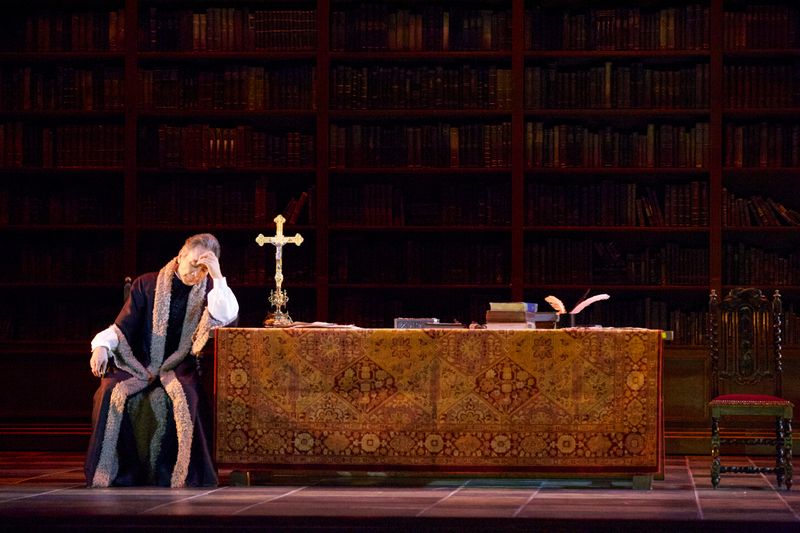
Asked which moments in this production stand out from Philip’s perspective, he picked three scenes in Act IV. “The king’s monologue is followed by a duet with the Grand Inquisitor, then comes the conflict with Elisabeth,” he said. The sequence begins with the king’s loneliness, builds tension through the confrontation between royal and religious authority, and culminates in his suspicions and anger toward his wife erupting.
The performance runs for a total of 4 hours and 20 minutes, including a 50-minute intermission. Choi Woong-jo called Don Carlos “one of the highlights” of Verdi’s operas. “The music is really good. It’s a must-see among Verdi’s works,” he said.
“The feeling that a person becomes an instrument”
Choi Woong-jo, who loved singing at church, chose vocal music in his final year of high school. He was also a good student, but he wanted to sing if he was going to do something for the rest of his life. “It was so fascinating and beautiful to feel that a person could become an instrument,” he recalled.
After graduating from the voice department at Seoul National University and the opera program at the Vienna Conservatory in Austria, he won first place at the Ferruccio Tagliavini International Voice Competition in Austria, second place at the Julián Gayarre International Singing Competition in Spain, and third place in the men’s division at the Bilbao International Singing Competition in Spain.
After spending two seasons at the Lucerne Theatre in Switzerland, he worked for many years as a resident soloist at the Aachen Theatre in Germany. He received offers for permanent positions at larger theaters, but, having built a close-knit family with his wife, whom he met at university, recalled, “I liked being in Aachen.” Based in Aachen, he also performed at other theaters in Germany, including those in Nuremberg, Würzburg and Augsburg. His association with KNO began in 2004 with The Elixir of Love.
Thanks to his resonant low voice, he has often played kings and fathers. In Wagner’s Lohengrin, he sang King Heinrich, and in Tristan und Isolde, King Marke. In Verdi’s Nabucco, he played Zaccaria, the high priest of the Hebrews, and in Mozart’s The Magic Flute, Sarastro, who leads the Temple of the Sun. When preparing a new role, he first asks himself, “What kind of character am I?” He explores the character’s emotions by examining the meaning of his own lines and listening to “what the other person is saying.”
As the performance approaches, he is focused on maintaining his stamina through rehearsals that run late into the night. He has enjoyed even the process of learning and practicing new scores, and smiled as he spoke ahead of this production.
“I’m so grateful and happy to sing. I enjoy the performance itself so much.”
[email protected] Shin Jin-a Reporter