“Just Comment and Buy on a Livestream for ‘High Returns’? It’s a Scam”...Financial Intelligence Unit (FIU) Uncovers 15,000 Fraudulent Accounts
- Input
- 2026-11-26 15:00:00
- Updated
- 2026-11-26 15:54:12
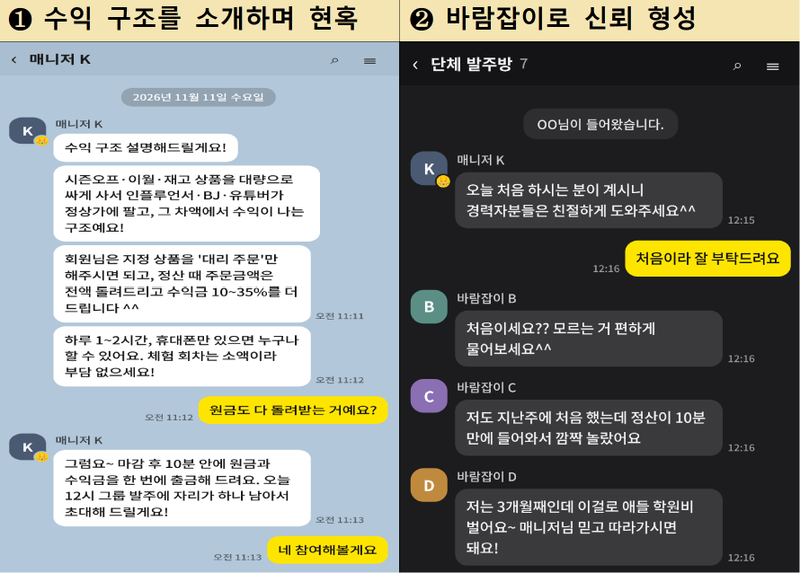
On the 26th, the Financial Intelligence Unit (FIU) introduced this case of online side-job (team-mission) fraud. The FIU warned that schemes targeting homemakers, university students and job seekers have recently been spreading. Criminal organizations lure victims by advertising high-paying side jobs on social media or by text message, then build trust through group chats or one-on-one conversations. They then demand advance payments under the pretext of participation fees or credits to be accumulated. They sometimes pay small amounts of earnings at first, but later encourage victims to send larger sums and demand additional payments, citing system errors or failed missions. The scheme ultimately ends with the perpetrators cutting off contact or kicking victims out of group chats after they have finished sending money.
That day, the FIU held a “Review Meeting on the Account Transaction Suspension System for Accounts Suspected of New Types of Phishing” at the Government Complex Seoul, chaired by Ha Ju-sik, director general for institutional operations and planning. They discussed the results of the system, measures to counter team-mission scams, and plans to update work guidelines. Representatives of the National Police Agency, the Financial Supervisory Service (FSS) and financial-sector associations attended.
According to the FIU, financial institutions placed a total of 18,670 accounts under temporary measures in response to reports of new types of phishing from June 30 to November 20. A comparison of the three months before and after the system was introduced found that losses from no-show scams, romance scams and team-mission scams fell by 49.9%.
Of the accounts placed under temporary measures, the National Police Agency’s Integrated Response Team confirmed 15,729 as accounts suspected of being linked to new types of phishing. Romance scams were the most common, with 7,218 cases (46%), followed by team-mission scams with 4,889 (31%) and no-show scams (proxy-purchase scams) with 3,622 (23%).
According to the National Police Agency, losses from these crimes fell from 108.4 billion won in the second quarter of this year to 54.3 billion won in the third quarter. The number of cases over the same period also fell 42%, from 3,468 to 2,011. The FIU said the decline reflected the effect of financial institutions proactively suspending account transactions, making it harder to withdraw criminal proceeds. It also said cooperation among relevant agencies, including the government-wide task force on voice phishing and its blocking of phone numbers used to commit crimes, contributed to the reduction in losses.
The system was introduced after the FIU worked with the National Police Agency’s Integrated Response Team to draw up guidelines based on an expansive interpretation of the Act on Reporting and Using Specified Financial Transaction Information (Specified Financial Information Act). The key measure is to enable financial institutions to swiftly suspend transactions on accounts involved in phishing scams disguised as goods or services transactions, which were not covered by payment suspensions under the existing Special Act on the Prevention of Loss Caused by Telecommunications-Based Financial Fraud and Refund.
However, the system does not include a separate procedure for reimbursing victims. Instead, cases are increasing in which funds in accounts subject to transaction suspensions are preserved through civil provisional attachment or seizure. At one bank, at least 1 billion won in victim funds was preserved under a court order after transactions were suspended. Another bank received a report of a medical-device proxy-purchase scam in which the perpetrator impersonated the head of the administrative office at a national science museum. The bank then suspended a suspicious account with a balance of at least 50 million won, and the victim applied for a provisional attachment during that period.
[email protected] Park Mun-su Reporter