"SMR Commercialization Must Ensure Economic Viability Through Design Standardization and Automated Instrumentation"
- Input
- 2026-11-26 12:59:26
- Updated
- 2026-11-26 12:59:26
[Financial News] As small modular reactors (SMRs) draw attention as a next-generation technology, calls have been made to improve their economic viability by standardizing designs and automating instrumentation technology in order to commercialize them. It was also proposed that firm demand be secured and relevant regulations established, given that SMRs have a wider range of applications than conventional large nuclear power plants, including fuel, data centers and defense.
The remarks were made at the 2026 KAST–Korean Science Journalists Association–SMCK Science and Technology Issues Forum, held on the 26th by the Korean Academy of Science and Technology, the Korean Science Journalists Association and the Korea Science and Technology Media Center (SMCK) at the Sangyeonjae City Hall branch in Jung District, Seoul. The forum was held under the theme “Small Modular Reactors (SMRs): The Potential of the Technology and the Challenges of Commercialization.”
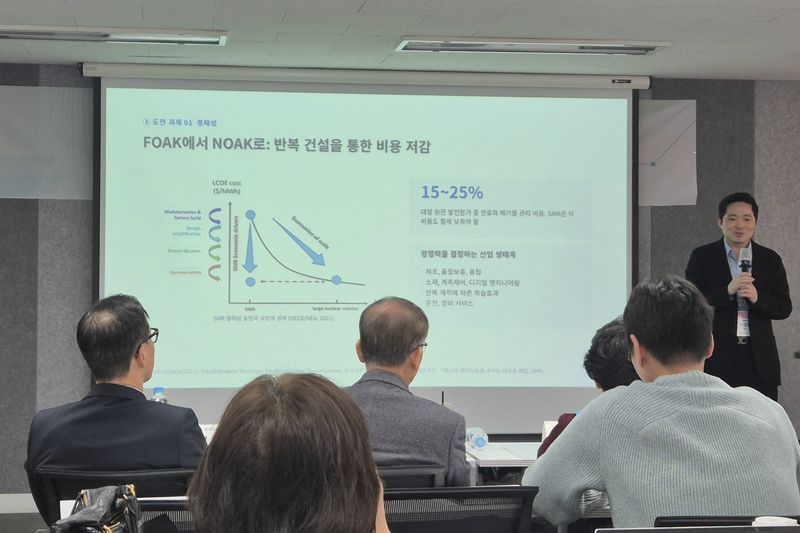
Professor Choi Seong-yeol of Seoul National University’s Department of Nuclear Engineering presented on “Challenges to Realizing Small Modular Reactors” that day. “The first challenge in commercializing SMRs is to address their lack of economic viability,” he said. “Because SMRs are built on a smaller scale than large nuclear power plants and are costly, designs need to be standardized so costs can be reduced through repeated construction.”
SMR construction costs are currently about three to four times those of large nuclear power plants.
Professor Choi said, “To reduce SMR operating costs, it is important to automate instrumentation technology, even to the point of semi-autonomous operation.” He added, “This automation will make it possible to operate multiple modules with a minimal workforce.”
In particular, he explained, “It is also important to secure stable demand for SMRs, which have high installation costs. The U.S. Trump administration, for example, is ensuring demand by having military bases use SMRs.”
In fact, SMRs have the advantages of being safer than large nuclear power plants, taking no more than two years to install, and having a wide range of applications.
Professor Lee Jeong-ik of the Department of Nuclear and Quantum Engineering at the Korea Advanced Institute of Science and Technology (KAIST) presented on “The Significance and Prospects of Small Modular Reactor Technology.” He explained, “With safety maximized, SMRs can be sited even near residential areas. Unlike nuclear power plants, which are construction projects, SMRs are equipment-based businesses, so their construction periods differ: seven years and two years, respectively.”
In this regard, Professor Lee added, “SMRs have a wide range of applications, including replacing coal and serving data centers and the defense sector. In the United States, where SMR development is currently active, a range of Korean companies—including Samsung C&T Corporation, SK Group, Hyundai Group, Doosan Group and Korea Hydro & Nuclear Power Co., Ltd. (KHNP)—are also participating, making this a global undertaking.”
The need for regulations related to SMRs was also raised. Professor Choi said, “It is important to establish regulations related to SMRs. Countries that establish regulations first can lead the market.” He added, “New regulations related to SMRs are also being developed internationally, including through the joint development of regulations for the nuclear, maritime and shipbuilding sectors.”
The forum was organized to examine the technological status and limitations of SMRs, which have recently emerged as the next game changer in the nuclear industry, and to expand communication between the science and technology community and the media.
[email protected] Yeon Ji-an Reporter