[Kim Seong-gon's Journey Through Chinese Classical Poetry] 9 Visiting Huangshan, the Famous Mountain Under Heaven, With the Welcoming Pine and Mengbi Shenghua
- Input
- 2026-11-26 15:59:13
- Updated
- 2026-11-26 16:32:18
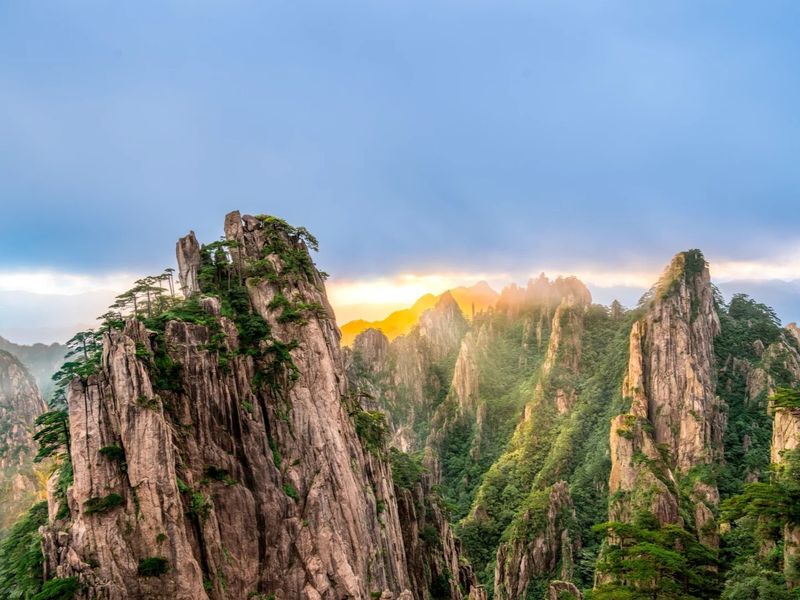
After wrapping up their itinerary in Shaoxing, the group stopped at Xianheng Tavern in Lu Xun’s Hometown to enjoy their last Shaoxing wine. Their next destination was Huangshan, a renowned scenic wonder under heaven. “When you return from the Five Great Mountains, you see no other mountains; when you return from Huangshan, you see no other peaks among the Five Great Mountains (五嶽歸來不看山, 黃山歸來不看嶽).” The line invariably appears in writing introducing Huangshan. But just how extraordinary must it be for even the mighty Five Great Mountains to lose their presence in its shadow? There is no way to know without visiting Huangshan in person.
The Huangshan Gazette, Definitive Edition (黃山志定本), compiled by the Qing-dynasty geographer Min Linsi (閔麟嗣), recounts a story about Xu Xiake (徐霞客), the famous Ming-dynasty traveler. When a friend asked him, after he had traveled throughout the land in search of its famous mountains, which place he thought was the finest, Xu Xiake replied: “Having traveled all under heaven, I have found nowhere in Anhui to match Huangshan. Once you climb Huangshan, there are no more mountains under heaven; your sightseeing ends here (登黃山, 天下無山, 觀止矣).”
“Guanzhi” (觀止) was originally used when someone heard the finest music and was moved beyond measure. It means that, having already experienced the greatest possible inspiration, there is no need to listen to any other music. The saying means there is no mountain that can surpass the emotion one feels on Huangshan. How could a journey to this “Guanzhi” Huangshan be anything but delightful?
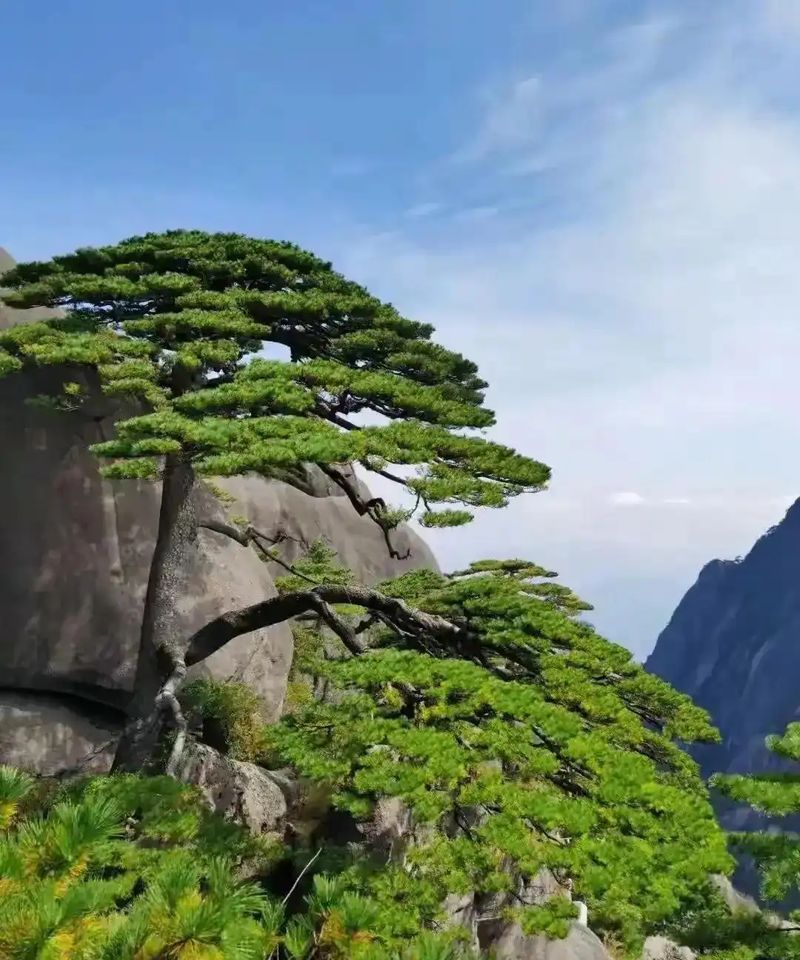
■ The Welcoming Pine opens its arms to greet visitors
Early the next morning, we took a cable car from Tangkou Town (湯口鎭), at the entrance to Huangshan, to Yupinglou (玉屛樓). After a short climb up a slope, the Welcoming Pine, Huangshan’s symbol, greeted us warmly. This thousand-year-old pine stands more than 10 meters tall and is a little over 60 centimeters in diameter. With its back to a large boulder called Qingshi Stone (靑獅石), it stretches a branch about 7 meters long straight out in front, as if a host were opening both arms to welcome guests.
The Welcoming Pine is a symbol of Huangshan and Anhui Province, but its photographs and paintings also adorn numerous public facilities, including the Great Hall of the People. Chinese people explain that the pine expresses their culture of welcoming guests. It brings to mind the idiom “bin zhi ru gui” (賓至如歸), meaning to treat guests so they feel as comfortable as if they had returned to their own homes. Yupinglou is like Huangshan’s front gate, so the Welcoming Pine, which comes out first to greet guests at this entrance, is in effect the host of Huangshan. In the old days, Ruan Ji of the Seven Sages of the Bamboo Grove used his blue and white eyes to show whether he liked or disliked a guest. Could the Welcoming Pine’s green needles not be its “blue eyes” (靑眼), welcoming its visitors?
Huangshan is dotted with unusual pines growing with their roots embedded in thousand-foot cliffs. It is nothing short of astonishing to see the Huangshan pines, which have endured for a thousand years, pushing through rock as hard as steel in an inhospitable environment without so much as a handful of soil. As they stretch their arms to take in sunlight and rain and dew, they also strive not to lose their balance on the sheer cliffs. Through a thousand acts of patience and ten thousand acts of care, they thicken their branches and twist them in different directions—perhaps that is how they have been shaped into the finest works of art.
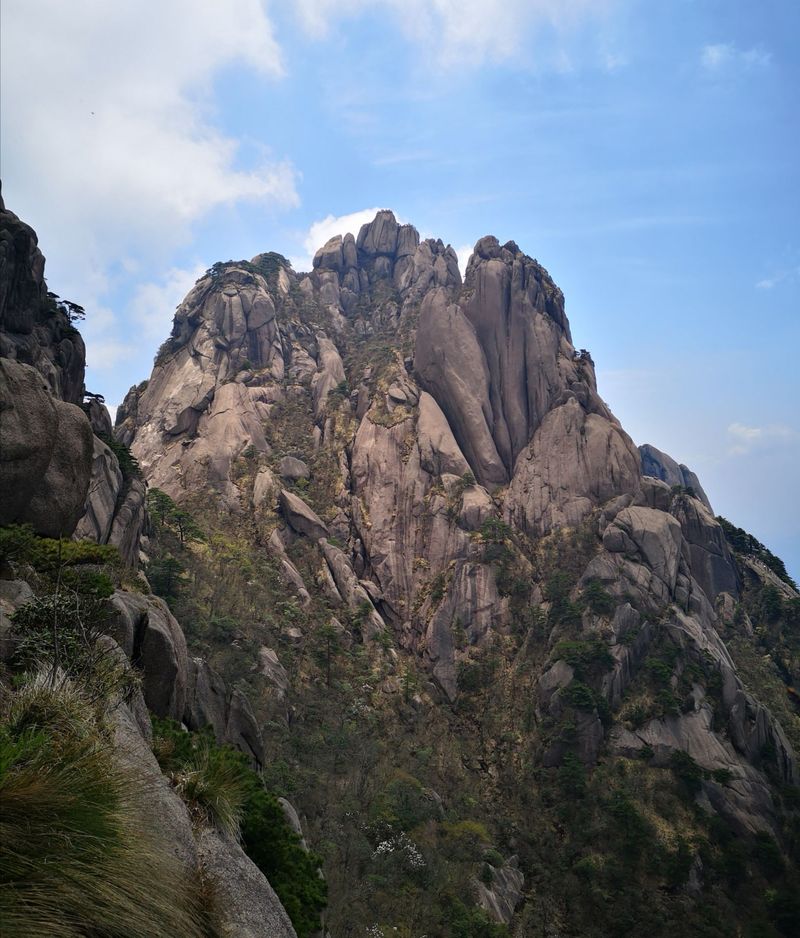
■ Lotus Peak, a flower the earth brought into bloom
Huangshan has 72 peaks. Lotus Peak (蓮花峰), Bright Summit (光明頂) and Celestial Capital Peak (天都峰) are called its three main peaks, with Lotus Peak the highest at 1,864.8 meters. Seen from Yupinglou, smaller peaks rise in layer upon layer around a large central peak, as if a lotus were just beginning to bloom toward the sky.
The narrow, steep stairway carved into the rock face clings closely to the inner side as it climbs, yet my knees repeatedly buckled. There are even sections where you have to crawl on all fours. But the extraordinary views that greet you when you pause for breath more than repay all the effort. The reason is the finest living painting, composed by graceful peaks and the strangely placed pines on each one, which take on ever-changing forms as clouds appear and disappear. That is why Huangshan is also known as “Cloud Mountain” (雲山).
After descending Lotus Peak, admiring the many peaks shifting in the evening sunlight from Bright Summit, and setting off along the mountain trail again, I saw a huge boulder standing upright. It rose from a flat rock that served as a base near the cliff, facing the western sky. Its elongated form tilted slightly forward, as if it might spring from its place and fly away at any moment. It was the famous Feilai Stone (飛來石).
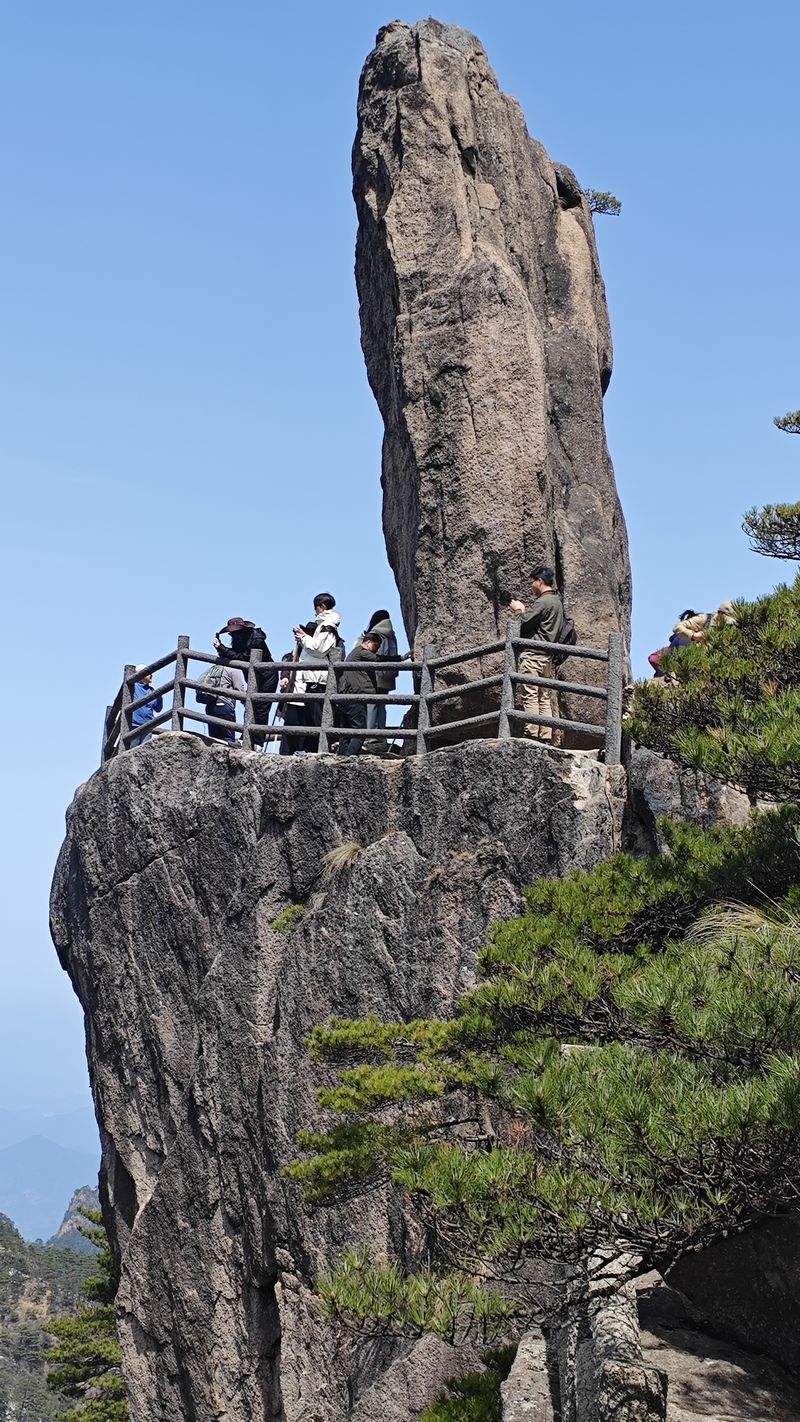
Huangshan’s Feilai Stone does not look as if it flew in and settled down; rather, it seems ready to take flight again and leave at any moment. A Ming-dynasty poet therefore wrote: “I know you flew here, but I fear you will fly away again (知爾是飛來, 恐爾復飛去).”
Perhaps a giant bird from mythology was flying toward the southern reaches of the world when it landed here to rest for a while. But how did it end up staying here and turning into a rock? I looked in the direction Feilai Stone gazes upon, and there was the answer.
■ The West Sea Grand Canyon, a place beyond the human world
Mountains from the heavens had descended into the canyon region west of Huangshan. A dreamlike scene embroidered with the graceful forms of celestial mountains stretched endlessly below my feet. This supreme landscape painting must have been what held Feilai Stone there. Faced with a view like this, one could forget whatever destination one had originally set out for. One could even be content to turn to stone. Countless peaks, high and low, near and far, line the canyon and overlap one another, creating an otherworldly paradise without equal. Some wear green pines on their heads like flowers; others drape them over their shoulders. The peaks seem to rise straight up and preen arrogantly, or to stand at a slant with one leg cocked, striking a pose. Add clouds and mist, and the scenery would be impossible to describe in words.
“Guanzhi! (觀止!)” There was nothing more to admire, nothing more to say. When I first came face to face with the West Sea Grand Canyon, all I could do was mutter, “This is not the human world!” I returned a few years later and spent the entire afternoon in a daze of wonder along the canyon’s cliffside path, until sunset arrived. As I watched the celestial mountains perform their living painting in the radiant evening light, hot tears suddenly welled up. I could not understand why I was crying uncontrollably.
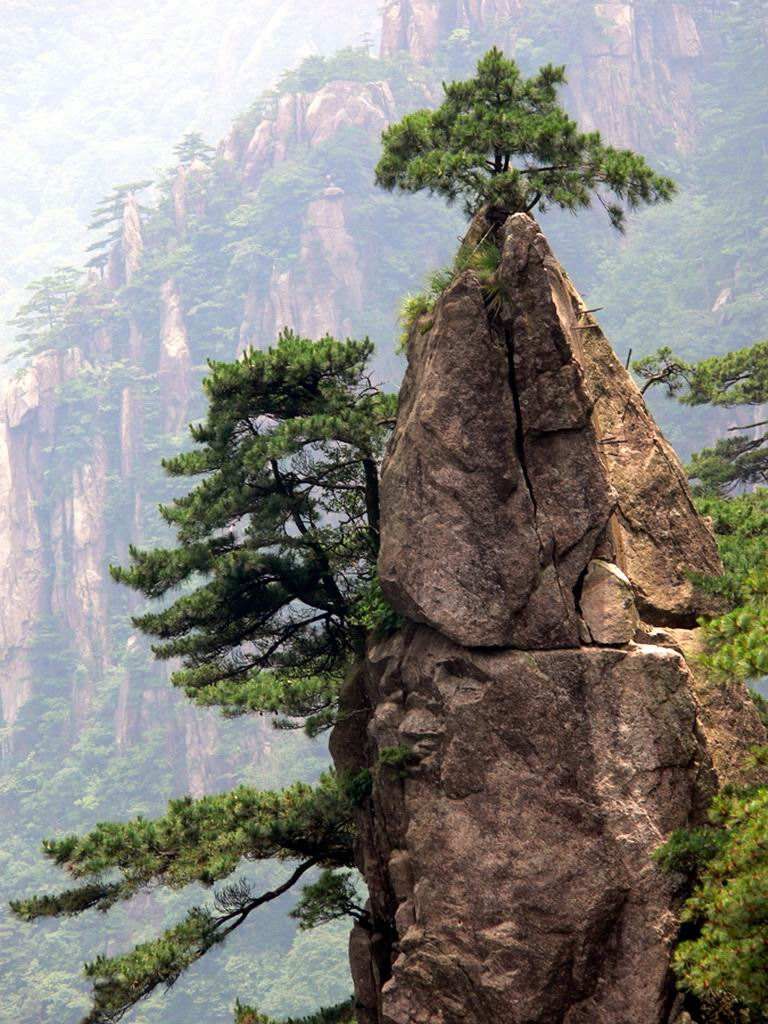
■ Mengbi Shenghua, flowers blooming from a brush tip
After spending the night on Huangshan, I watched a brilliant sunrise and a sea of clouds the next day. On the way down the mountain, I went to Mengbi Shenghua in the Beihai Scenic Area. On top of a rounded, sharply pointed rock that resembles a giant brush tip soaked in ink, a green Huangshan pine grows lushly. It was named Mengbi Shenghua (Dream Pen Blossoms) because it looks like a flower blooming from the tip of a brush. A legend about the poet Li Bai is associated with the site.
When Li Bai admired Huangshan’s beautiful scenery and composed and recited a poem, monks from a mountain temple came to serve him wine and food with great hospitality. At their request, Li Bai swept his brush across the page in a drunken flourish and wrote a poem, leaving everyone in the room amazed. After finishing the strokes of the final character, Li Bai picked up his brush, flung it far away, and left. When the monks returned after seeing him off, they witnessed an astonishing sight: the brush stuck in the ground had become a huge peak, and a pine tree was growing at its tip—as if a flower had bloomed from the brush.
But why specifically call it “Mengbi,” or “Dream Pen”? The Five Dynasties work Kaiyuan Tianbao yishi (開元天寶遺事) by Wang Renyu (王仁裕) recounts that Li Bai’s talent greatly improved after he dreamed as a young man that a flower had bloomed from the tip of his brush. The expressions “shenghua miaobi” (生花妙筆) and “mengbi shenghua,” derived from this story, are used to praise writers of outstanding creative talent.
As I was about to bid farewell to Huangshan, I felt so reluctant to leave that I visited the beautiful valley at the foot of the mountain known as Emerald Valley. Since couples often visit, it is also called Lovers’ Valley (情人谷). With its clear water, clean rocks and pristine bamboo groves, it certainly deserved its sparkling name, “Emerald.” I sat on a broad rock throughout the afternoon as autumn sunlight shimmered, listening to the clear song of the stream, its waters clapping together. It was heaven itself.

Kim Seong-gon, professor in the Department of Chinese Language and Literature at Korea National Open University (KNOU)
[email protected] Sun-Min Jung Reporter