BOK Monetary Policy Board: “Elevated Inflation and Household Debt Risks Persist” ... Maintains Stance of Further Tightening [Monetary Policy Direction]
- Input
- 2026-11-26 11:14:24
- Updated
- 2026-11-26 11:14:24
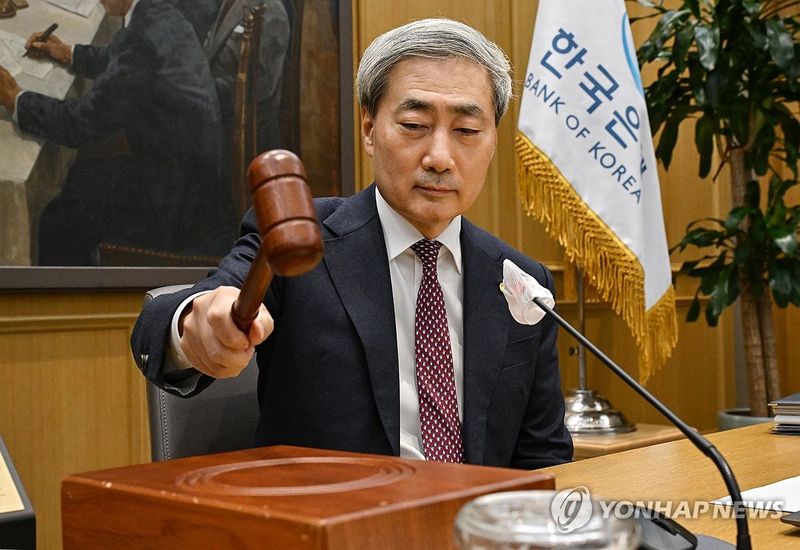
[Financial News] The Bank of Korea’s Monetary Policy Board said on the 26th that it had raised the base rate by 0.25 percentage points, from 3.00% to 3.25% per year, adding, “We will closely monitor future inflation and economic trends, as well as financial stability, and decide on the timing of any further rate hikes.”
In its monetary policy decision, the Board explained, “With growth in the domestic economy having strengthened further and inflation expected to remain above the target level (2.0%) for a considerable time, and with risks to financial stability persisting, we judged it appropriate to raise the base rate by 0.25 percentage points.”
Five Monetary Policy Board members voted in favor of the rate increase, while members Hwang Geon-il and Lee Su-hyeong dissented, favoring a hold at 3.00% per year.
The monetary policy decision indicated that concerns about inflation had intensified.
The Board expected inflation to remain above the target level for a considerable time as the pass-through of elevated cost pressures continued and demand-side pressures grew amid stronger economic growth. The consumer price inflation forecast for next year was raised to 2.4%, above the previous forecast of 2.3%, while the core inflation forecast was raised to 2.6% for both this year and next year, above the previous forecast of 2.5%.
The Board said, “The future path of inflation is expected to be affected by movements in international oil prices and the exchange rate, the pace of improvement in domestic demand, and the extent to which wage increases spread.”
In October, both consumer price inflation and core inflation stood at 2.8%, in the upper end of the 2% range, driven by rising prices for personal services and durable goods. Meanwhile, short-term inflation expectations among the general public edged down to 2.6% from 2.7% the previous month.
On financial stability, the Board remained vigilant about household debt and the real estate market. Household lending grew faster as both housing-related and other loans increased.
The Board said, “There is a need to remain alert to risks of financial imbalances related to the housing market in the Seoul metropolitan area and household debt.”
While viewing domestic economic conditions as generally positive, the Board emphasized that “uncertainties remain regarding the expansion of the semiconductor cycle and its impact on domestic demand, as well as developments in the Middle East situation.”
The Board expected the global economy to continue growing at a solid pace on the back of robust investment in artificial intelligence (AI), despite tensions in the Middle East. It also forecast that strong semiconductor performance would sustain high growth in domestic exports and investment, while improving income conditions and increased fiscal spending would gradually strengthen the recovery in consumption.
Accordingly, it projected growth of 3.9% this year and 4.1% next year, sharply higher than its August forecasts of 3.3% and 2.9%, respectively.
[email protected] Jung Sang-gyun Reporter