Yoon Suk Yeol's Acquittal on Perjury Charge Over 'Cabinet Meeting Plan' Finalized... Supreme Court: 'Even If Guilt Is Suspected, Rule in Defendant's Favor'
- Input
- 2026-11-26 11:02:08
- Updated
- 2026-11-26 11:13:37
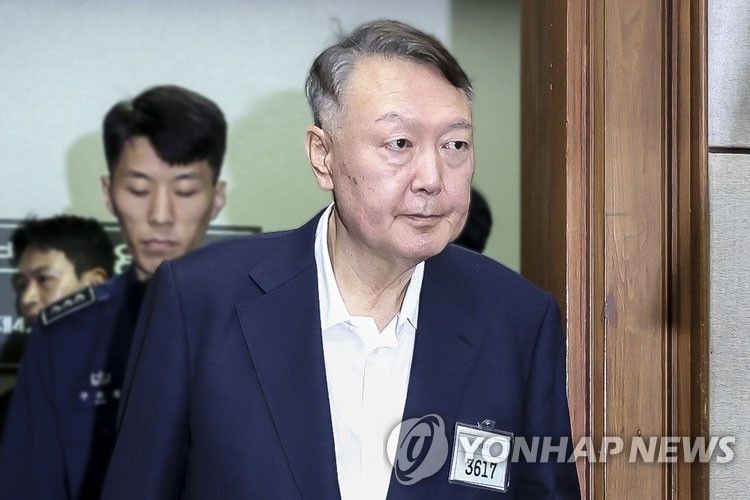
The Supreme Court's First Division, with Justice Ma Yong-joo presiding, on the morning of the 26th dismissed the prosecution's appeal in the perjury case against the former president and finalized the lower court's acquittal. The Seoul Central District Court's Criminal Division 32, the court of first instance, presided over by Judge Ryu Kyung-jin, acquitted him on May 28, while Criminal Division 1 of the Seoul High Court, the appeals court, presided over by High Court Judge Yoon Sung-sik, dismissed the prosecution's appeal on September 16.
On November 19 last year, the former president appeared as a witness and was sworn in at a hearing in the case against former Prime Minister Han Duck-soo, which included charges of aiding the ringleader of an insurrection. He testified that, even before Han suggested that a Cabinet meeting was necessary, he had planned to gather enough Cabinet members to meet the quorum, deliberate at a Cabinet meeting, and then declare martial law.
The special counsel deemed the testimony false. Its position was that the former president had no plan from the outset to hold a Cabinet meeting or call additional Cabinet members to meet the quorum, and only began arranging a meeting after receiving Han's suggestion.
The issue was whether the crime of perjury had been established. The key question was whether the testimony that there had been plans to hold a Cabinet meeting and summon additional Cabinet members before Han's suggestion was false and contrary to the former president's own memory, and whether that had been proven beyond a reasonable doubt. Perjury is committed when a witness who has been sworn in gives testimony contrary to their memory.
The appeals court found the evidence insufficient based on four circumstances. Former Defense Minister Kim Yong-hyun had stated from the early stages of the investigation that the former president had had a Cabinet meeting in mind; the former president and Kim had prepared documents in advance for Cabinet members who did not attend the initial meeting in the office; and, immediately after the meeting, the former president identified six Cabinet members and ordered that they be summoned as well.
Han's testimony also served as evidence. Although it was accepted that Han had said before martial law was declared that a Cabinet meeting should be convened, he testified that he did not know precisely whether the former president had already planned to hold one. The court therefore said it was difficult to conclude that Han's suggestion had prompted the intention to convene the meeting.
The circumstances surrounding the former president's attempt to leave the large reception room before the quorum was met also did not change the conclusion. The appeals court found that this was difficult to view as evidence that he had no intention of convening a meeting, given the prosecution's argument that additional Cabinet members had already been summoned and that he stopped trying to leave as soon as he was told the quorum was insufficient.
The Supreme Court upheld this assessment. The bench stated, "A finding of guilt must be based on evidence with sufficient probative force to convince a judge, beyond a reasonable doubt, that the facts alleged in the indictment are true," and added, "If there is no such evidence, then even if the defendant is suspected of guilt, the court has no choice but to rule in the defendant's favor."
It further held that the lower court had committed no error such as failing to conduct the necessary examination, violating the rules of logic and experience, exceeding the limits of the principle of free evaluation of evidence, misunderstanding the legal principles governing the probative value of evidence, or omitting a determination.
[email protected] Kim Dong-gyu Reporter