'Semiconductor Korea'... Growth to Enter the 4% Range Next Year for the First Time in Six Years
- Input
- 2026-11-26 10:43:56
- Updated
- 2026-11-26 10:43:56
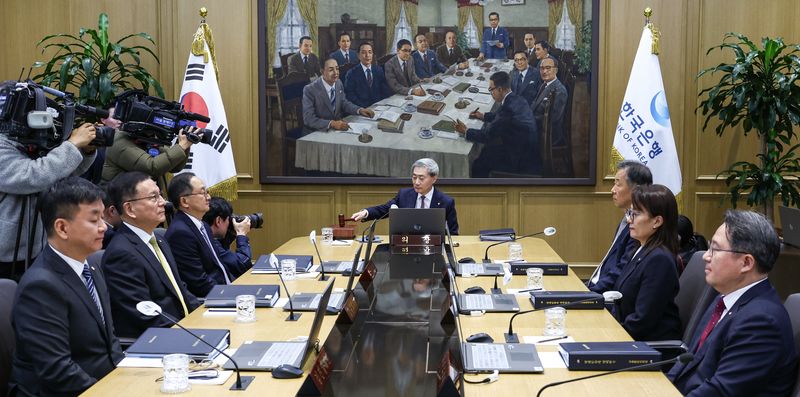
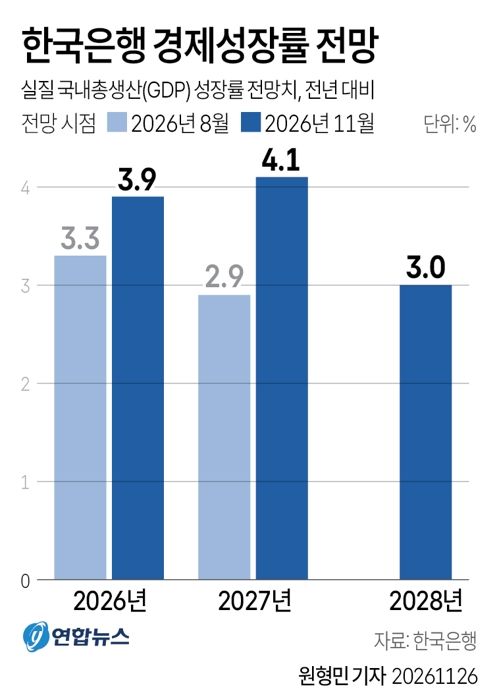
[Financial News] The Bank of Korea (BOK) sharply raised its forecasts for real gross domestic product (GDP) growth this year and next to 3.9% and 4.1%, respectively, on the 26th. The figures are up 0.6 percentage points for this year and a full 1.2 percentage points for next year from its August forecasts of 3.3% and 2.9%.
The 1.2-percentage-point upward revision to next year’s growth forecast is the largest since December 2008, when the BOK began forecasting economic growth for the following year. The 2028 growth forecast, released for the first time, also came in above expectations at 3.0%. The potential growth rate, which had fallen to the mid-1% range, is also expected to rebound to the 2% range.
At its Monetary Policy Board meeting on monetary policy direction that day, the BOK announced the revised growth forecasts while raising its benchmark interest rate by 0.25 percentage points to 3.25% per year.
South Korea’s economy is set to grow 3.9% this year, its strongest growth in five years since 2021, when it grew 4.6%. Next year, it is set to return to annual growth in the 4% range for the first time in six years, since 2021, when growth was 4.6%.
If the 2028 forecast of 3.0% is also achieved, that would mean three consecutive years of real growth in the 3–4% range for the first time in 16 years, since 2010–2012.
The biggest driver of growth, by far, is the unprecedented boom in AI (artificial intelligence) semiconductors. Despite criticism of the country’s heavy reliance on semiconductor exports, the assessment is that the spillover effects of the semiconductor boom will continue for at least the next two years.
Real GDP continued to surge, growing 1.8% in the first quarter, 0.6% in the second and 1.0% in the third. Meanwhile, exports continued their record-breaking surge in October, at $115.28 billion, and from November 1 to 20, at $77.4 billion.
According to an analysis by the Korea Development Institute (KDI), semiconductor production, facility investment and factory construction are so dominant that they account for half of this year’s growth and about two-thirds of next year’s growth.
The leverage effect also played a major role in GDP calculations.
The nominal GDP share of manufacturing of electronics and optical equipment, including semiconductors, nearly tripled, rising from an average of 7.5% in 2022–2025 to 20.7% in the first half of this year. This is seen as having maximized the chain-weighting effect, whereby increased production in this industry pushes up overall real growth by a much greater amount.
The government’s “highly expansionary fiscal policy,” supported by a “semiconductor tax revenue windfall,” has also boosted growth. With next year’s total expenditure budgeted at 821 trillion won, up 12.8% from this year, the government has already contributed 0.8 percentage points to third-quarter growth of 1.0%, reflecting the growing impact of fiscal policy. Analysts say that as government-led fiscal investment and transfers to the private sector get underway in earnest, construction and facility investment, particularly around semiconductor factories and plants, will continue to recover together.
But behind macroeconomic growth are significant concerns about volatility risks stemming from the economy’s concentration in semiconductors, as well as deepening K-shaped polarization that is increasingly disconnected from the livelihoods of ordinary households.
[email protected] Jung Sang-gyun Reporter