'Commercial Banks → Savings Banks' Inclusive Finance Funding ... Interest Rates on Loans to Mid-to-Low-Credit Borrowers Cut by 3–5 Percentage Points
- Input
- 2026-11-26 10:25:28
- Updated
- 2026-11-26 13:23:54

[Financial News] Woori Bank will provide approximately 50 billion to 100 billion won to its financial affiliate, Woori Financial Savings Bank, helping it offer unsecured loans to borrowers with mid-to-low credit scores at an average rate of around 10%. This is 3–5 percentage points lower than the rates on existing savings-bank loans. Financial authorities plan to launch “inclusive on-lending loans” in the first quarter of next year, under which commercial banks, including Woori Bank, will work with savings banks to provide low-interest unsecured loans to borrowers with mid-to-low credit scores. Previously, loans had to be repaid normally for at least one year to be classified as performing; going forward, they can be classified as performing after at least six months of repayment. Authorities have decided to ease prudential regulations to expand inclusive finance.
Banks to provide funds to savings banks ... effect of lowering interest rates
On the 26th, the Financial Services Commission held its 8th Inclusive Finance Transformation Meeting and announced measures to expand inclusive finance with relevant institutions and private-sector experts.According to the FSC, interest rates for medium- and high-credit borrowers rose in most sectors as market rates increased, while rates for low-credit borrowers fell by 0.05 percentage points at banks and 0.27 percentage points at savings banks. However, the “rate cliff”—where interest rates rise sharply for medium-credit borrowers in the nonbank financial sector—remains.
The FSC plans to ease the interest burden on borrowers with mid-to-low credit scores in an era of high interest rates by introducing “inclusive on-lending loans”: banks will provide funds to savings banks, which will use them to make loans to these borrowers. Eligible borrowers are those with mid-to-low credit scores who fall within the scope of the Saehuimangholssi Loan program. Banks and savings banks will set rates independently, but the plan is to keep the final loan rate at an average of around 10%. The FSC expects consumers to be able to borrow at rates about 3–5 percentage points lower than on existing savings-bank loans.
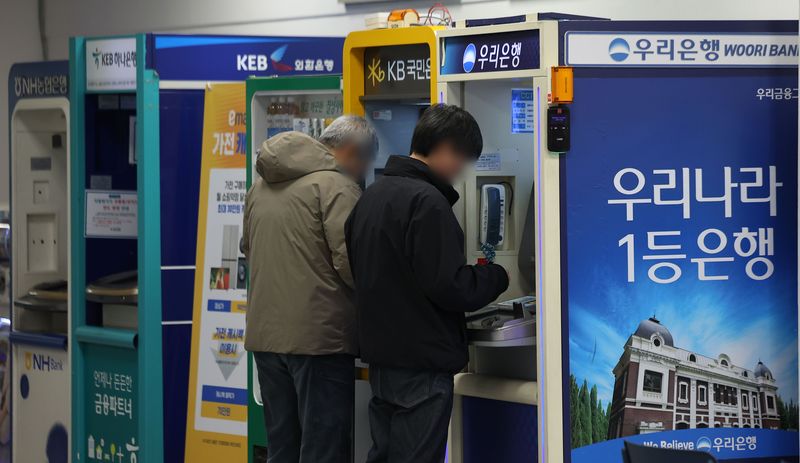
Woori Bank plans to provide funds to its affiliate, Woori Financial Savings Bank, which will offer unsecured loans to borrowers with mid-to-low credit scores, with a limit of approximately 50 billion to 100 billion won. The loans are expected to carry annual interest rates of 8–12%.
The FSC plans to grant regulatory exemptions through a planned regulatory sandbox, designate innovative financial services early next year, and launch on-lending loan products during the first quarter. It will also offer incentives, including counting banks’ on-lending loan performance toward their Saehuimangholssi Loan performance and exempting them from contribution payments to the Korea Credit Guarantee Fund, Korea Technology Finance Corporation and regional credit guarantee foundations.
Financial authorities to ease prudential regulations
Financial authorities have also decided to ease prudential regulations to expand inclusive finance. First, they will lower the risk weight (RW) on loans guaranteed by the Small Enterprise and Market Service, among others, from 20% to 0%. Public institutions subject to a 0% RW for credit risk will also be assigned a 0% default-risk weight when market risk is calculated, instead of the current 0.5–15%. In the insurance sector, the Korea Inclusive Finance Agency will be recognized as an eligible guarantor under the Korean Insurance Capital Standard (K-ICS), reducing the risk factor applied to guaranteed loans from 8% to 2.5%.Banks will also be allowed to use alternative credit-scoring models more broadly. In addition to their use in existing loan assessments, the models can be approved as regulatory models and used to calculate capital ratios and provisions. This will enable banks to provide more loans to borrowers with mid-to-low credit scores using the same amount of capital.
Among loans restructured by banks, insurers, credit finance companies and savings banks, those classified as “special mention” at the time of restructuring will be classified as “normal” if they are repaid normally for at least six months. Credit card receivables can be excluded from delinquent receivables and classified as normal if they undergo the card company’s own debt restructuring or the Credit Counseling and Recovery Service’s Swift Debt Adjustment before becoming delinquent. For savings-bank loans to individual business owners, in addition to meeting the existing requirement that borrowings from financial institutions exceed annual sales, borrowers must also have recorded net losses for two consecutive years to have their loans classified as “special mention.”
Banks’ capital burden will also be eased. The amount of subordinated bonds recognized as supplementary capital can be deducted by 5% at the start of each quarter, rather than by 20% at the start of each year.
Financial Services Commission Chairman Lee Eog-weon said, “The five major financial holding companies had provided about 14 trillion won in inclusive finance through the second quarter, and both Saehuimangholssi Loan lending and social contribution performance in the banking sector are at all-time highs.” He added, “We will rationalize regulations, including by improving capital regulations, so that inclusive finance can continue.”
[email protected] Jo Eun-hyo Reporter