BOK Tightens Again, Raising Base Rate to 3.25%... Growth Forecasts Sharply Raised to 3.9% This Year and 4.1% Next Year
- Input
- 2026-11-26 10:10:46
- Updated
- 2026-11-26 10:47:40
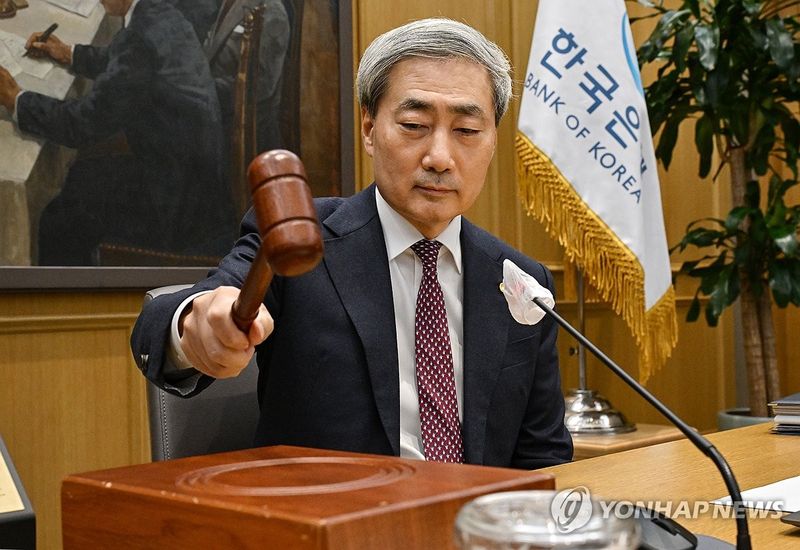
[Financial News] On the 26th, the Bank of Korea raised its base rate by 0.25 percentage points, from 3.00% to 3.25% per annum. It also sharply raised its economic growth forecasts for this year and next to 3.9% and 4.1%, respectively. It set its first-ever growth forecast for 2028 at 3.0%.
After two consecutive rate hikes in July and August, followed by a pause (hold) in October, the BOK has tightened the reins again, three months later. The base rate of 3.25% per annum is its highest level in two years, since November 2024.
The BOK held its final monetary policy direction-setting meeting of the year and decided to raise the rate with five of the seven Monetary Policy Board members in favor. The other two voted to hold. The decision continues the existing tightening stance and is in line with the general expectations of market experts.
The Monetary Policy Board said, “The domestic economy's growth momentum has strengthened further, while inflation is expected to remain above the target level for a considerable period.” It added, “With risks to financial stability also persisting, we judged it appropriate to raise the base rate by 0.25 percentage points.”
The rate hike is a preemptive measure to address unexpectedly strong growth driven by robust semiconductor exports and inflationary pressures above the 2.0% target. Real GDP growth surged to 1.8% in the first quarter, 0.6% in the second quarter and 1.0% in the third quarter, far exceeding the BOK's previous forecast. In addition, October consumer price inflation and core inflation, both at 2.8%, continued to rise at a high pace in the upper 2% range, creating conditions for a rate hike.
Stock-market volatility has increased recently, with the KOSPI falling below the 5,000 mark amid concerns over an AI bubble. However, the BOK is believed to have placed greater weight on curbing overheating in the real economy resulting from semiconductor performance bonuses paid by large companies and the government's large-scale expansionary fiscal spending, as well as on preventing inflation expectations from spreading.
In the revised economic outlook released alongside the decision, this year's growth forecast was raised to 3.9%, up 0.6 percentage points from the August forecast of 3.3%. Next year's (2027) forecast was raised to 4.1%, 1.2 percentage points above the previous forecast of 2.9%.
This is the first time in 16 years, since 2010–2012, that the South Korean economy has recorded real growth in the 3–4% range for three consecutive years. During the semiconductor supercycle, the economy recorded real growth of 3% for two consecutive years, at 3.4% in 2017 and 3.2% in 2018.
The growth forecast for 2028, released for the first time, was set at 3.0%. The BOK expects the 'trickle-down effect from semiconductors' to continue for at least three years and drive growth, as the recovery in facility and construction investment, among other factors, continues.
Consumer price inflation forecasts for this year and next were adjusted slightly to 2.7% and 2.4%, respectively, from previous forecasts of 2.7% and 2.3%. Inflation in 2028 is also forecast at 2.1%, close to the 2.0% target.
The BOK's slight upward revision to its inflation forecast for next year is seen as reflecting increased demand-side inflationary pressures, as robust exports led by AI semiconductors, expanded facility investment and expansionary fiscal policy converge.
[email protected] Jung Sang-gyun Reporter