Teen Smoking and Drinking Decline, Exercise Rises ... Breakfast Skipping at 44.6%
- Input
- 2026-11-26 12:00:00
- Updated
- 2026-11-26 12:00:07
[Financial News] Smoking and drinking among adolescents are down, while exercise is up. But more than four in 10 students skip breakfast, and one in two female students who drink consume at least three shots of soju at a time, the findings showed.
The Korea Disease Control and Prevention Agency will announce the results of the 2026 Youth Health Behavior Survey on the 27th. The survey was conducted from June 8 to July 10 this year among 53,181 students at 800 middle and high schools nationwide. The participation rate was 93.9%. An anonymous online survey covered 82 items across 14 areas, including smoking, drinking, physical activity, diet and mental health.
Alcohol use falls from 8.0% to 5.5% ... and alcohol and cigarettes are getting harder to buy
The current use rate for tobacco products was 3.3% (4.2% for boys and 2.3% for girls), continuing a steady decline since the indicator was introduced in 2019. Use of regular cigarettes (2.6%), liquid e-cigarettes (2.3%) and heated tobacco products (1.4%) all edged down from last year. However, among adolescents who use tobacco, the share using two or more types together rose 3.7 percentage points from last year to 65.1%.
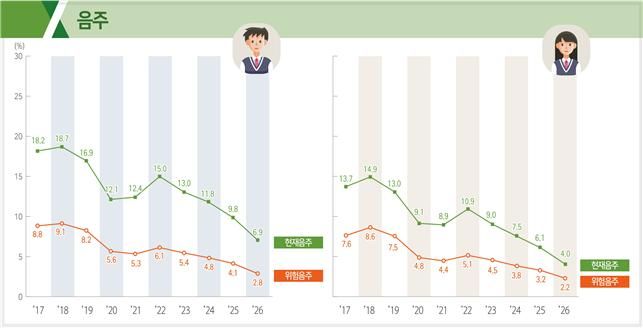
The current drinking rate fell 2.5 percentage points to 5.5%, from 8.0% last year. It declined among both boys and girls. The rate of risky drinking—defined as consuming five shots of soju at a time for boys and at least three for girls—also fell by 1.2 percentage points to 2.5%.
But a clear gender gap emerged when looking only at students who drink. The rate of risky drinking among current drinkers was 45.5%, similar to last year. The rate for boys fell 1.4 percentage points to 40.7%, while the rate for girls rose 2.5 percentage points to 54.5%.
The share of adolescents who had tried to buy cigarettes or alcohol and said they could do so easily fell sharply. The proportion saying tobacco was easy to buy was 57.8%, down 6.1 percentage points from 63.9% last year; the proportion saying alcohol was easy to buy was 55.0%, down 8.1 percentage points from 63.1%. The rate for girls fell by as much as 15.0 percentage points. Exposure to secondhand smoke indoors at home and in public places is also continuing to decline.
The share of students engaging in physical activity for at least 60 minutes a day on five or more days a week edged up for both boys (25.4%) and girls (9.4%), to 17.6% overall. The rate of engaging in vigorous physical activity at least three days a week rose 3.0 percentage points to 41.3%, from 38.3% last year. The rate of doing muscle-strengthening exercise at least three days a week increased 1.3 percentage points to 25.7%.
The gap persisted. Among middle school boys, the rate of engaging in physical activity for at least 60 minutes a day on five or more days a week rose markedly, from 23.5% in 2017 to 31.3% this year. Among high school girls, however, it remained at 5.9% in both 2017 and this year, unchanged for a decade.
44.6% of students skip breakfast ... less vegetables and fruit
The breakfast-skipping rate rose 1.0 percentage point from last year to 44.6%. The rate was higher among girls (47.0%) than boys (42.2%), and the increase was also larger for girls. The share eating fruit at least once a day was 17.4%, while the share eating vegetables at least three times a day was 11.3%; both edged down.
The share drinking sweetened beverages at least three times a week was 58.3%, unchanged from last year. The rate of consuming zero-sugar drinks rose 1.1 percentage points to 17.6%. Boys drank more than girls across all three categories: sweetened beverages, high-caffeine drinks and zero-sugar drinks.
The rate of experiencing feelings of depression fell from last year for both boys (19.8%) and girls (28.7%), to 24.2% overall. The perceived stress rate was 41.1%, similar to last year, but 50.1% of girls—one in two—said they felt a great deal of stress in their daily lives.
In the mental health areas examined in depth every three years, loneliness edged down from 18.1% in 2023, while subjective happiness rose 1.7 percentage points from 2023 to 59.5%. Smartphone overdependence fell 1.5 percentage points to 26.5%.
Lim Seung-gwan, commissioner of the Korea Disease Control and Prevention Agency, said, “Over the past decade, indicators for smoking and drinking among adolescents have fallen markedly, while rates of physical activity—particularly vigorous exercise—have risen, pointing to an overall improvement in health behaviors.” He added, “However, the multiple use of tobacco products, risky drinking among female students, and the increase in breakfast skipping are areas that require in-depth policy intervention by gender and school level.” He continued, “We will work closely with relevant ministries, including the Ministry of Education, to actively support tailored policies addressing adolescents’ physical and mental health.”
The survey’s statistical report and raw data will be made available in December on the Korea Disease Control and Prevention Agency’s Youth Health Behavior Survey website.
[email protected] Jung Myung-jin, medical correspondent Reporter