“Before the Vector Insects Become Active”... South Chungcheong Steps Up Pine Wilt Disease Control on the West Coast
- Input
- 2026-11-26 14:26:39
- Updated
- 2026-11-26 14:26:39
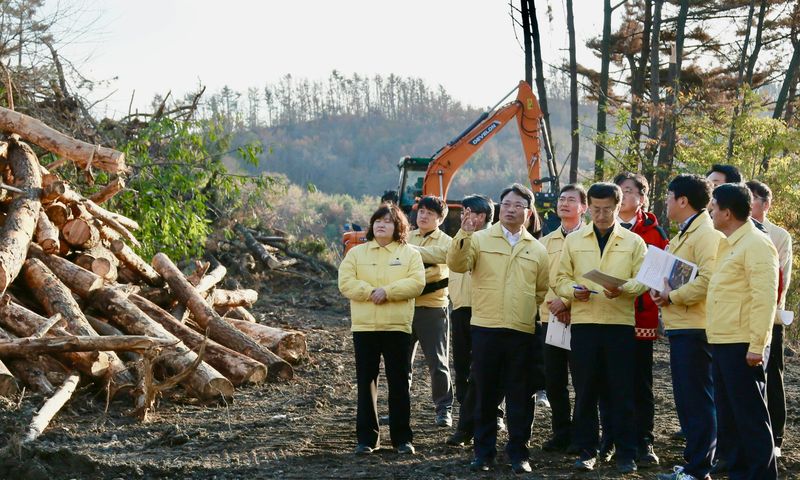
As pine wilt disease spreads rapidly across South Chungcheong Province, the provincial government, local city and county governments, and the Korea Forest Service are stepping up control efforts, focusing on affected areas along the West Coast. The provincial government has activated an all-department task force directly led by the governor, while the KFS has adopted an industrialized control approach as part of its plan to build a “national control belt” linking the West Coast with inland areas, in an effort to stop the spread.
92.7% concentrated on the West Coast... cumulative total near 900,000 trees
According to the South Chungcheong provincial government on the 26th, 139,922 pine trees in the province were infected as of the end of May this year, more than 26 times the 5,331 trees affected over the whole of last year. The cumulative number of affected trees requiring control across all 15 cities and counties is estimated at around 900,000. Damage is concentrated along the West Coast. Four cities and counties—Taean (34,783 trees), Boryeong (31,751), Seocheon (31,427) and Cheongyang (31,717)—account for 92.7% of the total. In Seocheon, the number of dead trees affected stood at 32,923 as of the end of September, 32 times the 1,028 recorded the previous year.Governor in charge... “tailored control” through next April
South Chungcheong Province has raised its response to the highest level. Governor Park Su-hyeon will head the regional control task force, which is being expanded and will operate from this month through May 31 next year, and will review progress in each city and county every week. The goal is to complete intensive control by the end of April next year, before the insect vectors become active.The province is also implementing its “South Chungcheong-style control strategy,” which varies the response according to the degree of damage. Control resources will be concentrated in Taean, Boryeong, Seocheon and Cheongyang, while preventive tree injections will be expanded in Seosan, Hongseong and Yesan to prevent further infections. Drones and aerial and ground surveillance will be used to detect newly affected trees early, and the province will work with the police to crack down on the illegal movement of pine trees. Regional councils involving military units, national parks, forestry cooperatives and residents will also be formed to reduce gaps in surveillance.
KFS’s “double line of defense”... blocking the spread inland
Since August, the KFS has successively designated Taean, followed by Boryeong, Seocheon and Cheongyang, as special control zones, strengthening national support for year-round preventive measures and mechanized operations. In addition, under its national control strategy, it plans to build a national control belt along the West Coast as a double-layered defense system. The plan is to establish operational and buffer zones within 2 km of the leading edge of affected areas and create a “safe control zone” at least 2 km wide along the outermost perimeter, using tree-species conversion, tree injections and heavy thinning to block the spread inland.The KFS has also introduced an industrialized control method that moves beyond simply disposing of affected trees through fumigation or burning and instead recycles them as resources for the wood industry, including lumber, boards and energy fuel. The aim is to speed up control despite budget and staffing constraints while turning affected trees into high-value resources, delivering both economic benefits and carbon-neutrality gains.
KFS Chief Park Eunsik said, “It is of utmost importance to establish a dedicated organization and develop a control strategy suited to local conditions.” He added, “We will do our utmost to combine local governments’ participation with support at the national level so that more areas can make a clean transition.”
Meanwhile, this year’s control budget for South Chungcheong Province totals 46 billion won, including 17 billion won in national funding and 29 billion won in local funds. To secure stable funding, the province asked the KFS to include 20 billion won in next year’s national budget. It also requested cooperation on a pilot program for aerial control in provincial forests and provincial parks, as well as an amendment to the Special Act, subject to reviews of ecosystem impacts and resident safety.
[email protected] Kim Won-jun Reporter