As Semiconductor Stocks Falter, Healthcare Comes Into Focus... Hanwha Global Healthcare Fund Ranks No. 1 in Returns
- Input
- 2026-11-26 09:05:43
- Updated
- 2026-11-26 09:05:43
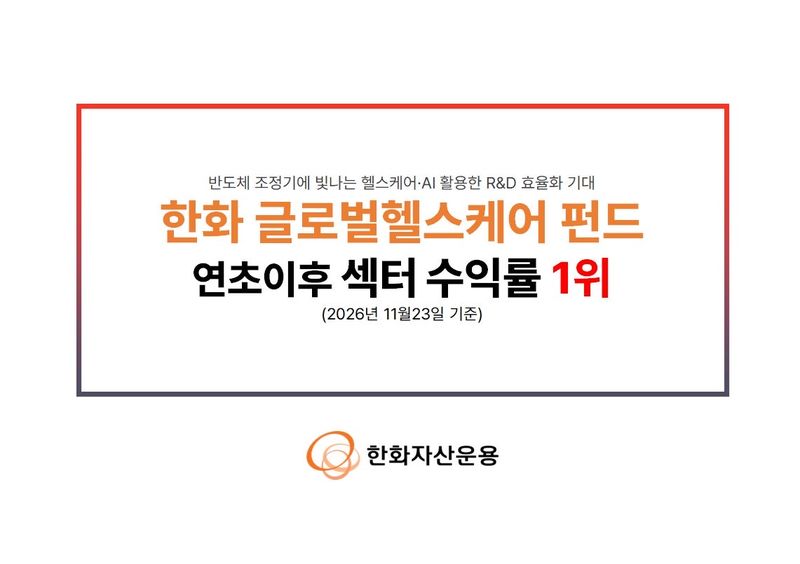
According to Hanwha Asset Management Co., Ltd. on the 25th, based on figures compiled by fund evaluator KG Zeroin, the Hanwha Global Healthcare Fund had a year-to-date return of 6.90% as of the 23rd, the highest among funds in the same category. Its return over the past six months was also the highest, at 10.92%. Its one- and three-year returns were 8.72% and 25.44%, respectively, both ranking second. These figures are for the master fund.
The healthcare sector has recently delivered relatively strong returns in global stock markets. According to Bloomberg, as of the 23rd, the U.S. healthcare sector was up 10.76% year to date, outperforming the S&P 500 by about 5 percentage points.
Healthcare funds have often begun to rise during past corrections in semiconductor stocks as well. Hanwha Asset Management Co., Ltd.'s analysis of 17 periods of gains since the fund was launched found that 12 (71%) began when the Philadelphia Semiconductor Index had fallen 15% or more from its peak. Those upswings lasted around eight months on average.
Launched in July 2006, the Hanwha Global Healthcare Fund invests across medical devices, life sciences tools and services, and healthcare management companies, with a focus on pharmaceutical and biotechnology firms. As of the 23rd, pharmaceuticals and biotechnology accounted for about 66% of the fund, which invests in areas expected to see structural growth, such as treatments for obesity and diabetes, new drugs for immune diseases, and anticancer drugs.
Improvements in research and development (R&D) efficiency through the use of AI are also cited as a growth driver for the healthcare sector. This is because AI is being used in an expanding range of areas, from discovering drug candidates to selecting clinical trial participants, diagnosis, and production optimization. Unlike big tech companies, which bear the direct costs of building AI infrastructure, healthcare companies can use AI to reduce the time and cost of research and development, according to the analysis.
Wang Seung-muk, head of the overseas equities management team at Hanwha Asset Management Co., Ltd., said, “Global healthcare is a defensive sector with stable earnings and cash flow, while also being a growth industry that can use AI to improve efficiency in new drug development and clinical trials.” He added, “We plan to manage the portfolio with a focus on companies that combine innovative new drugs with robust cash flow.”
[email protected] Bae Han-geul Reporter