Eight in 10 Sejong Apartment Applicants Choose 'National-Standard' Units ... 1.9 Times the National Share
- Input
- 2026-11-26 08:55:55
- Updated
- 2026-11-26 08:55:55
According to Real Estate R114 on the 26th, of the 10,404 first-priority applicants for three complexes supplied in Sejong from January last year through October this year, 8,565 (82.3%) applied for national-standard units with an exclusive floor area of 84 to 85 square meters, inclusive. That was about 1.9 times the national subscription share of 44.3%.
Nationwide, too, national-standard units attracted the most applicants among the different floor-area bands. Of 1,186,509 first-priority applicants overall, 525,455 applied for these units—about 210,000 more than the 310,188 who applied for units with an exclusive floor area of 59 square meters. During the same period, national-standard units accounted for 117,285 of the 190,209 homes in the nationwide general supply, or 61.7%.
Although supply in Sejong was concentrated on national-standard units, subscription demand was even more concentrated than their share of supply. National-standard units accounted for 78.7% of the general supply but 82.3% of applications. Their first-priority competition rate was also 14.87 to 1, exceeding the combined rate of 11.79 to 1 for other sizes.
A similar pattern emerged over a longer period. From 2022 through October this year, 19,508 of Sejong's 29,335 first-priority applicants overall applied for national-standard units, accounting for 66.5%. That was higher than their 61.4% share of supply over the same period. The competition rates were 25.47 to 1 for national-standard units and 20.39 to 1 for other sizes.
Sejong's population and household makeup are cited as the basis for this demand. According to resident registration population statistics from the Ministry of the Interior and Safety, Sejong's average age in October this year was 40.1, the lowest among metropolitan-level local governments nationwide. That was 6.2 years below the national average of 46.3.
According to the Ministry of Data and Statistics' 2025 Social Indicators of Korea, the average household size in Sejong in 2024 was 2.4 people, above the national average of 2.2. Households with four or more members also made up 21.6%, higher than the national average of 16.0%. Both figures were among the highest nationwide.
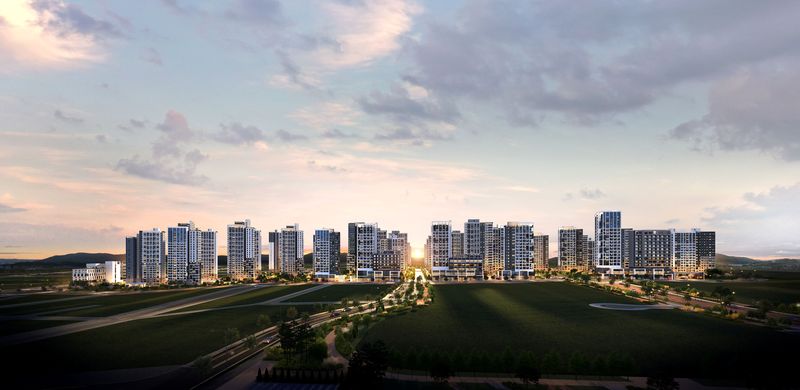
Meanwhile, the Sejong Smart City L Sujain complex, developed by Sejong Smart City and built by BS Hanyang, is set to be offered this month. It is the first complex to be supplied in the lead district of the Smart City National Pilot City, and all 2,191 apartments will have an exclusive floor area of 84 square meters. Features such as four-bay layouts and terraces are planned, depending on the unit type.
The complex plans to introduce service robots, patrol robots, robot delivery and smart parking in stages. Life Cube, a separate paid residential-services space, is to offer personalized health management, a smart farm and a shared kitchen, among other services.
Community facilities—including a fitness center, golf practice range, Pilates room, small library, study room, kids' cafe and shared office—will be developed to suit the characteristics of each complex. Planned sites for kindergartens and elementary, middle and high schools are nearby, and commercial and medical facilities are also planned. The Geum and Miho rivers are close by, and parks and green spaces within the residential area are also slated for phased development.
[email protected] Choi Ga-young Reporter