[Exclusive] Out-of-Towners Win 4 in 10 Seoul Home Auctions... Buyers Came Up From Daegu, Too
- Input
- 2026-11-29 14:21:03
- Updated
- 2026-11-29 14:21:03
On the 29th, Financial News analyzed applications for ownership-transfer registration in voluntary auctions from the Supreme Court Registration Information Plaza. Of the 2,231 purchases of multi-unit buildings in Seoul from January through October this year, 864, or 38.7%, were by nonlocals whose registered addresses were in other cities or provinces. Multi-unit buildings include apartments, row houses, multi-family homes and officetels.
During the same period last year, Seoul recorded 2,310 purchases in total, including 752 by nonlocals. The total number of purchases this year fell by 79, or 3.4%, from last year, but purchases by nonlocals rose by 112, or 14.9%. The nonlocal share also increased by about 6 percentage points, from 32.6% to 38.7%.
Purchases of multi-unit buildings in Seoul through out-of-town auctions rose each year, from 297 in 2022 to 471 in 2023, 793 in 2024 and 871 last year. This year, the figure reached 864 through October, just seven below last year’s full-year total. With two months of data still to come, eight or more additional purchases in November and December would set a record high since 2022.
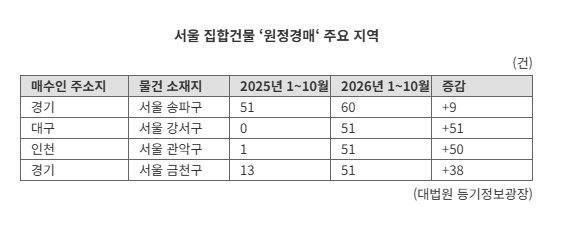
By buyers’ registered addresses, Gyeonggi Province accounted for 455 purchases, or more than half (52.7%) of all purchases by nonlocals. Matching buyers’ registered addresses with Seoul’s districts, the most common pairing was buyers from Gyeonggi Province acquiring properties in Songpa District, with 60 purchases. Acquisitions in Gangseo District by buyers from Daegu, in Gwanak District by buyers from Incheon, and in Geumcheon District by buyers from Gyeonggi Province each totaled 51.
One reason auctions have drawn attention as a way to buy property in Seoul is that their owner-occupancy requirements differ from those for ordinary sales. Under last year’s October 15 housing market stabilization measures, the designation of all 25 Seoul districts as land transaction permit zones took effect on October 20 last year. To buy an apartment subject to the permit requirement through an ordinary sale, buyers must obtain approval from the head of the relevant district office and, in principle, move in within four months of the approval date and live there for two years.
Court auctions, by contrast, are exempt from the land transaction permit requirement. In addition, if a buyer acquires a property at auction without a loan to fund the purchase, the system’s owner-occupancy requirement does not apply, leaving room to use the property for rentals or other purposes. This means nonlocal buyers can hold a property without moving in themselves.
Professor Ko Jun-seok of Yonsei University’s Sangnam Institute of Management said, “Recently, I’ve often seen people from outside Seoul, including Daegu and Busan, take an interest in Seoul auctions.” He explained, “Because buyers have to secure the funds without a loan to avoid the owner-occupancy requirement, there’s a lot of interest in auctions in the Gangbuk region, where prices are lower than in the Gangnam area.” He added, “Another advantage is that buyers don’t have to submit a funding plan.”
[email protected] Choi Ga-young Reporter