Kim Jong Un Condemns U.S. for 'Transplanting Nuclear Proliferation to Northeast Asia'... Issues Indirect Warning Over South Korea's Nuclear-Powered Submarine
- Input
- 2026-11-26 07:23:31
- Updated
- 2026-11-26 07:29:51
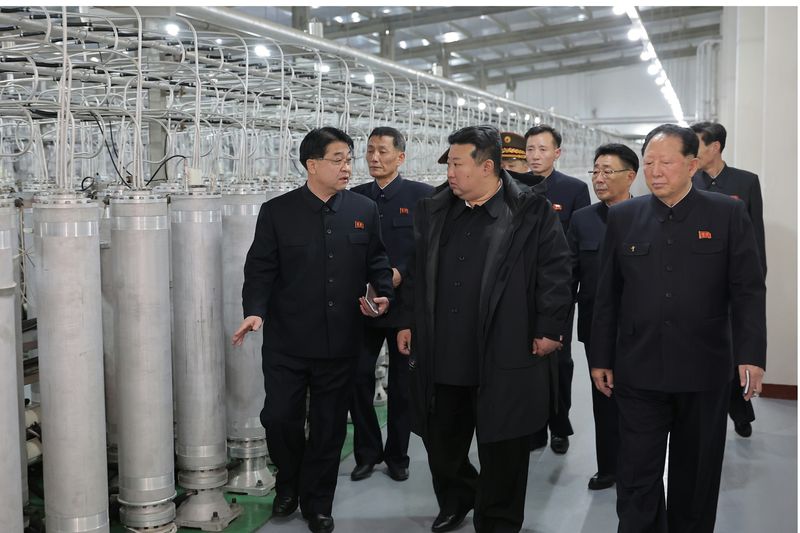
North Korean media reported on the 26th that Kim made the remarks while conducting on-site guidance at a nuclear facility. His visit has drawn attention because it took place just after North Korea-U.S. talks fell through.
According to the Korean Central News Agency (KCNA) that day, Kim conducted on-site guidance on work in the nuclear material production and nuclear weapons research sectors on the 25th. He claimed the visit was intended to address the unstable nuclear threats emerging on the Korean Peninsula against the backdrop of serious geopolitical changes recently detected in the international nuclear security framework.
Kim claimed that the United States was “transplanting wholesale into Northeast Asia the dangerous example of nuclear proliferation through AUKUS,” and that it was “encouraging its followers to acquire nuclear submarines and pursuing nuclear sharing and the joint use of nuclear weapons with its allies, thereby building a system of nuclear military alliances on a global scale, including in the Asia-Pacific region.” AUKUS is a security partnership among the United States, the United Kingdom and Australia in the Indo-Pacific region, and the three countries are cooperating on the development of nuclear submarines for Australia. The remarks appear to be a reaction to the South Korean government's move to acquire nuclear-powered submarines in cooperation with the United States.
Kim said, “The stark reality of an armed external enemy and our retaliatory, self-defensive nuclear weapons are inextricably linked.”
He also claimed that anyone who tried to deny or usurp its constitutional status would be demanding the abandonment of its constitution and system, in what would be the most egregious violation of sovereignty and interference in internal affairs. He threatened to regard such an act as an open declaration of war and the party responsible as an enemy.
Kim also reviewed activities in the nuclear material and nuclear weapons production sectors for 2026, aimed at implementing the nuclear strategy plan set out by the 9th Congress of the Workers' Party of Korea. He emphasized strengthening North Korea's nuclear capabilities, including multi-domain tactical nuclear weapons. North Korean media reported that the country would further accelerate the exponential quantitative upgrading of its self-defensive nuclear capabilities.
The international community has continued to express concern over North Korea's advances in nuclear weapons. Earlier, International Atomic Energy Agency (IAEA) Director General Rafael Mariano Grossi said on the 18th (local time), “Additional expansion work at the existing Nyongbyon enrichment facility has been underway since mid-September 2026, and exterior work on the new extension building was completed around the end of last month.” He added, “North Korea's continued expansion of its uranium enrichment program remains a serious concern.”
Grossi also said that the 5-megawatt (MW) reactor at Nyongbyon, which North Korea uses to extract plutonium from spent nuclear fuel, was probably still operating, and that signs had been observed that it had entered its seventh irradiation cycle. Once the cycle is complete, spent nuclear fuel will be removed from the reactor for reprocessing.
Grossi also added that another facility at Nyongbyon, a light-water reactor, appeared to have been operating continuously since April this year. North Korea, which faces numerous United Nations (UN) sanctions over its illegal weapons development, is believed to be operating uranium enrichment facilities in Nyongbyon, Kangson, Kusong and elsewhere.
However, IAEA inspectors have been unable to access North Korea since 2009 and are monitoring its nuclear program using satellite imagery and publicly available information.
[email protected] Kim Kyung-soo Reporter