South Korea Can't Feel Safe Even With 15% Tariffs... U.S. Takes Aim at Its Entire Economic Structure
- Input
- 2026-11-26 07:02:36
- Updated
- 2026-11-26 07:02:36

【Financial News, New York—Correspondent Lee Byung-chul】 The United States proposed a tariff rate of up to 15% for South Korea but took aim squarely at its export-led economic growth model. In an investigative report on structural overproduction, the U.S. government took issue with the overall structure of the South Korean economy, including not only key industries such as semiconductors and automobiles, but also policy financing by state-run banks, workers' wages, domestic consumption and imports of Chinese-made intermediate goods. It also left open the possibility of raising the tariff rate to as high as 25%, depending on the outcome of future consultations.
South Korea's manufacturing share is 3 times the U.S. figure; exports are 5 times as high
The Office of the United States Trade Representative (USTR) announced on the 25th (local time) a plan to impose tariffs to address structural overproduction in 14 countries and economic blocs, including South Korea, China, Japan and the European Union (EU). For South Korea, it proposed a tariff rate of up to 15% under the existing South Korea–United States trade agreement. It said it would also consider raising the rate to as high as 25% if it determines that future consultations and implementation of the existing agreement are inadequate.
In an investigative report under Section 301 of the Trade Act of 1974, released alongside the announcement, the USTR claimed that South Korea is expanding its manufacturing capacity beyond market demand through government support. It singled out pronounced signs of structural overproduction in South Korea's leading export industries, particularly automobiles, semiconductors and petrochemicals.
The USTR identified as causes of overproduction the South Korean government's plans to expand production and exports by industry, preferential loans through state-run banks, the maintenance of production capacity regardless of market conditions, inadequate responses to imports and investment from non-market economies such as China, and insufficient protections for foreign workers.
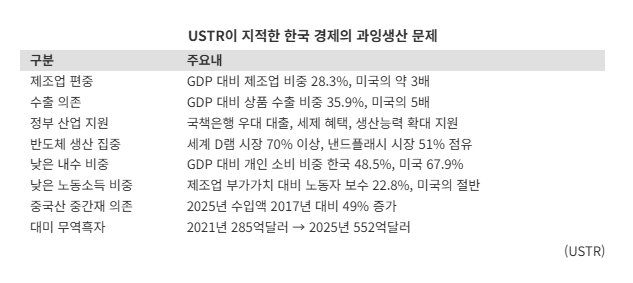
According to the USTR, from 2021 to 2025, manufacturing accounted for an average of 28.3% of South Korea's gross domestic product (GDP), about three times the U.S. share (9.9%). Goods exports accounted for 35.9% of South Korea's GDP, more than five times the U.S. figure (7.1%). By contrast, personal consumption accounted for 48.5% of South Korea's GDP, 19.4 percentage points below the U.S. figure (67.9%). From 2021 to 2023, labor compensation accounted for an average of 22.8% of manufacturing value added in South Korea, about half the U.S. share.
The USTR said the South Korean government had focused on increasing manufacturing output and exports while neglecting to boost domestic consumption and workers' wages. It claimed that South Korea artificially kept wages low to reduce companies' production costs and boost export competitiveness, while lowering people's purchasing power and curbing consumption growth.
Concentrated memory chip production in South Korea poses an economic security risk
The USTR cited South Korea's First Basic Plan for Fostering National Strategic Technologies (2024–2028), K-Semiconductor Belt Strategy, Future Mobility Industry Development Strategy 2030 and 123 major national policy tasks as examples of government-led efforts to expand production and exports.
It noted in particular that Samsung Electronics and SK hynix, the two semiconductor companies, account for more than 70% of the global DRAM market and 51% of the NAND flash market. It said South Korea's dominance in the memory chip market is sustained by excessive government support, including aggressive export growth targets, tax incentives, infrastructure development and regulatory reform.
The USTR also took issue with the South Korean government's goal, set through the K-Semiconductor Belt Strategy, of cementing its position as the world's leading memory chip market and doubling semiconductor exports from $100 billion in 2020 to $200 billion in 2030. It also said that memory chip production facilities concentrated in South Korea could pose an economic security risk to the United States.
The USTR said, “The high concentration of memory chip production in South Korea could become a bottleneck in the supply chain if natural disasters or other production and logistics disruptions occur.”
Imports of Chinese-made intermediate goods by South Korea and investment in South Korea by Chinese companies also came under scrutiny. According to the report, in 2025 South Korea's imports of Chinese-made intermediate goods were $30 billion (49%) higher than in 2017. Imports of Chinese-made capital goods, including machinery and production equipment, also rose by $4 billion (25%) over the same period. The USTR claimed that the surge in imports of Chinese-made intermediate goods not only distorts competition in the South Korean market but also artificially boosts the competitiveness of South Korean products made using them.
The USTR said, “South Korea has largely failed to control foreign direct investment (FDI) from China,” adding, “This has enabled China to shift its excess production capacity and output overseas through South Korean industries.”
U.S.: “South Korean industrial policy reduces U.S. jobs and investment”
The USTR claimed that South Korea's industrial policy harms the United States in three ways: by reducing business opportunities for U.S. companies, lowering U.S. manufacturing output and exports, and heightening economic security risks.
South Korea's goods trade surplus with the United States rose by about 94% in just four years, from $28.5 billion in 2021 to $55.2 billion in 2025. The USTR said the widening surplus was driven by industries such as automobiles, information and communications technology (ICT), machinery and chemicals, which benefit directly or indirectly from the South Korean government's industrial policies.
The USTR claimed that as South Korean companies artificially increase production and exports, U.S. companies are losing sales opportunities and revenue not only in the United States but also in South Korea and third-country markets. It said this leads to lower profitability for U.S. companies, reduced investment in production facilities and technological innovation, fewer jobs and lower wages.
It said the decline of U.S. manufacturing leads to the collapse of the manufacturing ecosystem and the loss of specialized skills, skilled workers and know-how, weakening even the country's future capacity for innovation and potential for economic growth.
The USTR concluded that, because South Korea's policies and practices related to structural overproduction are unreasonable and harm U.S. economic activity, there are grounds for taking countermeasures such as tariffs.
[email protected] Correspondent Lee Byung-chul Reporter