One Day Soars, the Next Plunges ... 102 Sidecar Activations Leave Retail Investors Reeling
- Input
- 2026-11-26 04:20:00
- Updated
- 2026-11-26 04:20:02
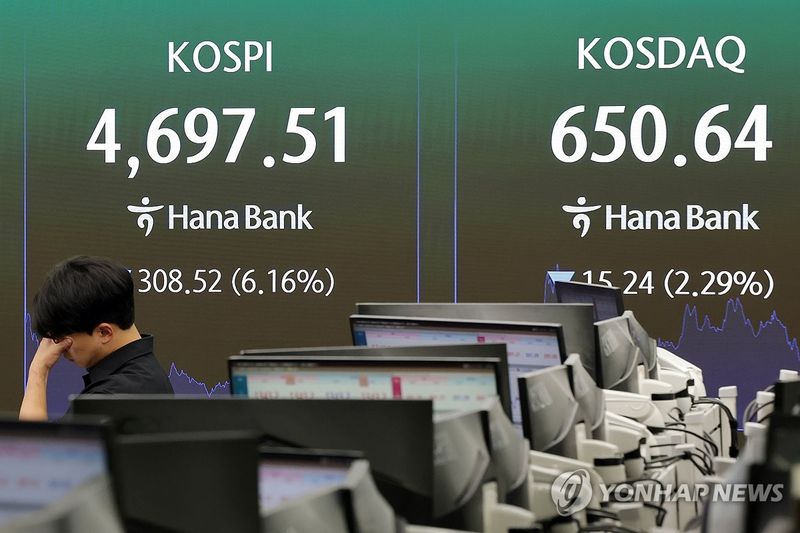
[Financial News] As domestic stock markets have seen extreme volatility, a total of 102 sidecars have been triggered this year on the KOSPI and KOSDAQ markets. Buy-side and sell-side sidecars each accounted for exactly half, with 51 apiece. After surging more than 6% the previous day, the KOSPI plunged at least 6% again on the 25th, even falling below the 4,700 level.
According to the Korea Exchange (KRX) on the 25th, the KOSPI opened at 4,809.00, down 197.03 points (3.94%) from the previous trading day. The decline exceeded 5% shortly after the opening, triggering a sell-side sidecar on the securities market at around 9:08 a.m.
Large-cap stocks, including Samsung Electronics and SK hynix, fell sharply amid a plunge in US semiconductor stocks and uncertainty surrounding Nvidia. The KOSPI eventually closed at 4,697.51, down 308.52 points (6.16%) from the previous trading day.
This year, domestic stock markets have repeatedly risen and fallen, and sidecar activations—which temporarily halt the effectiveness of trading quotes—have also increased sharply. A sidecar is a mechanism designed to ease sharp market fluctuations by temporarily suspending program-trading orders when futures prices move abruptly by at least a set threshold.
Through this morning, a total of 62 sidecars had been triggered on the securities market: 29 buy-side and 33 sell-side. On the KOSDAQ market, 40 were triggered in total, including 22 buy-side and 18 sell-side sidecars.
Combined, the two markets saw 51 buy-side and 51 sell-side sidecars, each accounting for half of the total 102. Conditions meeting the requirements for sidecar activation repeatedly occurred during both sharp rises and steep falls in stock prices.
Sharp stock price swings have continued in recent trading sessions. After plunging 5.21% on the 20th, the KOSPI rose 6.32% on the 24th, buoyed in part by news of Nvidia CEO Jensen Huang’s return. A buy-side sidecar was triggered that day.
But the following day, the 25th, selling pressure surged from the opening, triggering a sell-side sidecar. The KOSPI not only fell back below the 5,000 mark it had regained the previous day, but also gave up all of its gains.
Heavy selling by foreign investors also contributed to the index’s decline. By the market close, foreign investors had sold a net approximately 1.9 trillion won on the securities market, shifting back to net selling in just one day. Individual investors, by contrast, bought a net approximately 1.4 trillion won.
The decline in domestic stock markets is also believed to have been driven by falling US tech stocks. On the 24th (local time), the Nasdaq Composite Index fell 1.48% in the New York stock market, while the PHLX Semiconductor Sector Index (SOX), comprising major semiconductor companies, plunged 7.88%.
Meanwhile, although Jensen Huang has returned to management, uncertainties surrounding Nvidia remain, including the prospect of a US Senate hearing and an accounting investigation by authorities.
Investor anxiety is believed to have grown amid speculation that the US government may soon announce “overproduction tariffs” and impose high tariffs on Chinese-made products.
[email protected] Han Seung-gon Reporter