“Retail Investors in Samsung Electronics and SK Hynix Cry Out Again” ... KOSPI Falls Below the 4,700 Mark, Too
- Input
- 2026-11-26 06:00:00
- Updated
- 2026-11-26 06:00:17
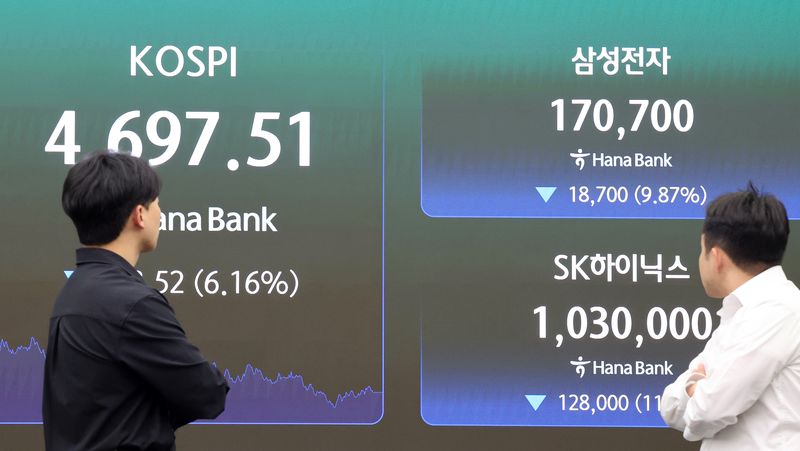
[Financial News] Samsung Electronics and SK Hynix, which had surged on news of Nvidia CEO Jensen Huang’s return, plunged by around 10% in a single day. With the two semiconductor heavyweights giving back all of the previous day’s gains, the KOSPI also fell more than 6%, dropping below the 4,700 mark.
According to the Korea Exchange (KRX) on the 25th, Samsung Electronics closed at 170,700 won, down 9.87% from the previous trading day. After opening down more than 5%, the stock’s losses widened to as much as 10.24% intraday, taking it down to 170,000 won. Its market capitalization also fell below 1 quadrillion won.
SK Hynix fell more sharply than Samsung Electronics. Its share price dropped more than 11.30% intraday, falling to around 1.02 million won, and ultimately closed at 1.03 million won, down 11.05% from the previous trading day. After breaking below the 1.1 million won mark, it is now at risk of falling below the 1 million won mark as well.
With the semiconductor heavyweights plunging in tandem, the KOSPI closed at 4,697.51, down 308.52 points (6.16%) from the previous trading day. It had surged 297.49 points (6.32%) on the 24th, reclaiming the 5,000 mark, but gave back all of those gains in a single day and fell further.
The KOSPI, which had earlier plunged below the 4,600 mark intraday on the 23rd, rebounded the previous day on news of CEO Huang’s return. But after U.S. semiconductor stocks plunged again, it failed to hold even the 4,700 mark.
Heavy foreign selling also contributed to the index’s decline. Foreign investors recorded net sales of about 1.9 trillion won on the KOSPI market that day. Individual investors stepped in to buy, but their buying was not enough to absorb the foreign selling.
Even with CEO Huang’s return, uncertainty surrounding the artificial intelligence (AI) industry remains unresolved. Analysts say that the possibility of tighter data-center regulations by U.S. Democrats and restrictions on semiconductor exports to China are weighing on investor sentiment.
Adding to concerns, global investment bank BNP Paribas reportedly raised the prospect of a memory-chip supply glut and falling prices in 2028, and cut its price target for Micron Technology by 54%. The prospect of a slowdown in the memory market has heightened investors’ anxiety.
Indeed, on the 24th (local time), shares of major semiconductor companies all fell on the New York stock market. Nvidia dropped 5.86%, AMD 8.86%, and Micron Technology 11.01%. The PHLX Semiconductor Sector Index (SOX) also plunged 7.88%.
Anthropic’s share price continued to fall after its initial public offering (IPO), dropping below its offering price and adding to concerns about the AI industry’s high valuations. The Trump administration’s signal that it may impose additional tariffs is also believed to have weighed on the stock market.
Kang Jin-hyuk, a senior researcher at Shinhan Investment & Securities, said, “With foreign investors returning to net selling, it is questionable whether a rebound driven by supply-and-demand dynamics can continue,” adding, “While stocks with the largest market capitalizations are underperforming, declines among individual stocks are limited.”
Meanwhile, investors are also watching for the release of the U.S. October personal consumption expenditures (PCE) inflation data. The Core PCE Price Index, which the Federal Reserve System (Fed) uses as a reference when setting monetary policy, is expected to rise 0.3% from the previous month.
If the actual increase exceeds market expectations, inflation concerns could intensify again, weakening expectations for rate cuts or bringing the possibility of a benchmark interest rate hike into focus, which could put further pressure on the stock market.
[email protected] Han Seung-gon Reporter