Roh Soh-yeong Rejects Chey Tae-won's Request for a Court-Recommended Settlement: "If You Are Sincere, Withdraw Your Appeal"
- Input
- 2026-11-25 21:25:03
- Updated
- 2026-11-25 21:25:03
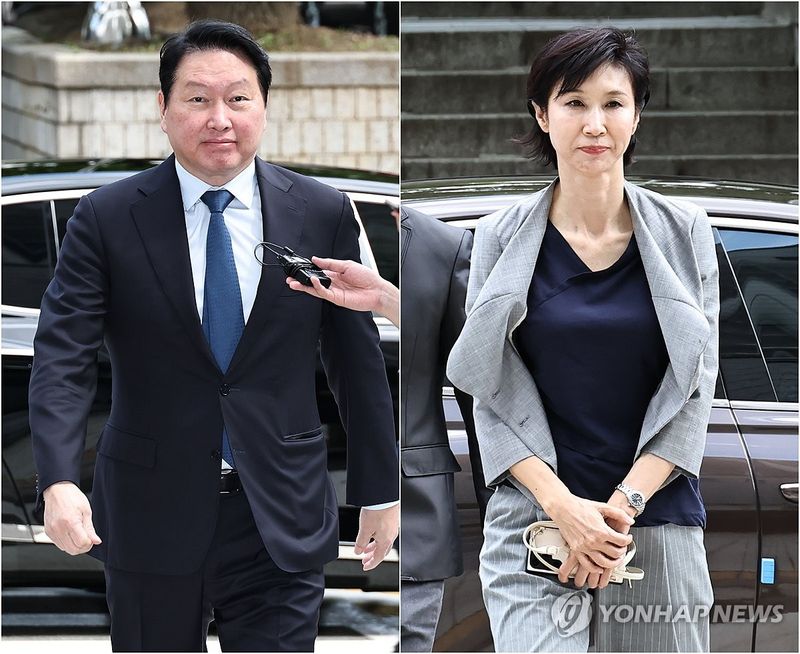
[Financial News] Roh Soh-yeong, 65, director of Art Center Nabi, who is involved in a property division lawsuit with SK Group Chairman Chey Tae-won, 66, rejected Chey's side's request for a court-recommended settlement, saying, "If you are sincere about an early resolution, withdraw your appeal."
Roh's attorney said a statement submitted to the court on the 25th stated that Roh did not agree to Chey's side's request. On the 23rd, Chey's side asked the Supreme Court of Korea's Second Division, which is hearing the further appeal, to issue a court-recommended settlement decision. Justice Kim Seong-su is handling the case. Chey's side said it was willing to pay in full the 944 billion won in property division set by the remand trial in July this year. A court-recommended settlement decision has the same effect as a final judgment if the parties do not object within two weeks of receiving it. Observers say the chances of such a decision being issued have become slim after Roh stated her opposition.
Roh's attorney said that, considering the time needed to draft and serve the decision and the period for filing an objection, even a court-recommended settlement would take at least a month, adding, "If they want a quick resolution, they can withdraw the appeal and have the judgment finalized immediately." The attorney also said it was rare for a party to request a decision directly.
In a brief, Roh's side argued that Chey's side had unilaterally made the request without consent, including a payment-deferral provision and settlement and no-suit provisions that were not part of the remand judgment. It also questioned whether Chey's side was trying to secure a so-called "psychological victory" by invoking the form of a settlement, or to prevent an additional property-division claim because it had hidden assets. Roh's side then asked the court to summarily dismiss the further appeal without review.
Chey's side expressed regret, saying it was dismayed that its sincerity had been questioned and the purpose of its proposal disparaged. It said the proposal was made in a broad-minded effort to resolve the dispute completely, despite the many issues still open to legal challenge. It also said, "If you agree to the court-recommended settlement, the case could be concluded as early as this week, and you could receive the amount you want," and called the demand that Chey withdraw his appeal a one-sided claim. Chey's side added that he would participate faithfully in the remaining proceedings and work toward an amicable resolution.
The two sides are expected to continue their dispute in the further appeal proceedings. If Chey withdraws his appeal, the remand judgment would become final, providing for payment of 944 billion won in cash and dividing the assets one-third to Roh and two-thirds to Chey. That would bring an end to about nine years of legal battles.
The two married in September 1988 and had three children, but their legal battle began in 2017 when Chey filed for divorce mediation. The court of first instance treated the SK shares as Chey's separate property and awarded 100 million won in compensation for emotional distress and 66.5 billion won in property division. In May 2024, the second-instance court recognized former President Roh Tae-woo's "30 billion won slush fund" and Roh's contribution, increasing the awards to 2 billion won in compensation for emotional distress and 1.3808 trillion won in property division. In October last year, the Supreme Court of Korea ruled that the slush fund, as illicit funds, could not be considered a contribution, and overturned and remanded the property-division portion of the ruling; the compensation for emotional distress was finalized. Chey challenged the remand ruling in a further appeal, but later narrowed the scope of his appeal, saying he would contest only 244 billion won of the 944 billion won. Roh did not file a cross-appeal.
[email protected] Lee Chang-hoon Reporter