In-Shoe Insole Distinguishes Walking, Running, and Climbing Stairs [Unboxing Lab]
- Input
- 2026-11-26 05:56:00
- Updated
- 2026-11-26 05:56:03
Do you remember the excitement of opening a delivery box? Astonishing discoveries that could change our lives are emerging from university labs even as we speak. They are simply wrapped in thick packaging called “academic papers.” In the Unboxing Lab, instead of complex equations and theories, we’ll pick out and share just the substance you want to know. So, shall we open the box? Today’s research is what we’re unboxing.
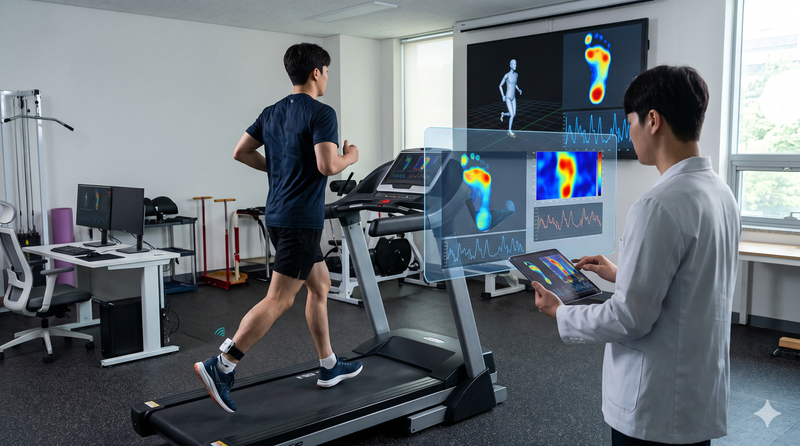
When we walk, run, or climb stairs, different pressures are generated on the soles of our feet for each activity. By reading these signals precisely, it may eventually be possible to record and analyze everyday gait simply by putting an insole in a shoe, without separate, complex equipment.
The technology is also expected to be useful for monitoring patients’ recovery during rehabilitation and analyzing athletes’ movements. It could also serve as a human-machine interface (HMI). The research team plans to improve the design so it can detect even finer pressure changes and shear forces, broadening its applications to robotic tactile sensors and haptic interfaces. However, the study demonstrated only that the system could distinguish eight everyday activities; further validation is needed before it can be used in actual rehabilitation and sports settings.
Methods already used to analyze movement include attaching sensors to joints or recording people with external cameras. However, some sensors containing rigid components did not conform well to the body’s curves and could come loose due to sweat or impact. Camera-based methods were also limited by the space available for filming, and measurements became difficult when objects obstructed the view of the body.
Insole-shaped sensors designed to address these limitations have been studied, but when made of soft materials, they had a “blind spot” in which signals barely changed under light pressure, making it difficult to distinguish movements precisely.
■ Soft Protrusions That Concentrate Force Like a High Heel
To maintain flexibility while increasing sensitivity, the research team combined liquid metal with silicone protrusions. The design allows liquid metal—an alloy of gallium and indium that remains liquid at room temperature and conducts electricity well—to flow through narrow channels inside the silicone. When a foot presses down on the insole, the channels deform and their cross-sectional area shrinks. This makes it harder for electricity to flow, increasing electrical resistance. Pressure is determined by measuring this change in resistance.
The problem was that even when pressed, the soft silicone itself did not compress easily, so the force was dispersed around it. In a flat structure, even when a light force was applied, the shape of the liquid-metal channels did not change enough.
The team focused on the principle that pressure increases when force is concentrated on a small area, as with a high heel. They placed soft silicone protrusions 1–3 mm in diameter directly above the liquid-metal channels to concentrate the force from the sole of the foot at a single point. The channel’s cross-sectional area beneath each protrusion shrank sharply, causing a large change in electrical resistance and allowing even light forces to be detected sensitively.
Testing silicone protrusions 1–3 mm in diameter, the team lowered the sensor’s threshold load—the force at which it begins to respond—to as low as 1 N (newton). This is equivalent to the force exerted by an object weighing about 100 g. The sensor can detect even light pressure, reducing blind spots. Because it is made without rigid components, the insole can be freely bent or stretched.
■ AI Reads Sole-Pressure Patterns to Classify Eight Activities
AI was used to distinguish movements. Pressure signals measured by six channels inside the insole are transmitted to a computer via Bluetooth wireless communication at 60 times per second (60 Hz).
The team had five adult men with foot lengths of 260–270 mm wear the insoles and perform eight activities: walking, running, jumping, sidestepping, walking uphill, walking downhill, climbing stairs, and descending stairs. The team trained a “one-dimensional convolutional neural network (1D-CNN)” on more than 7,000 activity data samples collected this way. A 1D-CNN is a deep-learning model that automatically identifies recurring patterns in signals that change over time. It distinguishes activities by learning the patterns of pressure changes at multiple points on the sole of the foot.
■ Sensor Signals Remain Stable Even After Repeated Compression
The results showed that a model trained on pooled data from multiple participants distinguished eight activities with 96.62% accuracy. A personalized model trained only on one person’s data achieved over 99% accuracy.
The model also correctly identified the movements of new users who had not participated in training, with an average accuracy of 79.4% and a maximum of 90% for a particular participant, indicating the potential for use even by first-time wearers. In a compression test involving 20,000 presses to assess stability under repeated use, the sensor’s initial electrical resistance changed by just 0.28%, from 7.87 Ω (ohms) to 7.89 Ω.
The change in signal magnitude when pressure was applied was also under 5% throughout the tests, demonstrating durability.
However, the experiment involved only five adult men. Further validation is needed to determine whether the technology can be used by people of different ages, sexes, and foot sizes, and whether it remains stable over the long term under real-world wearing conditions, including exposure to sweat and humidity and washing.
Professor Bae Jun-beom said, “We plan to develop the system so it can provide real-time feedback by applying on-device AI that processes data directly within the sensor module.”
Meanwhile, the research findings were published as the cover article in the October issue of ACS Sensors, an international journal in the field of sensors.
[email protected] Kim Man-gi Reporter