Jeon Jong-hak: “Opposes Introducing the Discovery System Without Thorough Preparation”... Calls for an Overhaul of the IP System in the AI Era
- Input
- 2026-11-25 18:32:05
- Updated
- 2026-11-25 18:32:05
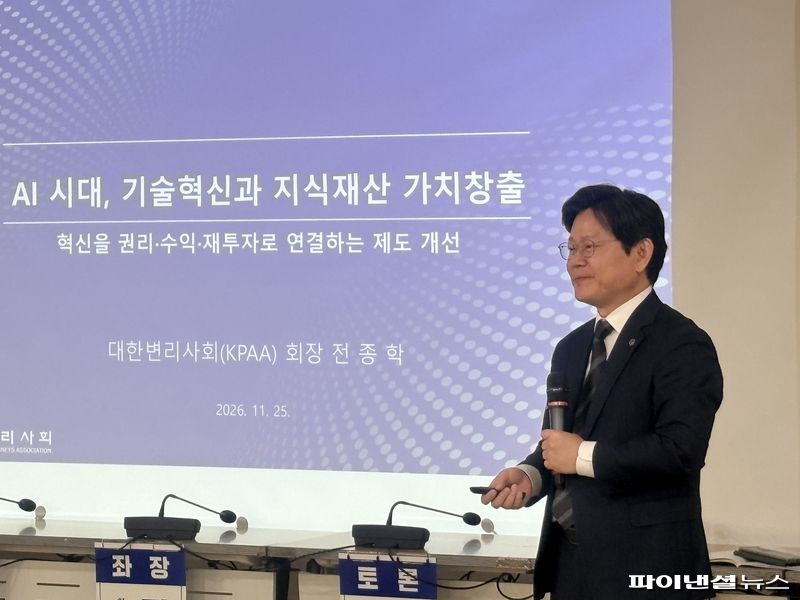
[Financial News] Jeon Jong-hak, president of the Korea Patent Attorneys Association (pictured) has called for institutional reforms to boost South Korean companies’ intellectual property (IP) competitiveness in the AI era. He said that before introducing the Korean-Style Evidence Disclosure System (K-Discovery), the country should guarantee confidentiality privilege for communications between patent attorneys and companies and improve the systems for representation in patent infringement lawsuits and IP disclosure. The government is also pursuing reforms to protect companies’ trade secrets, enable the use of manufacturing data and ensure transparency in AI training data.
A policy seminar titled “AI Innovation and Intellectual Property Value Creation” was held on the 25th at the National Assembly Members’ Office Building in Yeouido, Seoul. It was jointly hosted by Lee Jae-jung, chair of the National Assembly’s Culture, Sports and Tourism Committee, and Kim Sung-won, chair of the National Assembly’s Industry, Trade, Resources, SMEs and Startups Committee, and organized by the Korea Federation of Intellectual Property Organizations.■ Surge in domestic patent applications prompts calls to improve rights-protection systemsAccording to the Ministry of Intellectual Property, domestic patent applications in the first half of this year totaled 141,259, up 29.2% from the same period a year earlier. Individual patent applications rose 134% to 33,819.
According to presentation materials released by President Jeon at the event, citing the “2025 Survey on Technology Protection at SMEs,” estimated damages from technology infringement at small and medium-sized enterprises in 2024 amounted to 1.0978 trillion won, roughly twice the 544.2 billion won recorded in 2023.
President Jeon pointed out that rights holders must prove patent infringement and the amount of damages, but key evidence is held by the companies accused of infringement, making it difficult for victims to obtain redress.
While supporting the introduction of an evidence disclosure system in principle, he also warned of the possibility of indiscriminate lawsuits by foreign competitors and non-practicing entities (NPEs).
President Jeon said, “I oppose introducing a discovery system without thorough preparation,” stressing that confidentiality privilege restricting the disclosure of professional consultation materials exchanged between patent attorneys and companies should be established first. He also proposed reforming the system for representation in patent infringement lawsuits and reflecting companies’ IP value in corporate disclosures.
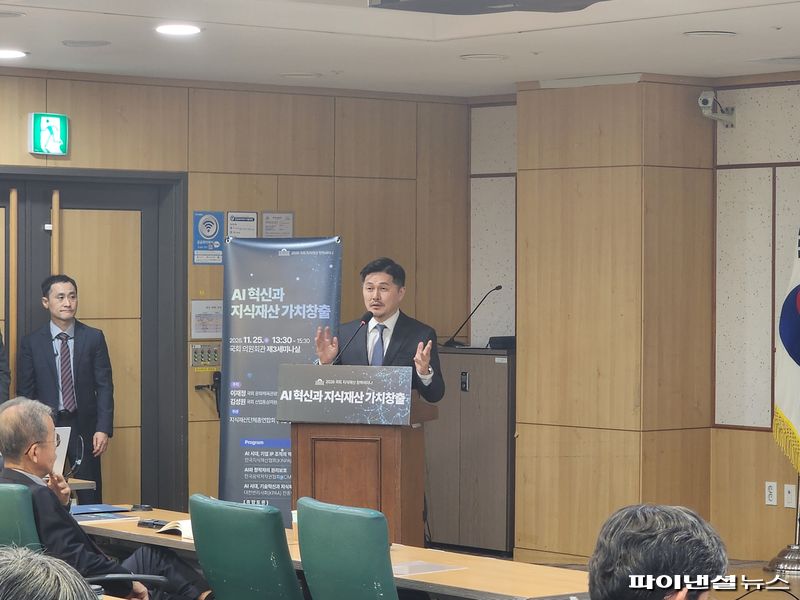
Kim Min-tae, president of the Korea Intellectual Property Association, explained that AI can complete search and analysis work on 1,000 U.S. patents in one to four hours—a task that previously took about a month. The idea is to leave repetitive work to AI and have specialists focus on interpreting the results and developing business strategies.
Yeo Woo-seok, a principal at LG Energy Solution, said that a comparative test conducted last April—in which the same employee invention disclosure form was given to a patent attorney and an AI solution—found that the AI drafted a patent specification, including claims, in just 10 minutes.
Yeo said AI is becoming “an opportunity to give patent teams strategic autonomy,” adding that patent analysis results can inform management decisions.
Hwang Man-sun, CEO of Korea Investment Partners, said the scope of rights and patent quality matter more than the number of patent applications. He proposed improving patent support systems at universities and government-funded research institutes and introducing chief intellectual property officers (CIPOs) at companies.■ Government moves to enable use of manufacturing data and protect copyright in the AI eraHan Deok-won, section chief of the Intellectual Property Policy Division at the Ministry of Intellectual Property, said that regarding the introduction of the Korean-Style Evidence Disclosure System, he would consult with the legal community, patent attorneys, industry and the National Assembly to ensure that stronger evidence-gathering measures and safeguards for companies’ trade secrets work in balance.
The Ministry of Trade, Industry and Energy (MOTIE) plans to expand next year a program that digitizes skilled workers’ technical know-how and develops it into AI solutions. The program began this year with funding from a supplementary budget. The ministry is also working to build infrastructure to collect and use, with companies’ consent, manufacturing data accumulated through national research and development (R&D).
Kwon Soonmok, chief of MOTIE’s Industrial AI Policy Division, stressed that companies’ and skilled workers’ contributions should be recognized as manufacturing data is turned into an asset, and that “the issue of workers’ rights or how benefits are returned to them” should also be considered.
In the cultural and arts sector, questions have been raised about compensation for copyrighted works used to train AI. Lee Si-ha, president of the Korea Music Copyright Association (KOMCA), proposed introducing an “AI training usage fee” under which AI companies would pay to train on existing works and the fees would be distributed to creators.
Music director Park Seong-il called for grounds for sanctions, saying that mass registration of AI-generated music could threaten existing creators’ copyright royalty income.
Park Hyun-sung, section chief of the Copyright Policy Division at the Ministry of Culture, Sports and Tourism, said “transparency of information” is important for fair transactions involving copyrighted works. He said the ministry is considering requiring transparency in AI training data and plans to begin phased projects next year to develop technology for identifying and tracking copyrighted works.
[email protected] Kim Mi-hee Reporter