'KPop Demon Hunters' Hit Fails to Stop Cuts to K-Animation Support... 'Fund Labor Costs, Not AI Subscription Fees'
- Input
- 2026-11-25 22:15:13
- Updated
- 2026-11-25 22:15:13
[Financial News] As the National Assembly reviews the government’s 2027 budget proposal, the animation industry has called for a 20 billion won increase in funding to develop the industry and an overhaul of the production support system.
Locus Corporation CEO Hong Sung-ho: “Even if you receive initial funding through an open call, it is difficult to secure the rest of the production costs.”
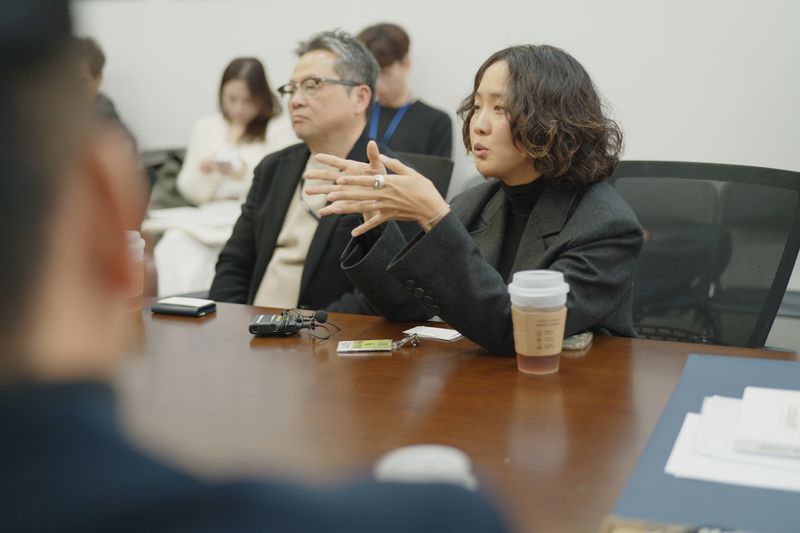
At a meeting between the chair of the National Assembly Special Committee on Budget and Accounts and the video content industry, held at the National Assembly Main Building in Yeongdeungpo District, Seoul, at 1:30 p.m. on the 25th, the animation industry pointed out that its support budget has been repeatedly cut. Hong Sung-ho, CEO of Locus Corporation, the production company behind Toemarok, said, “Animation is a field that can make a major contribution to the spread of K-culture.”
Hong said, “Although the Ministry of Culture, Sports and Tourism’s overall content budget has increased, the budget for animation has been cut significantly.” He added, “KPop Demon Hunters has been such a hit, and although animated films account for fewer releases than live-action films in Korea’s domestic box office, their share of total revenue has climbed to as much as 27%. Yet only the animation budget has been cut.” He criticized the cuts to support funding despite the market’s growth and asked officials to “take into account, during the review process, a request to supplement the budget by approximately 20 billion won.”
He also said the way the Korea Creative Content Agency (KOCCA) selects recipients through open calls is problematic and needs to be improved. “Even if you receive initial funding through an open call, it is difficult to secure the rest of the production costs,” he explained. He therefore proposed that the government commit in advance to a support amount for projects that meet certain requirements, such as having a distribution deal, and then cover part of their production costs after completion through tax credits or cash rebates.
He also proposed a support plan linked to regional employment. Under the proposal, if a production company spends on labor costs in areas where animation companies are concentrated, such as Suncheon in Jeonnam-Gwangju Integrated Special City, the central government and local governments would jointly cover 40–50% of the costs.
Citing the involvement of a Canadian production team in director Bong Joon Ho’s Ally, Hong said, “There is a need to introduce a production support system linked to local labor costs.” The Canadian federal government and Quebec provide some production costs, including local labor costs, in the form of tax credits to video production companies that meet certain requirements. He stressed that such a system would also create jobs in the region.
Regarding the recent allocation of government funding to AI content, he said grants for using artificial intelligence (AI) could end up being spent on subscriptions to overseas services. He also argued, “It would be better for the government to support labor costs and for companies to pay the subscription fees.” Animation is a labor-intensive industry, and production locations are less restricted than those for live-action films.
Director Han Ji-won: “The independent animation industry needs sustained support”
Director Han Ji-won called for expanded and more realistic production support budgets, support for independent animation film festivals, and support programs tailored to independent animation, so that domestic production companies can secure intellectual property (IP) and build their capacity to sustain themselves.
At the meeting, Han stressed that continued investment in independent short films is needed to strengthen the animation industry. He said that his experience making several independent shorts led to his directing the Netflix feature-length animated film Lost in Starlight last year.
He said he wanted to tell younger colleagues, “There are support programs like this, too,” but regretted that he had seen film festivals and support programs disappear, be scaled back, or change.
Han also pointed to cases where support for animation—which takes a long time to produce—ends after just six months. “Animation is made painstakingly, one step at a time, so it needs stable support over the long term,” he said, urging officials to ensure stable funding for independent animation production programs and film festival budgets.
[email protected] Shin Jin-a Reporter