End-September Bank Nonperforming Loans at 18.7 Trillion Won... “Ratio at 0.62%, Down 0.01 Percentage Point”
- Input
- 2026-11-26 06:00:00
- Updated
- 2026-11-26 06:00:12
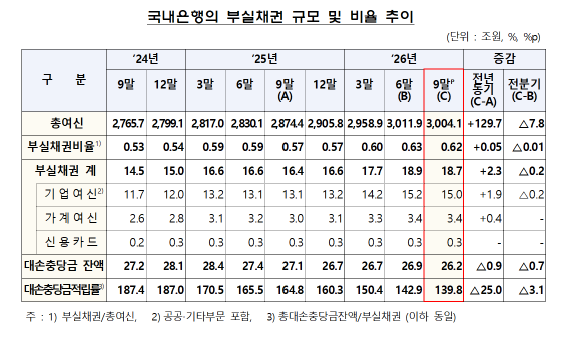
[Financial News] Domestic banks’ nonperforming loans remained in the 18-trillion-won range in the third quarter of this year, according to compiled data. After reaching an eight-year high in the second quarter, the total fell by 200 billion won, but compared with the same period a year earlier, NPL ratios rose across corporate loans, household loans and credit card receivables.
According to the Financial Supervisory Service (FSS) on the 26th, domestic banks’ nonperforming loans (loans classified as substandard or below) totaled 18.7 trillion won at the end of September, down 200 billion won from 18.9 trillion won at the end of June. The figure was slightly lower than the previous quarter, when it reached its highest level since the 19.4 trillion won recorded at the end of June 2018, but banks were still carrying a large volume of bad loans. By category, corporate loans accounted for 15 trillion won, household loans for 3.4 trillion won and credit card receivables for 300 billion won. Each was unchanged from the second quarter.
The balance of loan loss reserves stood at 26.2 trillion won at the end of September, down 700 billion won from 26.9 trillion won at the end of June. The loan loss reserve coverage ratio was 139.8%, down 3.1 percentage points from 142.9% at the end of the previous quarter and 25.0 percentage points from 164.8% in the same quarter a year earlier.
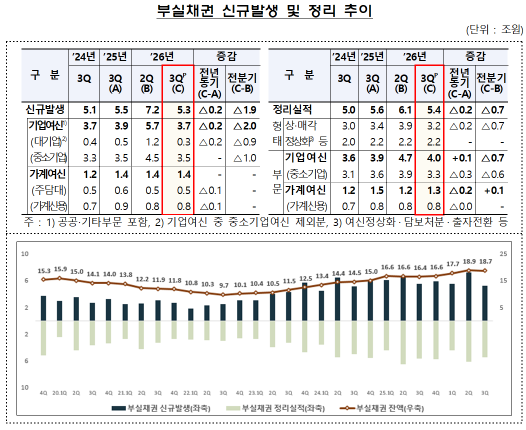
Newly recorded NPLs totaled 5.3 trillion won in the third quarter, down 1.9 trillion won from 7.2 trillion won in the previous quarter. That was also 200 billion won lower than the 5.5 trillion won recorded in the same quarter a year earlier. Newly recorded NPLs on corporate loans fell by 2 trillion won to 3.7 trillion won, from 5.7 trillion won in the previous quarter. New NPLs at large companies totaled 300 billion won, down 900 billion won from 1.2 trillion won, while those at small and medium-sized enterprises came to 3.5 trillion won, down 1 trillion won from 4.5 trillion won. Newly recorded NPLs on household loans stood at 1.4 trillion won, similar to the previous quarter.
NPLs resolved during the third quarter totaled 5.4 trillion won, down 700 billion won from 6.1 trillion won in the second quarter. That was also 200 billion won less than the 5.6 trillion won recorded in the same quarter a year earlier. By type, resolutions consisted of 1.9 trillion won in write-offs, 1.3 trillion won in sales, 900 billion won in loan recoveries through the disposal of collateral, 800 billion won through loan normalization and 400 billion won in other measures.
The NPL ratio is the share of a bank’s total loans that are nonperforming. Domestic banks’ total loans, which stood at 3,011.9 trillion won at the end of June, fell to 3,004.1 trillion won at the end of September. The NPL ratio for the third quarter was 0.62%, down 0.01 percentage point from the end of the previous quarter. However, it was up 0.05 percentage point from the same quarter a year earlier.
By category, the NPL ratio on corporate loans was 0.77%, similar to the end of the previous quarter. It was up 0.06 percentage point from 0.71% in the same quarter a year earlier. The ratio on loans to large companies was 0.50%, down 0.03 percentage point from 0.53% at the end of the previous quarter, while the ratio on loans to small and medium-sized enterprises was 0.93%, up 0.01 percentage point from 0.92%. The ratio on loans to small and medium-sized corporations was 1.07%, down 0.01 percentage point from 1.08%, while that on loans to individual business owners was 0.72%, up 0.05 percentage point from 0.67%.
The NPL ratio on household loans was 0.33%, unchanged from the end of the previous quarter. It was up 0.03 percentage point from 0.30% in the same quarter a year earlier. The ratio on mortgage loans was 0.22%, unchanged from the previous quarter, while that on other credit loans and similar products rose by 0.03 percentage point to 0.70%, from 0.67%. The NPL ratio on credit card receivables was 1.88%, unchanged from the previous quarter and up 0.01 percentage point from 1.87% a year earlier.
The FSS said, “The overall NPL ratio edged down due to a decline in newly recorded NPLs and the resolution of overdue loans,” but noted that “NPL ratios continue to rise in vulnerable segments, including loans to individual business owners and household credit loans, as well as at regional banks.” It added, “Given economic conditions, including persistently high interest rates and an upward trend in market rates, it is necessary to prepare in advance for the possibility of further credit risk growth.”
The FSS plans to direct banks to fully take into account the possibility of increased credit risks when closing their books at year-end and drawing up business plans for next year, and to strengthen their loss-absorbing capacity, including capital and loan loss reserves. It also plans to encourage banks to support vulnerable borrowers in improving their repayment capacity through active debt restructuring, and to proactively resolve NPLs that are difficult to rehabilitate.
[email protected] Park Mun-su Reporter