“Was the Surgery 33 Years Ago Botched?” ... The Identity of the 20-Centimeter Mass Removed From a 66-Year-Old Man’s Abdomen [Warning Signs]
- Input
- 2026-11-25 19:00:00
- Updated
- 2026-11-25 19:00:09
[Financial News] Every time he ate, he felt bloated. Intermittent abdominal pain also became part of daily life. Years passed that way.
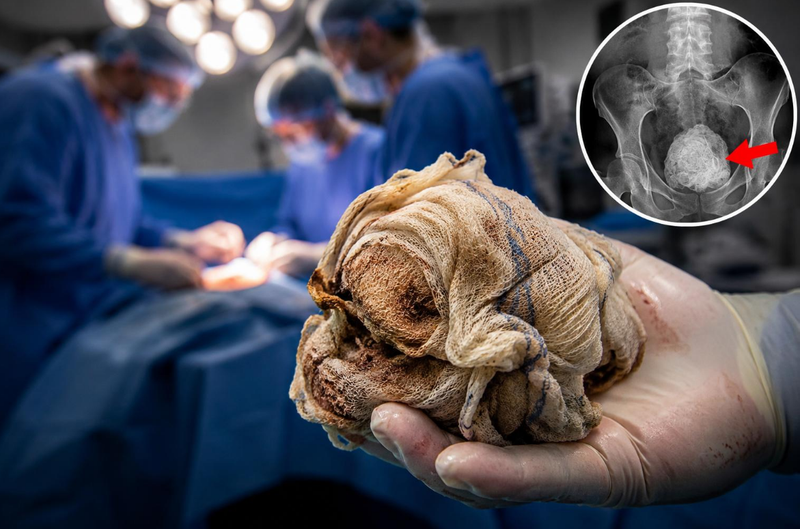
When clinicians pressed on the left upper abdomen of the 66-year-old man who eventually sought emergency care, they felt a heavy abnormality beneath their fingertips. It was a huge mass accompanied by pain. An MRI showed that it measured 20 cm across, 17 cm long and 15 cm high. A huge lump, nearly the span of an adult man’s hand, had curled up inside his abdomen, pushing surrounding organs out of position.
The identity of the mass removed in surgery was shocking. It was neither cancer nor a recently developed tumor.
The cause lay in a stomach operation the man had undergone 33 years earlier, when he was in his early 30s. Surgical gauze left inside him at the time had become entangled with surrounding tissue over more than 30 years, forming a giant, monstrous lump.
■ A 20-cm mass that pushed the stomach and colon aside ... the culprit was outside the organs
On the 18th, the international medical journal Journal of Surgical Case Reports published three cases of retained foreign objects after surgery, reported by the surgical team at Santo Espírito Hospital on Terceira Island, Portugal.
The case that drew the most attention was that of a 66-year-old Portuguese man. Clinicians found two clues during the examination: a scar from stomach surgery 33 years earlier and a giant mass they could feel in his left upper abdomen.
An upper endoscopy and colonoscopy showed that the stomach and colon (the transverse colon) had been pressed by strong external pressure and pushed inward, causing them to bulge.
This meant the mass had not grown inside an organ but was pressing on the surrounding area from outside. Fortunately, there was no evidence that it had directly invaded the tissue of nearby organs.
■ Traces of surgery in his 30s emerge in his 60s ... a “gossypiboma” caused by gauze left inside the body
After surgery to remove the mass, a biopsy revealed an intense foreign-body reaction to surgical gauze in the omentum, the fatty tissue that covers the abdominal organs.
The medical term for a mass formed when surgical gauze left inside the body triggers an inflammatory response in surrounding tissue and becomes enclosed in a fibrous membrane is “gossypiboma” or “textiloma.”
What is striking is how widely the timing of symptoms can vary. Some patients are found to have a fever and inflammation just 14 days after surgery, while in cases like this man’s, a firm fibrous membrane can form around the foreign object, allowing the patient to live without any notable problems for decades before abdominal pain or a giant mass eventually appears. The man experienced a mild hemorrhagic complication after surgery but fortunately recovered without incident.
■ A mistake the patient could not have known about ... the 33-year trace left when the basics fail
Surgical gauze being left inside the body is rare, but it is a medical error that can be prevented with rigorous safeguards.
If left untreated, it can lead to severe inflammation, an abscess or bowel obstruction, sending the patient back to the operating table.
The researchers stressed, “When an unexplained abdominal mass is found in a patient with a history of surgery, the possibility of a retained foreign object must always be considered,” and added, “It is essential to count gauze and instruments in the operating room, use surgical supplies that can be identified on imaging, and rigorously follow safety checklists.”
A piece of gauze carelessly left behind in the operating room when he was in his early 30s. That small mistake, which the patient had completely forgotten, endured in silence for 33 years and had, before anyone knew it, become a giant 20-cm mass pressing on the abdomen of an elderly man.
[email protected] Jeon Sang-il Reporter