Park Chung Hee’s Industrialization, DJ’s Market Reform... Seeking AI-Era Growth Solutions in Their Economic Leadership
- Input
- 2026-11-25 17:11:12
- Updated
- 2026-11-25 17:11:12
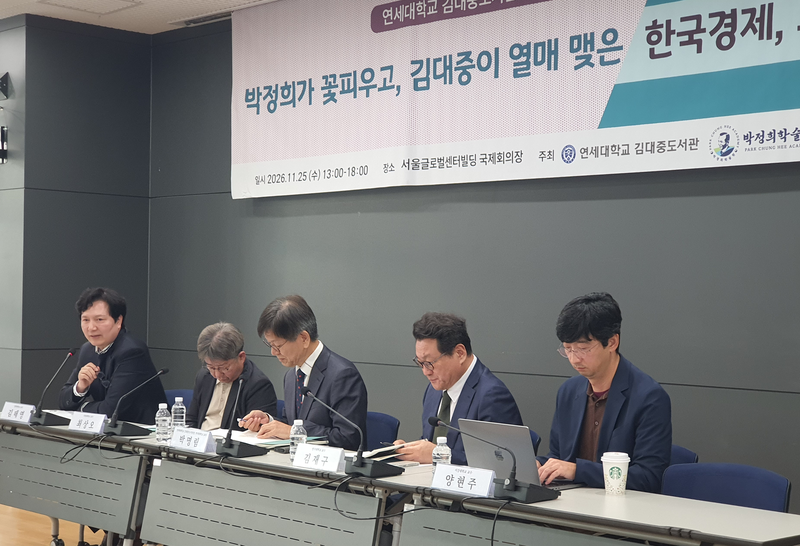
[Financial News] Former President Park Chung Hee laid the foundations for economic growth through industrialization and export-oriented nation-building, while former President Kim Dae-jung reformed market order and corporate structures and pushed for informatization after the foreign exchange crisis. Discussions have emerged about finding solutions for growth amid low growth and in the age of artificial intelligence (AI) in the economic philosophies of the two presidents, who led Korea’s economic transformation in different eras.
The Park Chung Hee Academic Institute, an incorporated association, and Yonsei University’s Kim Dae-jung Library held a joint academic conference on the 25th at the international conference hall of Seoul Global Center under the theme “The Korean Economy, Blossoming under Park Chung Hee and Bearing Fruit under Kim Dae-jung: What Lies Ahead?” The conference was organized to examine the economic development philosophies of former Presidents Park Chung Hee and Kim Dae-jung and seek new growth strategies beyond industrialization and informatization.
In his welcoming remarks, Choi Dae-seok, chairman of the Park Chung Hee Academic Institute, said, “The two leaders worked in different eras and took different approaches to economic development, but shared the same aspiration for the development and prosperity of the Republic of Korea.” He added, “President Park Chung Hee laid the foundations for economic growth through industrialization, while President Kim Dae-jung overcame the foreign exchange crisis and established new growth engines for the information age.”
The first session, titled “Park Chung Hee’s Economic Development Philosophy and Leadership,” examined export-led industrialization, entrepreneurship, and the policy design and outcomes of Saemaul Undong.
Kim Jae-gu, a professor at Myongji University, cautioned against reducing the Park Chung Hee administration’s economic policies to simple “government-led growth.” He said, “It did not weaken or suppress the market; it strengthened and used it,” adding, “The state and government set the stage, but entrepreneurs competed in the market and citizens became agents of self-help and cooperation.”
Yang Hyun-ju, a professor at Sogang University who presented on Saemaul Undong, focused on how policy design affected outcomes in different regions. She presented research findings showing that resources were initially distributed equally, followed by additional support based on performance, which fostered competition and voluntary participation; even under the same conditions, outcomes varied according to the cooperative structures within each village.
The next session focused on former President Kim Dae-jung’s vision of the “parallel development of democracy and a market economy” and the shift in the economic system after the foreign exchange crisis.
Yang Jae-jin, a professor at Yonsei University, examined the ideological feature of the former president’s “popular economy” theory: the effort to develop the market economy and democracy together. The aim was to ease the concentration of economic power while guaranteeing workers’ rights and welfare, thereby realizing political and economic democracy together.
The presentation by Lim Won-hyuk, a professor at the KDI School of Public Policy and Management, focused on actual policy changes and outcomes after the foreign exchange crisis. He assessed that the Kim Dae-jung administration addressed weaknesses through structural reforms in four sectors—public, financial, corporate and labor—strengthened market discipline, and expanded the social safety net. He said that the administration later fostered IT, venture businesses and cultural industries as new growth engines and expanded foreign direct investment (FDI) and international economic cooperation, but that job quality and distribution remained challenges to be addressed.
Following the presentations on each topic, experts discussed the achievements and limitations of the economic policies of the Park Chung Hee and Kim Dae-jung administrations, as well as the direction Korea’s economy should take in the AI era beyond industrialization and informatization.
[email protected] Choi Seung-han Reporter