Korean Air: 'No Change in Hanjin KAL Corporation's Governance' ... Confidence Despite Hoban Group's Increased Stake
- Input
- 2026-11-25 16:38:52
- Updated
- 2026-11-25 16:38:52
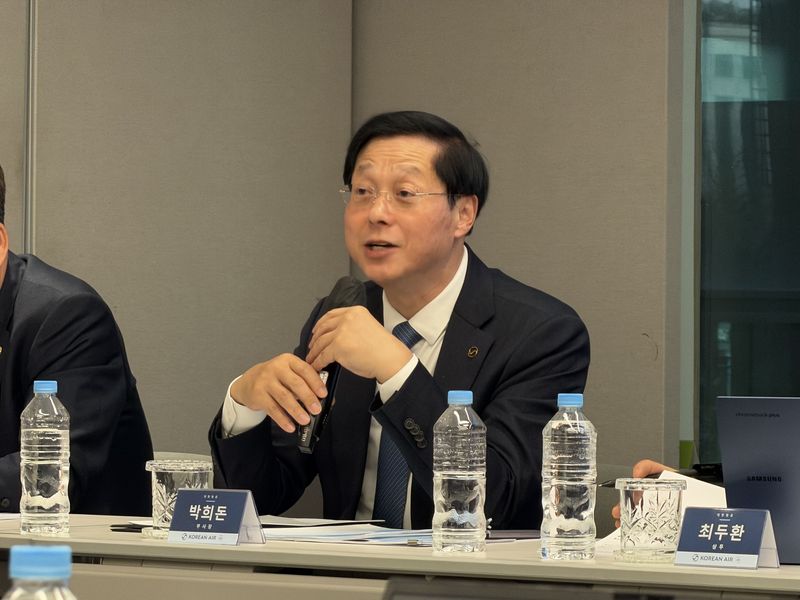
[Financial News] Korean Air said there was no cause for concern about its governance in connection with Hoban Group's increased stake in Hanjin KAL Corporation. It forecast annual synergies of 26 billion won from the integration of three low-cost carriers (LCCs)—Jin Air, Air Busan and Air Seoul—and said the value of Korean Air's stake in the integrated LCC is expected to rise by at least 100 billion won.
At a shareholder meeting held at Korea Investment & Securities Co., Ltd.'s headquarters in Yeouido, Seoul, on the 25th, Park Hee-don, Korean Air's executive vice president and head of management strategy, was asked whether Hoban Group's increased stake in Hanjin KAL Corporation could affect Korean Air or the LCC integration schedule. He replied, "I don't think you need to be overly concerned about governance at Hanjin KAL Corporation, the ultimate parent company."
Park stressed that the structure under which Korean Air and the LCC operate under the control of Hanjin KAL Corporation and Korean Air, respectively, would not change. He added, "We have partners at home and abroad who support the development of Korean Air and the aviation industry," and said, "We have strong support from the global aviation industry." Park continued, "We will also prepare thoroughly and devote ourselves to Korean Air's development so that shareholders have no cause for concern."
The meeting was arranged to explain how the merger of Jin Air, Air Busan and Air Seoul would affect shareholders of their parent company, Korean Air, and to hear their views. Korean Air estimated that integrating the three LCCs would generate annual synergies of 26 billion won. The analysis found that optimizing 12 of the 16 overlapping routes would yield 13 billion won annually, while improving aircraft utilization could generate 5 billion won. The benefits of joint purchases of fuel, ground handling and in-flight meals, as well as optimizing the allocation of resources such as information technology (IT) and facilities, were each estimated at 4 billion won.
Assuming these synergies continue, Korean Air estimated that the total value of the integrated LCC's equity would increase by 177.8 billion won after converting future benefits to present value and subtracting integration costs of 28.6 billion won. Taking into account Korean Air's expected 58.1% stake in the integrated LCC after the integration, the increase in the value of Korean Air's stake would be 103.4 billion won. The company said the integration could ultimately benefit shareholders.
Korean Air currently holds a 54.91% direct stake in Jin Air. Once the merger of Korean Air and Asiana Airlines is completed, Korean Air will take over Asiana Airlines' 58.40% stake in Air Busan and its 100% stake in Air Seoul. Jin Air is then expected to absorb the two airlines, after which Korean Air is projected to hold a 58.1% stake in the integrated Jin Air.
Korean Air declined to comment on whether the integrated Jin Air's headquarters would be located in Seoul or Busan, saying, "The impact on shareholders based on the location would be limited." It said, however, that it would closely examine the efficiencies in flight schedules and resource allocation resulting from the integration of airlines based in Incheon and Busan, respectively. The company plans to continue its strategy of expanding Busan's role after the integration, regardless of the headquarters' location. Choi Doo-hwan, a managing director in charge of Korean Air's integration task force, said, "We will establish a second hub not only at Incheon International Airport but also at Busan's Gimhae International Airport." He added, "Our goal is to attract passengers traveling from Southeast Asia to Busan and then onward to third countries such as Japan and China."
Korean Air aims to complete its integration with Asiana Airlines on December 17 and launch the integrated Jin Air on March 17 next year.
[email protected] Jung Won-il Reporter