'18%→3%': Japan's Share of the Global Economy Shrinks to One-Sixth
- Input
- 2026-11-25 16:03:56
- Updated
- 2026-11-25 16:03:56
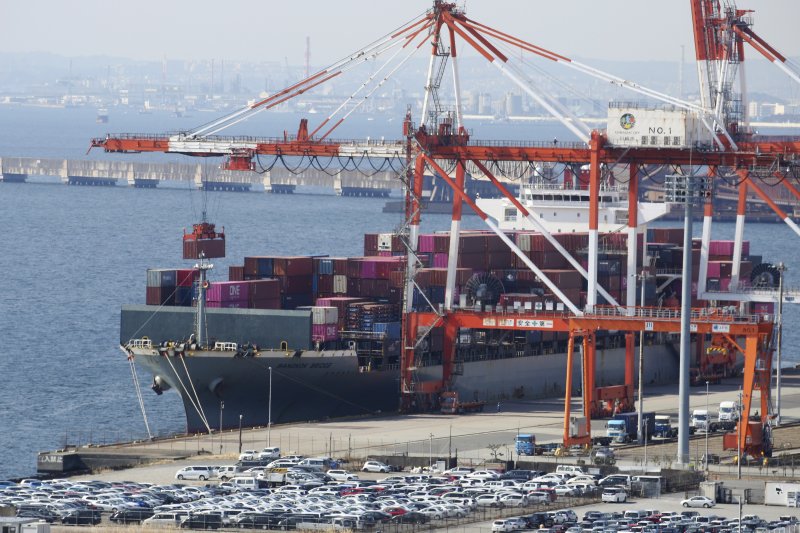
【Financial News, Tokyo = Correspondent Seo Hye-jin】Japan's share of global gross domestic product (GDP) is expected to shrink from 18% in the 1990s to 3% this year, or one-sixth of its former level. As a weak yen compounds prolonged low growth, the economy, once the world's second-largest, is also expected to fall to sixth place next year. Japan's share of global GDP based on purchasing power parity (PPP), which reduces the impact of exchange rates, is also declining, from 9% to 3% over the same period, making the country's diminished economic standing increasingly clear.
The Asahi Shimbun reported on the 25th, after analyzing International Monetary Fund (IMF) statistics, that Japan's share of global GDP is expected to fall to around 3% this year under both market exchange rates and purchasing power parity.
In its recently released World Economic Outlook (WEO), the IMF projected Japan's nominal GDP at $4.3419 trillion this year. It forecast that Japan would be overtaken by India and the United Kingdom next year, dropping to sixth place globally.
In the 1990s, when the effects of the bubble economy were still being felt, Japan accounted for 18% of global GDP at market exchange rates. Its share of the global economy has since declined as it lost its lead in the advanced semiconductor industry and low growth continued amid a falling birthrate and an aging population.
More recently, the weak yen has further reduced the size of Japan's economy in dollar terms. According to Mitsubishi UFJ Research and Consulting, the purchasing power parity exchange rate, which reflects differences in prices across countries, is 94.14 yen to the dollar, while the market exchange rate is around 160 yen. The explanation is that as the yen is undervalued relative to its purchasing power, the dollar value of GDP denominated in yen also falls.
However, the decline in Japan's economic standing cannot be explained by the weak yen alone. Even when calculated based on the real purchasing power of each country's currency, Japan's share of global GDP has fallen from 9% in the 1990s to around 3% this year. This means that even after accounting for exchange-rate effects, Japan's economy has failed to keep pace with global growth.
Japan has also fallen behind South Korea in per capita GDP. The IMF projects South Korea's per capita GDP at $43,512 this year, surpassing $40,000 for the first time. Japan's is projected at just $35,400, putting South Korea at about 1.2 times Japan's level.
The weak yen is producing winners and losers depending on companies' size and business structure. It has helped large exporters defend their earnings to some extent, but rising prices for imported raw materials and products are weighing on small and micro businesses focused on the domestic market.
From January to October this year, 67 Japanese companies went bankrupt due to the weak yen, a 19% increase from the same period last year. The figure has already surpassed last year's annual total of 65. The impact has been particularly pronounced among small and micro businesses.
There are also concerns about a vicious cycle in which the weak yen drives up prices and further erodes the yen's value. Some warn that if prices in Japan rise faster than in other countries, the yen's purchasing power could weaken, putting further downward pressure on its value.
[email protected] Seo Hye-jin Reporter