Lee’s “Grow the M&A Pie,” Ruling Party’s “Protect Retail Investors” ... Split Over Mandatory Tender Offers?
- Input
- 2026-11-25 16:15:22
- Updated
- 2026-11-25 16:15:22
According to ruling party sources on the 25th, calls within the Democratic Party to revise the agreement on the mandatory tender offer system have now reached the party’s policy committee.
Oh Gi-hyeong, chair of the K-Capital Market Special Committee, left open the possibility of requiring a tender offer for all remaining shares the previous day. He also urged further talks with the People Power Party. Min Byeong-deok, senior vice chair of the policy committee for economic affairs, also opposed the existing agreement.
At a forum on combating zero-capital M&A held at the National Assembly that day, Rep. Min said, “I feel very strongly that keeping the ‘50%+1 share’ threshold is not right.” He also pushed back against concerns that a tender offer for all shares would discourage M&A, saying, “The point is to give shareholders a choice, not to require that all 100% be purchased.”
Committee members Kim Hyeon-jeong and Hong Bae Park also each introduced a bill centered on requiring a tender offer for all remaining shares. Park, in particular, reportedly called for revisions at a policy lawmakers’ general meeting on the 10th, saying the existing agreement could undermine market confidence in the Democratic Party’s commitment to capital market reform.
These calls stemmed from controversy over whether the existing agreement would be effective. Last September, the ruling and opposition parties agreed that an acquirer who obtains at least a 25% stake in a listed company and becomes its largest shareholder must buy at least 50%+1 share of all issued shares, including the shares already acquired. The aim was to let ordinary shareholders share in the control premium enjoyed by major shareholders when control changes hands.
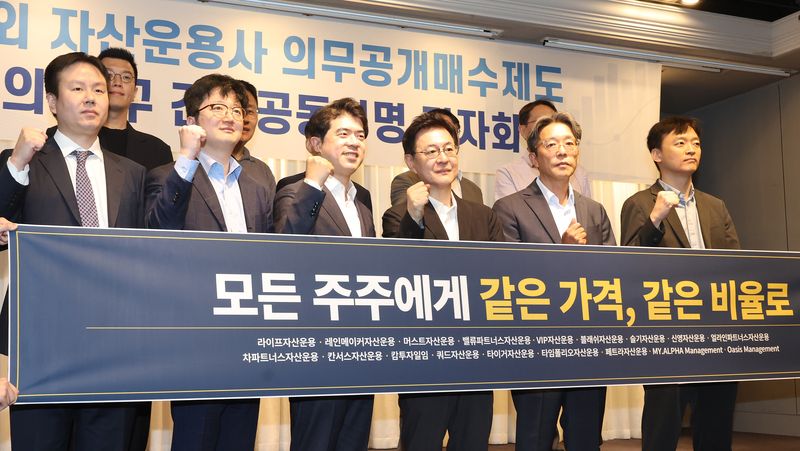
However, domestic and foreign asset managers and others objected that an acquirer who first secured a 40% stake held by a major shareholder would need to buy only about 10% more from ordinary shareholders. As a result, the bill, which had passed the National Assembly’s Legislation and Judiciary Committee, was put on hold before being brought to a plenary session on the 1st of last month. Parties in the broad progressive camp, including the Rebuilding Korea Party, also jointly called for a tender offer for all remaining shares on the 23rd.
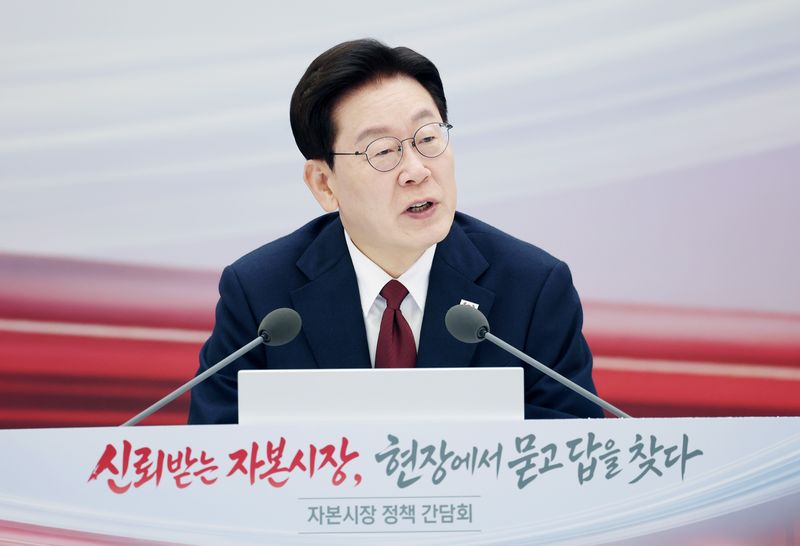
Lee is believed to favor the existing agreement. At a capital market policy meeting at the Korea Exchange on the 13th, he stressed the need to normalize the market as a whole by revitalizing M&A, saying, “Even if it means taking flak, we should grow the pie.” His position, in effect, is that requiring purchases of “50%+1 share” or more could boost M&A. The Financial Services Commission, too, plans to prioritize handling the existing agreement.
Political observers say the Democratic Party has been left needing to draw up a new agreement by revising not only the tender offer ratio but also how the control premium is distributed.
[email protected] Jiwon Song Reporter