Amid U.S. Market Turmoil, Investors Seek Stability—but Korean Retail Investors Place High-Risk Bets
- Input
- 2026-11-25 16:13:38
- Updated
- 2026-11-25 16:13:38
[Financial News] Money is flowing into broad-market index funds and ultra-short-term Treasury products in the U.S.-listed exchange-traded fund (ETF) market. As stock-market volatility increases and investors turn to relatively stable investments, Korean retail investors investing in overseas markets are instead buying leveraged ETFs and making aggressive bets.
According to Koscom Corporation’s ETF CHECK on the 25th, six of the 10 ETFs with the largest net inflows in the U.S. market over the past week (the 18th–24th) were broad-market index funds, such as those tracking the S&P 500 and Nasdaq-100. Two ultra-short-term Treasury ETFs were also among the top 10, while leveraged products accounted for just one.
The ETF that attracted the most money was VOO, which tracks the S&P 500, with net inflows of $9.5142 billion. SPY, which tracks the same index, drew $5.3301 billion. They were followed by SGOV ($2.8825 billion), which invests in U.S. Treasury securities with maturities of three months or less; VTI ($2.3159 billion), which invests across the U.S. stock market; and IWM ($2.211 billion), which invests in U.S. small-cap stocks.
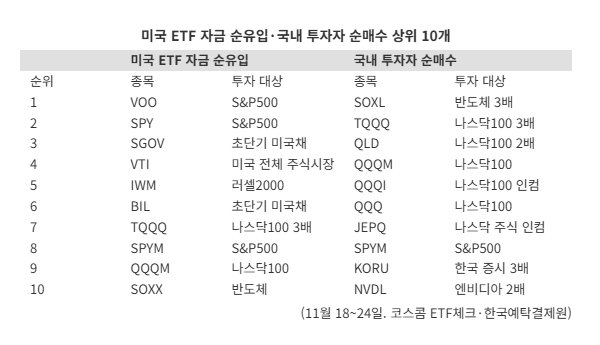
By contrast, domestic investors’ buying was concentrated in leveraged ETFs. Data from the Korea Securities Depository showed that five of the 10 U.S. ETFs with the largest net purchases by domestic investors over the past week, based on settlement dates, were leveraged products. The total value of net purchases settled for the top 10 was approximately $1.76 billion, of which leveraged ETFs accounted for 91.3%.
The product bought most heavily by domestic investors was SOXL, which tracks three times the daily return of a U.S. semiconductor index. Net purchases settled over the week totaled $1.27312 billion, accounting for at least 72% of the total net purchases settled for the top 10 ETFs.
TQQQ ($186.46 million) and QLD ($118.91 million), which track three times and twice the Nasdaq-100’s daily return, respectively, ranked second and third in net purchases. KORU ($12.87 million), which tracks three times the daily return of the South Korean stock market, and NVDL ($11.70 million), which tracks twice Nvidia’s daily return, were also among the 10 ETFs with the largest net purchases.
Given the recent swings in domestic and overseas stock markets, this suggests domestic investors are betting on the possibility of a rebound led by semiconductor and technology stocks. Individual investors in particular appear to have high concentrations in specific stocks and a strong preference for high-risk investments.
Kang So-hyun, a senior research fellow at the Korea Capital Market Institute, wrote in a report published last February, “Analysis of the Characteristics and Performance of Individual Investors’ Overseas Investments,” that “the share of high-risk derivative products such as leveraged and inverse ETFs has been gradually increasing since 2020.” The report also noted that “as the share of leveraged and inverse products continues to rise, overseas-market investors’ performance is subject to a structure marked by high volatility and uncertainty.”
A person in the asset management industry said, “With investors’ return expectations also rising amid volatile market conditions, investment appears to be concentrating in high-leverage products that can deliver high returns in the short term.” The person added, “If stock prices repeatedly rise and fall, the ‘negative compounding effect’ can make it difficult for returns to recover even if the underlying asset rebounds, so investors should exercise caution.”
[email protected] Seo Min-ji Reporter