As Stock Market Fears Mount and Interest Rates Also Surge, 41 Trillion Won Pours Into Fixed-Term Deposits in Two Months
- Input
- 2026-11-25 17:02:55
- Updated
- 2026-11-25 17:02:55
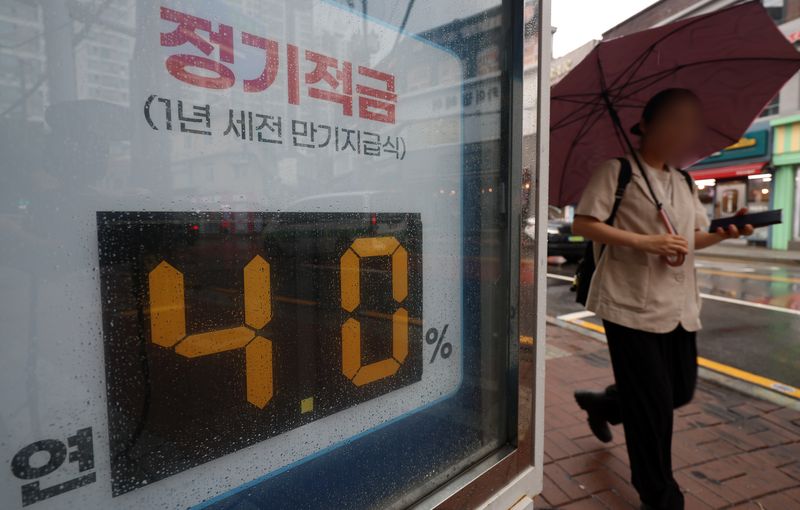
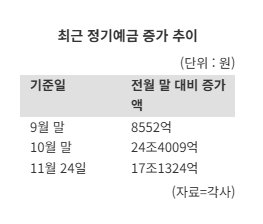
[Financial News] Bank fixed-term deposits have grown by more than 41 trillion won in less than two months as the stock market plunged and deposit rates rose. The continued inflow of funds into deposits offering guaranteed interest is believed to have coincided with the KOSPI’s slide from the 6,000 level at the end of September to the 4,000 level recently.
According to the financial sector on the 25th, the combined balance of fixed-term deposits at the five major banks (KB Kookmin Bank, Shinhan Bank, Hana Bank, Woori Bank and NH NongHyup Bank) stood at 1,047.6204 trillion won as of the 24th. That was up 41.5333 trillion won from 1,006.0871 trillion won at the end of September. After increasing by 24.4009 trillion won over the course of last month, deposits grew by a further 17.1324 trillion won through the 24th of this month. If inflows continue through month-end, fixed-term deposit growth could exceed 20 trillion won for two consecutive months.
The increase in deposits is being driven by greater volatility in the stock market. The KOSPI hit a record closing high of 9,114.55 on June 22 before falling to 6,838.04 on September 30. It then dropped to 5,730.74 on October 30 and to 4,697.51 at today’s close. The index has fallen by at least a quarter in less than two months since the end of September, and funds are believed to have shifted into bank deposits offering guaranteed interest.
Rising deposit rates are also supporting the inflow of funds. According to the Bank of Korea’s “October 2026 Weighted Average Interest Rates at Financial Institutions,” released today, the annual rate on new savings deposits at deposit-taking banks was 3.62% last month, up 0.17 percentage points from the previous month. The rate on pure savings deposits, which include fixed-term deposits, also rose 0.17 percentage points over the same period, to 3.56% a year. The share of new fixed-term deposits paying an annual rate of 4% or more rose 18.4 percentage points in a month, from 10.6% in September to 29.0% in October.
A key indicator to watch in gauging whether funds will continue moving from the stock market to banks is demand deposits. These accounts, which allow money to be deposited and withdrawn at any time, hold both corporate funds for payments and cash awaiting an investment destination. The key question is whether this money will move into fixed-term deposits or be withdrawn to buy stocks if the market rebounds.
Demand deposits at the five major banks fell by 12.1725 trillion won last month. With fixed-term deposits rising sharply over the same period, some funds may have shifted within banks into higher-interest products. This month, the balance of demand deposits stood at 656.4744 trillion won on the 12th, down 6.878 trillion won from the end of the previous month. But on the 24th, it stood at 671.7510 trillion won, up 8.3986 trillion won from the previous month-end. The balance, which had fallen through midmonth, has recently rebounded.
A banking industry official said, “Ahead of month-end, inflows of corporate funds for payments, such as employee salaries and transaction settlements, seem likely to coincide with an increase in investment funds waiting on the sidelines amid stock market volatility.” The official added, “If investment funds sitting in demand deposits move into fixed-term deposits, the trend of placing funds with banks could strengthen.” They also said, “If further increases in the benchmark interest rate are reflected in deposit rates, there will be greater incentive to move funds waiting on the sidelines into fixed-term deposits.”
[email protected] Ye Byung-jung Reporter