“A Wave of Mass Closures Is Coming Next Spring”... KFME Pushes Back Against Labor Law and Tax Reforms
- Input
- 2026-11-25 17:17:37
- Updated
- 2026-11-25 17:17:37
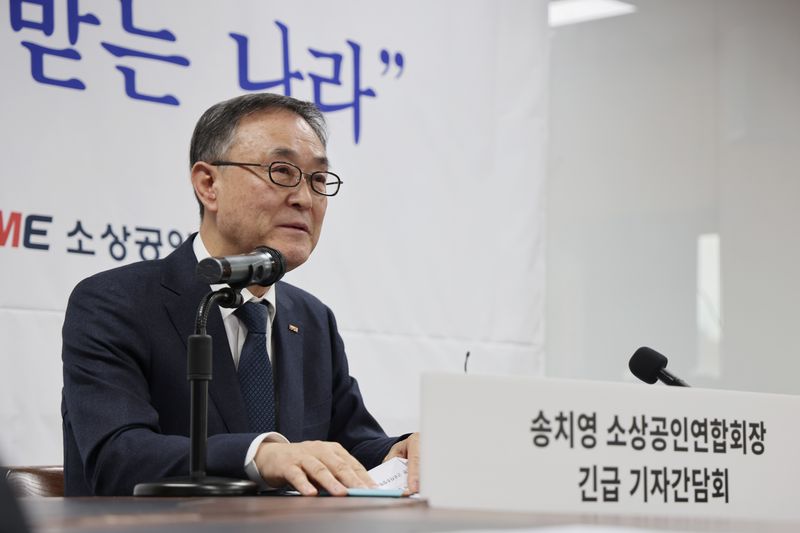
Song Chi-young, chairman of the Korea Federation of Micro Enterprises (KFME), held an emergency press briefing at the federation’s conference hall in Seoul on the 25th and said, “If the Ministry of Employment and Labor forces through the ‘Work Law Package’ (the Basic Act on Working People and the Worker Presumption System), I will immediately launch a campaign calling for Minister of Employment and Labor Kim Young-hoon to step down, rallying the voices of 8.11 million small business owners.”
Song strongly opposed the introduction of the ‘Work Law Package,’ calling it a harmful employment law. According to KFME, if up to 8.7 million people—including freelancers, workers in special types of employment and platform workers—are treated as employees, the resulting costs for the four major social insurance programs and severance reserves are estimated to add 5.05 million won in labor costs per person per year, or 44 trillion won annually in total.
Song pointed out, “If small business owners with limited capacity to respond legally are made to bear the burden of rebuttal, it could lead to a proliferation of disputes over severance pay and lawbreakers,” adding, “Small businesses are called a reservoir of employment, but if they collapse, the very foundation of employment will be shaken.”
Song also warned that if tax increases and labor regulations pile on amid a prolonged slump in domestic demand, a ‘wave of mass closures’ will hit next spring. “Even with the year-end peak season approaching, people are crying out that things are harder than during the IMF foreign exchange crisis or the COVID-19 pandemic,” he said, appealing that “if things continue this way, we are at risk of a wave of mass closures starting next spring.”
According to Korea Credit Data (KCD), delinquent loans to sole proprietors totaled 16.4 trillion won in the third quarter of this year, up 21.5% from the same period a year earlier. Average sales per business were 46.61 million won, down 4.36%, while average quarterly profits also fell 8.30% to 10.2 million won. The nationwide vacancy rate for general retail shops, compiled by the Korea Real Estate Board for the third quarter, reached 13.7%, the highest since records began.
Song also called for the government to withdraw its plan to scale back the tax credit for credit-card sales. The government’s tax reform plan for next year includes cutting the tax-credit rate on card sales from the current 1.3% to 1.2% and lowering the annual deduction cap from 10 million won to 5 million won. According to KFME, this is expected to add up to 600 billion won in tax burdens, primarily for 2.09 million small businesses with annual sales of 500 million won or less.
Song also called for measures including the prompt establishment of a presidential committee on small businesses directly under the president; the launch of a government-wide ‘emergency economic system to revitalize small businesses and support people’s livelihoods’; and long-term leases of vacant commercial properties purchased by the Korea Land and Housing Corporation (LH).
Song stressed, “A trillion dollars in exports and growth centered on large corporations alone amount to only partial prosperity,” adding, “The government must establish an official channel for direct communication with small business owners and shift to policies centered on people’s livelihoods.”
[email protected] Lee Ju-mi Reporter