S-Oil Corporation Completes '9-Trillion-Won Shaheen Project'; Petrochemical Production Share to Rise to 25%
- Input
- 2026-11-25 16:08:18
- Updated
- 2026-11-25 16:08:18
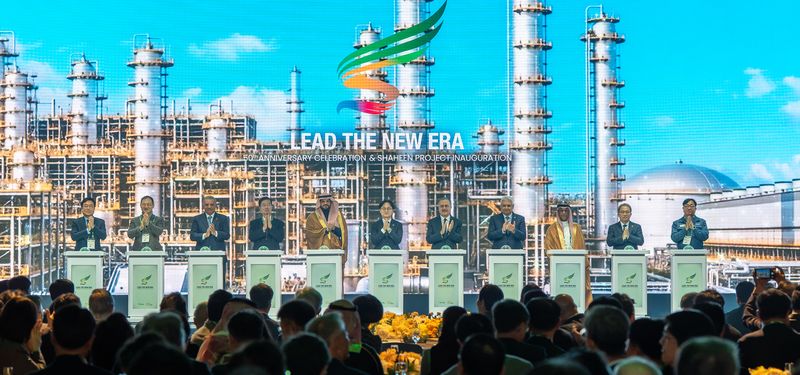
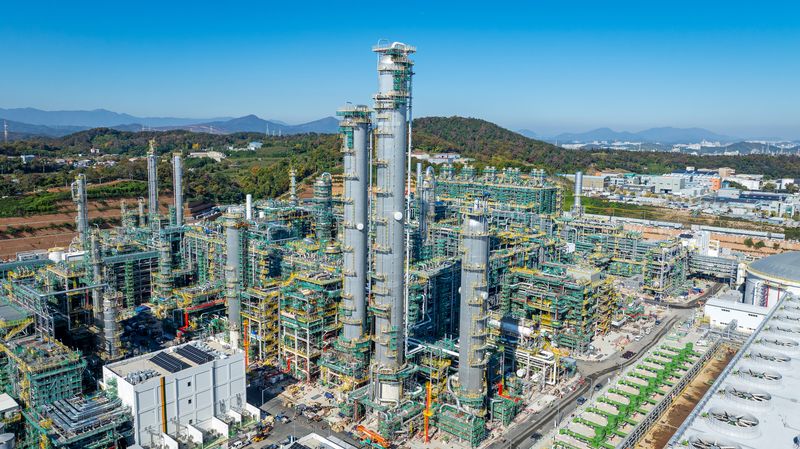
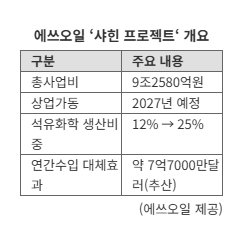
[Financial News] S-Oil Corporation (S-OIL) has completed construction of its Shaheen Project, a 9-trillion-won investment—the largest in the history of South Korea's petrochemical industry—and plans to begin commercial operations next year. The project has added about 3.2 million tonnes of annual petrochemical production capacity, and the share of petrochemicals in its production is expected to rise from 12% to 25% after commercial operations begin. S-Oil Corporation plans to use the global sales network of SABIC, an affiliate of Saudi Aramco, and the Ulsan-area pipeline network to secure markets at home and abroad.
S-Oil Corporation held an event at the Shilla Hotel in Seoul's Jung District on the 25th to mark its 50th anniversary and the completion of the Shaheen Project. About 500 people from the governments and business communities of the two countries attended, including Minister of Trade and Industry Kim Jung-kwan; Mohammed bin Abdulrahman Al Ibrahim, Saudi Arabia's Deputy Minister of Energy for Oil and Gas; Saudi Aramco President and CEO Amin H. Nasser; and S-Oil Corporation CEO Anwar A. Al-Hejazi.
In his commemorative address that day, CEO Nasser said the Shaheen Project, worth $7 billion, was Saudi Aramco's largest-ever investment in Korea. He said geopolitical tensions in the Middle East had caused serious shocks to energy supplies and stressed, “Energy security is economic security.”
The Shaheen Project involves the construction of a steam cracker, a Thermal Crude to Chemicals (TC2C) unit that converts crude oil into petrochemical feedstocks, polymer production facilities and other installations at the Onsan National Industrial Complex in Ulsan. Following a final investment decision in November 2022, a groundbreaking ceremony was held in March 2023. S-Oil Corporation plans to begin commercial operations next year after test runs. After investing about 4.8 trillion won in the Residue Upgrading Complex and Olefin Downstream Complex (RUC/ODC), completed in 2018, S-Oil Corporation has invested more than 14 trillion won in the two projects alone, including the Shaheen Project.
S-Oil Corporation Board Chairman Kwon Oh-gyu said, “The Shaheen Project is the starting point of a new leap forward, achieved through the experience and capabilities S-Oil Corporation has built up over the past 50 years, along with its unflagging spirit of challenge.”
Ahead of commercial operations, S-Oil Corporation signed an export marketing agreement with SABIC for polyethylene (PE) products. In South Korea, it plans to supply basic petrochemical feedstocks directly to downstream petrochemical companies in the Ulsan area through an integrated pipeline. S-Oil Corporation expects this to reduce logistics costs for Ulsan-area petrochemical companies and generate an import-substitution effect of about $770 million annually.
[email protected] Kim Mi-hee Reporter