‘The Budget Was Increased, but the Attacks Couldn’t Be Prevented’... Savings Banks’ Investment Effectiveness in Doubt After String of Hacking Incidents
- Input
- 2026-11-25 16:59:24
- Updated
- 2026-11-25 16:59:24

[Financial News] With five savings banks suffering hacking incidents in just two months, security management of their individual IT systems has come under scrutiny. In particular, a series of data leaks has been found to have occurred through customer-facing services run separately from core IT networks, raising concerns about further incidents. The banks had increased their IT system budgets, but following a string of data breaches, critics say they should focus on making their information security investments more effective.
Savings Banks’ “Peripheral Systems” Become Targets of Attacks
According to financial industry sources on the 25th, hacking incidents have struck five savings banks in succession, including Welcome, Yegaram, DB, OK and Hana Savings Bank, from late September through this month.
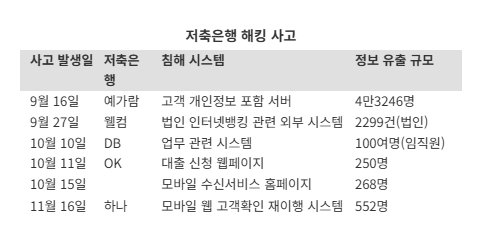
Hana Savings Bank, the most recent victim of a hacking incident, found indications that personal credit information belonging to 552 customers had been leaked after an external, unauthorized intrusion into its customer re-verification system on its mobile website on the 16th. The leaked information included 19 items, such as names, resident registration numbers, home addresses, employers and email addresses. The bank is investigating whether any additional information was leaked.
Earlier, customer information was leaked from OK Savings Bank’s loan application webpage and mobile deposit-taking service, and from an external system related to corporate internet banking at Welcome Savings Bank. Yegaram Savings Bank was hacked through its own service server. At DB Savings Bank, employee information was leaked through a work-related system. The reported scale of the leaks by bank was 43,246 people at Yegaram Savings Bank, 2,299 cases at Welcome Savings Bank, 552 people at Hana Savings Bank, 518 people at OK Savings Bank and about 100 people at DB Savings Bank, for a total of approximately 46,700 cases.
The fact that these incidents occurred mainly in systems operated separately from core IT networks revealed poor security investment in, and awareness of, peripheral systems. Analysts say that as hacking techniques using artificial intelligence (AI) grow more sophisticated, conditions have emerged in which multiple financial institutions can be attacked simultaneously with little money or manpower.
A financial industry official explained, “As the use of AI reduces the cost and time required for hacking, even places that offered little payoff from an attack in the past are becoming targets. The scope of attacks has expanded beyond the first-tier financial sector to the second-tier financial sector, and is spreading to relatively vulnerable peripheral systems.”
IT Investment Rose, but “Security” Took a Back Seat
Most of the savings banks affected by hacking were found to have increased their IT-related spending this year. According to each bank’s semiannual financial statements, the five banks hit by hacking incidents spent a total of 21.53511 billion won on IT operations in the first half of this year, up 3.0% from the same period last year. By bank, the figures were 13.28029 billion won at OK Savings Bank, 3.47392 billion won at Welcome Savings Bank, 2.61521 billion won at Yegaram Savings Bank, 1.8901 billion won at Hana Savings Bank and 275.59 million won at DB Savings Bank.
IT operating expenses increased at four of the banks, with OK Savings Bank the exception. DB Savings Bank posted the largest increase, at 34.9%, followed by Yegaram Savings Bank (29.3%), Hana Savings Bank (9.4%) and Welcome Savings Bank (8.9%). OK Savings Bank’s expenses fell 3.5%.
However, IT operating expenses include costs such as system operations and maintenance, making it difficult to determine how much was actually spent on information security. Critics say banks need to go beyond simply increasing IT-related spending and check whether budgets are being allocated appropriately to address security vulnerabilities.
Improving transparency around information security investment is another challenge. Of the 79 savings banks in South Korea, only two—Welcome Savings Bank and Shinhan Savings Bank—have voluntarily disclosed this year’s information security investment and staffing figures through the Korea Internet & Security Agency (KISA)’s comprehensive information security disclosure portal. The government revised the Enforcement Decree of the Act on Promotion of the Information Security Industry this month and decided to expand the scope of entities required to disclose information security data starting next year. As a result, some savings banks are expected to disclose their information security investment and staffing figures.
[email protected] Seo Ji-yun Reporter