Nonresident Joint Owners of a Single Home, Take Note: Comprehensive Real Estate Tax Deduction Falls from 1.8 Billion to 1.2 Billion Won
- Input
- 2026-11-26 09:26:53
- Updated
- 2026-11-26 09:26:53
[Financial News] In Seoul, the number of people who jointly own multi-unit buildings has risen by more than 50,000 so far this year. However, the increase varied by area, with the rise in the three Gangnam districts slowing by nearly half. The slowdown in transactions amid lending restrictions and the end of the grace period on the capital gains tax surcharge, as well as confusion over comprehensive real estate tax reform, may have had some impact.
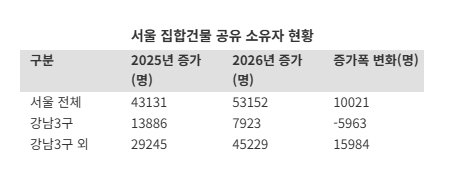
According to real estate ownership records from the Court Registry Information Plaza, as of October this year, there were 1,534,348 co-owners of multi-unit buildings in Seoul, up 53,152 (3.6%) from the end of last year. That was 10,021 (23.2%) more than the increase of 43,131 over the same period last year.
By contrast, the increase in co-owners in the three Gangnam districts fell 42.9%, from 13,886 last year to 7,923 this year. The increase slowed in Gangnam District, from 6,463 to 1,986, and in Songpa District, from 3,616 to 1,939. In Seocho District, it edged up from 3,807 to 3,998.
By contrast, the opposite trend emerged in other parts of Seoul. In Gangdong District, the increase grew about fourfold, from 3,059 last year to 12,113 this year. That accounted for 22.8% of the total increase in Seoul. The increase also grew in Gangseo-gu (1,978→2,711), Seongbuk District (1,031→2,710) and Gwanak District (500→2,350).
The decline in transaction volumes is cited first among the reasons for the slowdown in the growth of joint ownership in the three Gangnam districts. After lending restrictions were tightened on October 15 last year, the grace period on the higher capital gains tax rate for owners of multiple homes ended on May 9 this year, bringing transactions to a lull.
Joint ownership is often more advantageous when chosen at the time of the initial home purchase, since transferring a share of an existing solely owned home to a spouse may incur additional costs, such as gift and acquisition taxes. As transactions involving new homes decline, opportunities to acquire homes jointly decline accordingly.
Changes in the tax environment surrounding joint ownership are also being cited as a factor. In August, the government announced a plan to reduce comprehensive real estate tax benefits for nonresidents who own a single home. The initial proposal would have lowered the basic deduction for each spouse in a nonresident couple jointly owning one home from 900 million won to 400 million won, but it was raised to 600 million won after controversy arose. Confusion over the tax-saving benefits continued because the current combined basic deduction of 1.8 billion won for joint owners could be reduced to 1.2 billion won for nonresidents.
Experts believe joint ownership will remain advantageous even if the comprehensive real estate tax is reformed. This is because married couples who jointly own one home can choose whichever is more favorable: being taxed separately or applying the special provision for one-home households.
Woo Byung-tak, an expert committee member at Shinhan Premier Pathfinder, explained, “The deduction is reduced because of nonresidency; it is not at all that joint ownership puts people at a disadvantage,” adding, “I think it is probably right to view the changes in the three Gangnam districts as a result of the overall number of transactions falling.”
Woo added, “Because the tax code is complicated, there may be some cases where people choose sole ownership because they mistakenly believe joint ownership has become disadvantageous,” but added, “I don’t think there will be many such cases.”
[email protected] Choi A-young Reporter